Continued from 4. Myanmar 2001
Ferry crossing
Dressed like locals we walked along the Strand and found the queue to buy ferry tickets to cross the river. The first time we wet the uncle accompanied us, spoke in Myanmese and got us local tickets. We had to play dumb so that we did not give away the fact that we were foreigners and end up paying exorbitant fares. We boarded the ferry and went to the upper deck where we found the typical low plastic stools on which to sit sheltered by our umbrellas. On a subsequent trip(2016) we went on our own and got foreign tickets. This time we could go into a covered enclosure on the upper deck and sit on plastic chairs. We were not bothered by vendors. The other side of the river had a vibrant market and hence a colourful village. Walking down one of the back streets we came upon many indians some of whom spoke Tamil. Many of them were retired . One was looking after the temple and was active in a Tamil society. He invited us to his home where we met his wife. They had lots to say about the Hindu temple nearby since they were actively involved in it. We took leave of them and simply walked further to take in the village atmosphere, the houses with their fruit trees, vegetable gardens and poultry.
Hospitality of a nanogenarian
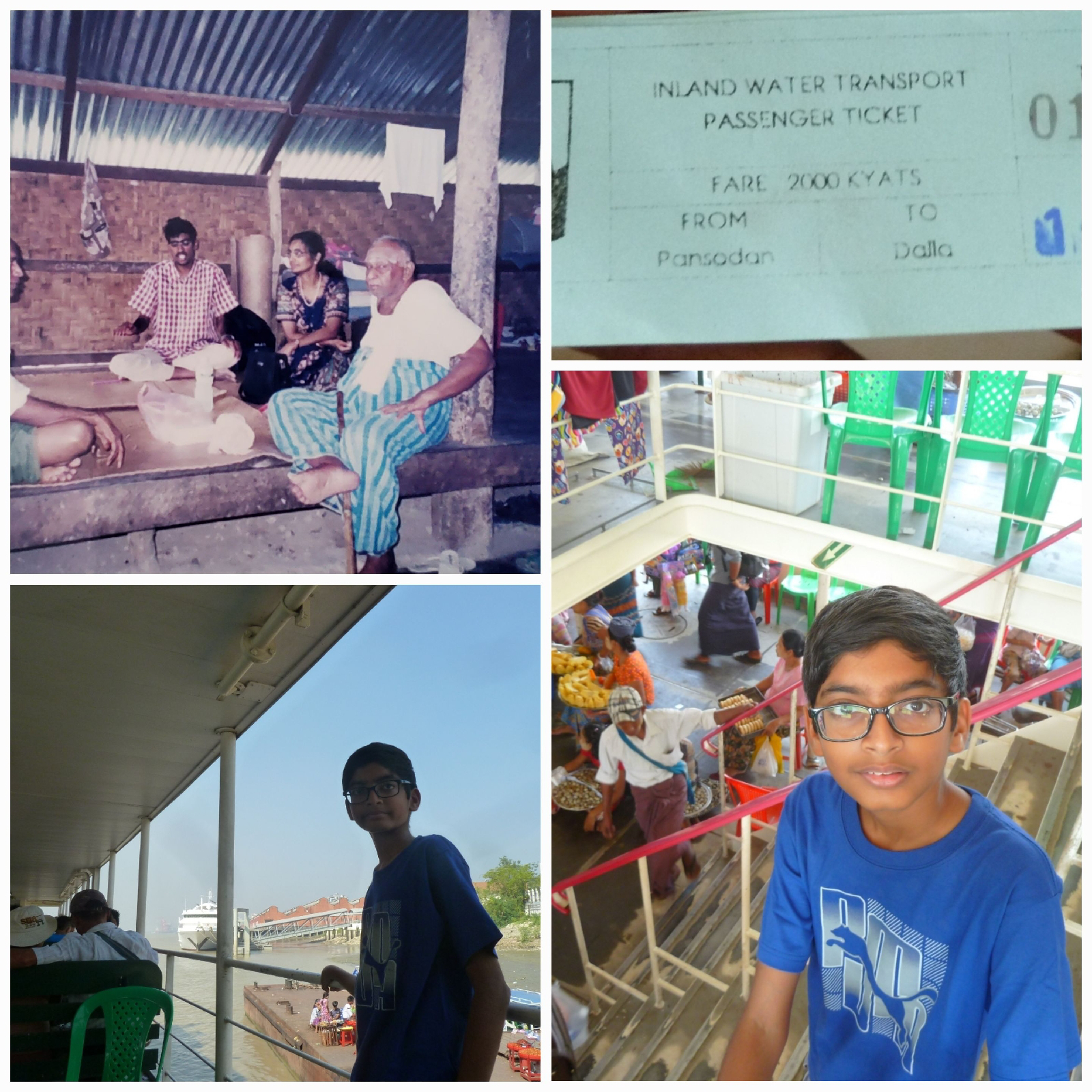

An auto ride took us to a 90 year old who live on his own in his padi field. He did not keave the country futing the purge and we were familiar with some of his relatives. Anticipating our arrival he had prepared a typical sumptuous 3 course meal for us, on a wood burning stove, served on banana leaves. He had a Burmese family living in the premises to do his bidding and to till the fields. his relatives. He had cooked a three course meal for us on his wood burning stove and served us on banana leaves. We also had a plentiful helping of his daily routine. He had a Myanmese family working for him both in the house and in his fields.
Safety
Talking about safety, as we prepared to board the ferry we noticed a couple of soldiers supervising three young men, chained to each other, also boarding. We were later told that the chained men could have been drug pushers. The military had its eyes everywhere.
One of our acquaintances who took us on a walk along Mogul Street (now Shwe Bontha Street) carried diamonds in his shirt pocket. He traded in diamonds. Another friend walked around town with a huge bundle of notes. There was no danger of theft then (about 10 years ago).
In another of our visits we happened to see a borrower returning money to the lender. The bundles of notes came in sacks and the counting took the best part of the afternoon.
Knees-up Transport
We also tried taking the local buses. 10 years ago the seats were very close together, worse than budget seats in Asian flights. And you literally had to brace your legs against the front seat since the leg room was too narrow to plant your feet on the ground.
Sharing the ride with market produce and fowl and quadrupeds
The Yangon Circle Line, the train, literally crawls 30 miles around the city and its suburbs and taking about 3 hours, passing through what feels like a whole echelon of Yangon society. Again foreigners pay more. Beside us sat people from all kinds of trades carrying their wares in baskets to be balanced on their heads. Some were bringing livestock to the market. We had chicken under our feet and even a goat. The odor of food from the snack vendor mingled with the odor of scented prayer flowers and the smell of animals. We didn't do the whole 30 mile loop. About half an hour was good enough to take us through the various neighbourhoods. Our sophisticated noses could tolerate so much.
Street life
The city is a heaving jumble of dilapidated colonial buildings, hole in the wall shops, street markets, noisy and congested alleys and streets, mosques, pagodas and roadside food stalls with their low tables and stools.
To be continued in 6. Myanmar.


