Showing posts with label Namibia. Show all posts

Walvis Bay, Namibia Revisited


To our astonishment, the port has been given a remarkable facelift. The wharves look neat and modern, yet one thing is conspicuously absent: there is no customs or immigration building. Instead, every passenger is cleared onboard, just as I described in my previous blog.

A Curious and Captivating Display

As we gaze from the starboard side, an intriguing maritime ballet unfolds before us. A small harbour craft approaches and begins unhooking a long length of broad, heavy-duty rubber boom. As it is slowly towed through the water, the undulating chain resembles a giant sea dragon gliding across the harbour, each link leaving its own tiny wake behind it.

At first, I puzzle over its purpose. Why is this strange floating barrier being drawn around the ship and extended to the opposite side? The answer soon becomes clear: it is an oil-containment boom, deployed as a precautionary measure. Should any oily discharge accidentally escape from the vessel, it would be trapped within this enclosed area, protecting the surrounding waters.

But the real surprise lies beyond the boom. Along its outer edge drifts an extraordinary gathering of hundreds of brilliant orange jellyfish. Gently rising and falling with the swell, they seem to perform a synchronized underwater ballet, each pulsating to an invisible rhythm. Against the blue-green harbour, their glowing forms create a mesmerizing spectacle—nature providing its own impromptu performance .

Shuttled to the Dunes !?

Private taxi operators woo us with glossy maps and enticing pictures, promising trips to the dunes and Swakopmund. Many of our friends take these tours, but few know what to really expect. Some report spending two hours simply driving around, stopping occasionally for photographs. It is not even the season for flamingos.

We are surprised to discover that there is now a shuttle bus to the Dunes. Boarding requires some patience and planning, as there are only two buses shuttling back and forth. Passengers are also not allowed to queue along the side of the entrance because heavy port trucks frequently pass through the area.

Ten minutes later, we arrive at the Dunes—not the desert dunes we could have imagined, but a gleaming new shopping mall filled with international brands and equally international prices. After a brief look around, we board the shuttle and head straight back to the port.

Where are all the people?

It wouldn’t have been too far to walk, but the spanky new roads are worth a try. The bus carries us along palm-lined avenues, past horse-riding paddocks, a vast and immaculately kept cemetery, and row upon row of housing backed by rolling sand dunes. Amazingly, these are not cookie-cutter homes; each seems to possess its own personality, as though every house has a story to tell. How astonishing it is to witness the scale of the city’s growth.

Yet not a soul is in sight.

Most residences appear shuttered, their air-conditioning units wrapped in burlap like carefully preserved relics. Succulent plants spill from gardens and yards, thriving against all expectation in this harsh, sandy landscape. Then a huge road sign appears: “No Prowling!” The words spark immediate curiosity. What happened here to warrant such a warning? One imagines tales of wandering intruders, desert mischief, or encounters now lost to local memory. Perhaps the explanation is more mundane—the heat, the sandstorms, the occasional housebreaker—but the mystery lingers.

The silence itself feels extraordinary. Where is everyone? Sheltering indoors from the fierce climate? Away on holiday? Or is this simply the rhythm of life in a place shaped by extremes? The empty streets give the city an almost dreamlike quality, as though it has been carefully constructed and then paused in time. It feels less like travelling through a neighbourhood and more like passing through the set of an unfinished story, waiting for its characters to emerge and reveal what lies beneath the stillness.

The Risqué

At the port, we take a risky shortcut to what was once a quiet esplanade along the lagoon. Yet again, we are caught by surprise. The port area has transformed dramatically, with broad multi-lane roads sweeping towards the harbour and new developments tracing the natural curve of the bay.

The new esplanade is a sensory assault. Vendors crowd every available space, their carved wooden animals displayed on sheets spread across the pavement. Topless women call out to passers-by, inviting them to pose for photographs while browsing the colourful menagerie and other curiosities. The atmosphere is lively, provocative, and impossible to ignore.

As we weave our way through the bustle, children latch onto us, pleading for a dollar. One appears, then another, then three more. What do you do when one has been indulged and a growing entourage begins to shadow your every step? The attention is relentless, and for a moment it feels as though escape may be impossible.

Determined not to be swallowed by the crowd, we press on towards the yacht club, putting precious distance between ourselves and the throng. Only then do we begin to relax.

The reward is worth the effort. What was once little more than a handful of waterside shops and simple eateries has evolved into a vibrant waterfront destination. Gleaming new buildings house stylish restaurants, a lively bar, an art gallery, and a welcoming coffee shop, all sparkling in the tropical light and giving the area an energy that was unimaginable on our last visit.


And the risk

The trip has us crossing working railway lines, where the warning bells and steel rails make us instinctively glance both ways before hurrying across. Brand-new gigantic trucks and other vehicles stand in long, silent rows awaiting delivery inland, their sheer size and number lending the dock an imposing, almost unsettling feel. They have replaced the marble chunks that lined the waterfront 14 years ago, a reminder of how much this place has changed.


Walvis Bay, Namibia

A pier lined with marble!
We are in Walvis Bay. Something I certainly had not even dreamed of after my school years. What will it have in store for us? Will it prove different from the general view that it is in an African country and therefore not as developed as the rest of the world? What can our visit show us?
As we step off the gangway we are confronted not by the heat but huge blocks lined up on both sides of the pier. It takes a few minutes for us to absorb the fact that these are blocks of marble each weighing at least 2 tons, ready to be hoisted onto ships for export to affluent nations. We can see the busy commercial port ( with a thriving fishing industry) much further. It is the year 2014, when the harbour has just begun constructing a container port on reclaimed land.
Sunny  but desolate
A 10 min risky walk amid the machinery on the pier takes us to the gates which will be locked overnight. The road that leads us to the 'city' is lined with sheets weighted down with wood craft of animals and masks - very attractive souvenirs. We walk past the vendors, who are not pesky at all, along the road that leads to the city centre. But where are the people? There seems to be a long rectangular building with rarely anyone entering or leaving. It appears to house a small convenience store within (no store front) and perhaps some other businesses. Should we enter to explore? No, we'd rather move along. 

Upscale but still 
Now we seem to be in a fashionable area. Houses are well laid out in a grid. What more they boast manicured and landscaped gardens. Even pine trees. Still, everything but the foliage seems to be still. The gardens are planted with succulents, desert flowers, waxy and fuzzy leaved plants etc. 
A church that was: the who, where and what
A little more wandering leads us to a small church in the distance set in a desert like surrounding. It's Walvis Bay’s oldest remaining building: the Rhenish Mission Church. I have since learnt that the building was prefabricated in Hamburg, Germany, and then reconstructed beside the harbour in 1880. It was consecrated the following year. It had to be relocated later( because the harbour had became heavily mechanised and therefore posed a risk),  to the present site in the mid-20th century.  It functioned as a church until 1966. 
We then come to a functioning unpretentious church with a mural depicting the 3 magi on a boat. Its the Dutch Reformed Mother Church with a fascinating history of Christianity in Africa with places of worship designated based on race and conversion.

Commercial buildings: What is a saree shop doing here?
As we approach the city centre we come across a home/ store (closed) that advertised Indian clothing at half price. Why is it not not open? We could have had a conversation with the proprietor.
And what is that attractive building with thick thatched roofs.? A restaurant. 
We begin to see more people movement  since we are now at a large grocery store with angled parking for customers.
Stirrings 
We have walked a long way but we are not at all sweaty in spite of the hot sun. We now approach a teenage crowd. These are students at the international school all looking very serious. Usually we stop to have conversations with students, but this time we don't. 

And then, again, we seem to be the only people walking along a huge expanse of lawn, punctuated by palm trees. A huge building looks rather inviting. As we walk towards it we realise it is a municipal building and attached to it is the city's  library. We love libraries. Librarians are usually well informed and gregarious. The librarian we meet here is no exception. She points to the little museum from where we learn a little of the history and geography of the area.

Now for the water front:  unhindered wilderness in an inhabited area
Satisfied that we've had a feel for the city we make our way back to the ship. After a quick lunch and some rest I think I should walk along the water front to the lagoon famed for its flamingoes. Its later in the day, closer to sun set and yet the esplanade is devoid of people. It gives me a sense of wilderness.
Chomping on an apple I walk for nearly an hour hoping to get to the reeds I'd seen from far away that mark the nature sanctuary. But it's getting darker and so I abort the attempt. Three, slightly pink pelicans, lined up below the oyster bar on stilts, calmly gaze at me as though consoling me.


The burning questions answered
The streets were quiet and the houses all shuttered. Why? Because of sandstorms, of course! In fact a locomotive stands unused at the station because sand storms cover tracks upsetting schedules and damaging equipment.
So, if I'd knocked on the door of the saree vendor someone would probably have opened it.
Where are the ship's passengers? Mostly on excursions to the lagoon for bird and marine animal watching, and to the sand dunes, or to the salt fields ( that supply 90% of south Africas needs) doing what is offered up for tourists.
A majority were busy sliding oysters into their mouths at the oyster bar.
Tourists did not swarm into the city or become a public nuisance as is wont to happen in major cities.


Tender scare and 1st train in 25 years: Luderitz, Namibia, 2014


There are ports and then there are ports.
When cruising on the sea we visit several ports. Some ports, as in Auckland, Amsterdam or Vancouver, are right in the city. We walk down the gangway into the port authority buildings, clear immigration( if not already done on board) and walk right into the city hub. Some ports are quite far out of the city and we may be shuttled to the city centre by a local bus company ( mostly free). Then there are ports that are not deep enough for huge ships to dock. These ports may have floating docks, connected to the mainland with a floating walkway. Then there are others in which the ship anchors in deeper waters and tenders passengers to and from the shore. Tendering simply means ferrying passengers to and fro in life boats. 
And we were tendered into Lüderitz in calm seas under clear skies.

Diamond boom and bust, a sip of the briny
We are in Luderitz, named after the German,  Adolf Lüderitz, who owned the land. In the early twentieth century. Diamond was discovered during construction of the railway line (in Kolmomskop, now a ghost town, buried under the shifting sand dunes of the Namib Desert, outside Lüderitz) and as a result the town boomed. The colourful colonial homes with the landscaped gardens and the Church are testament to it. But the terrain is rocky and not conducive to agriculture. 
Where do they get their drinking water? They only get about 2 cm of rainfall a year! As we walk around town we see women sweeping out sand.  Spying the town library we walk in and chat with the librarian. She enlightens us. The town has a salt water condensing plant, hence the drinking water. The day before they had experienced a severe sandstorm, not unusual, and the town has been practically swept clear not only because of the shipload of visitors but also. . . .

The train! The train!
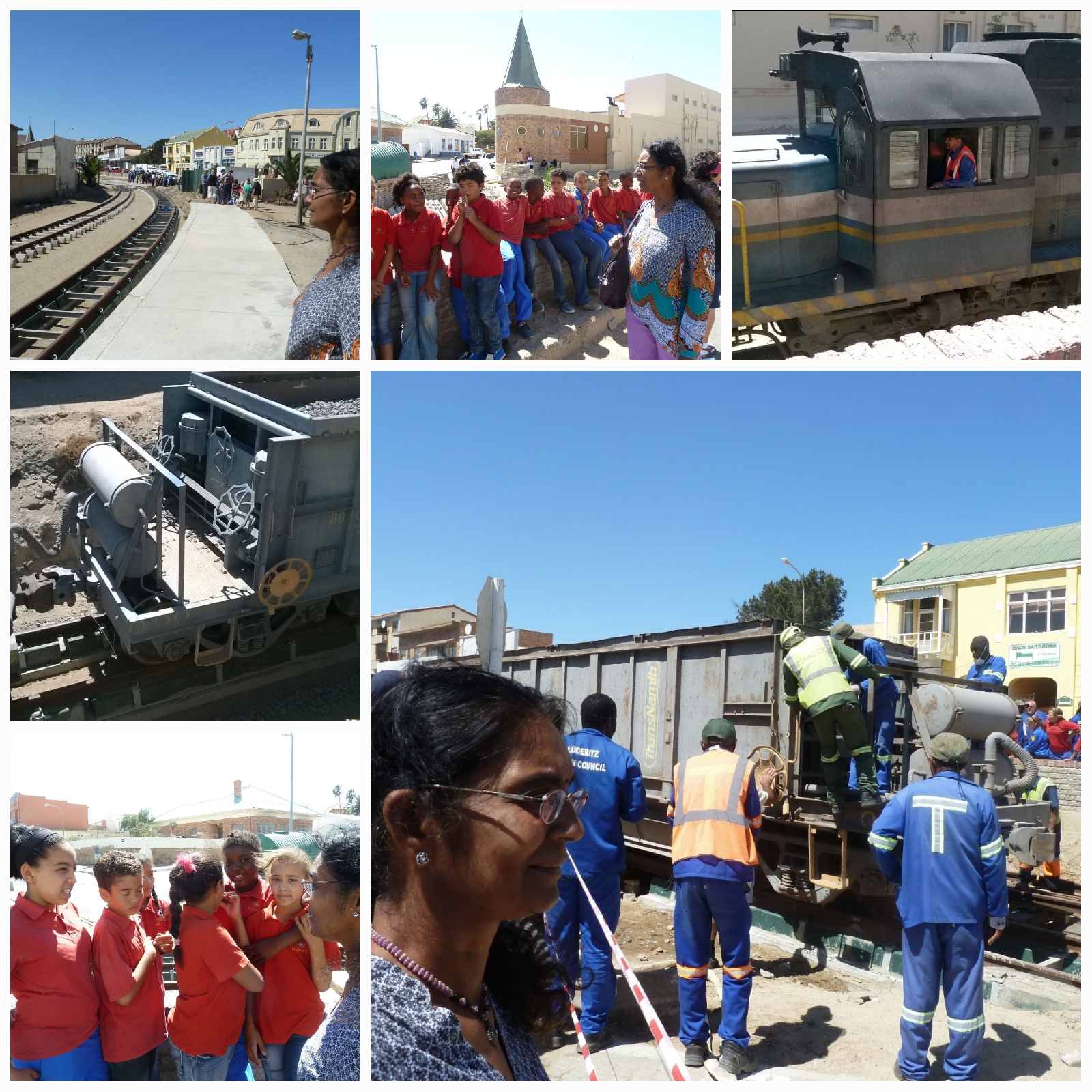
The main thoroughfare, Bismark road, is lined with school children and townsfolk. They have been there for nearly an hour. We chat with them. They are thrilled that we were educators. They are expecting a train, the first in 25 years, which is probably delayed because the tracks would have been covered by the sand from the sand storm.  
While they patiently bear the heat and wait for the train we walk around the town along the colonial villas and all the way up to the church as well as the town's founder's home which is now a museum. We are impressed. We walk down the rocky outcrop, a lonely place (a couple were robbed of their ipad here and nothing could be done for the teens were swift-footed), before we come back into town just in time for the train's arrival. Its an ancient train and we can imagine the problems that can arise in such terrain and climate.
Buffeted, slammed, dashed
By lunch time we are all done with the excitement and so walk towards the dock to queue up for our tender, eagerly looking forward to a cold salad on board. While we were ashore the wind had picked up and there is now a considerable swell around the ship. It is a bumpy ride indeed. Our tender heaves from side to side. As the swells rise we bob like a cork. It gets worse. The sea turns its fury on us as we approach the boarding platform on the ship. In normal times the tender aligns itself against the boarding platform, we step from the tender onto the platform, climb up a few stairs and we are in the belly of the ship. But that isn't happening now. We are lashed, and dashed against the ship. Imagine how challenging it must have been for both the ship and tender pilots to keep their barks steady in a seething sea. Everybody in the tender has become quieter. We are hoping none of us gets sea sick. We know where the life-jackets are, if needed. We trust the crew. Finally some crew on the platform manage to haul in and secure the ropes from the tender to the bollards on the platform. As we gingerly walk towards the door we are told to wait till the gap narrows before hopping on to the steady surface. I manage it and so did many others . When the gap widens the crew and passengers wait patiently. The crew does a marvellous job in pulling passengers out of harm's way when just as they are about to hop across the gap widens. There was one near mishap. The passenger had one foot on the ship and another dangling in the gap. He was not light either. What strong hands must have pulled him to safety! What a well trained crew!

A very eventful and memorable day, indeed.
We have had many thrilling experiencess on the sea as in avoiding a cyclone, taking measures against pirates, being tossed by rogue waves in the middle of the Atlantic Ocean, sailing through treacherous waters near the Falkland Islands and the capes at the bottom of Africa and South America,  and in the North Pacific Ocean off the Kamchatka Peninsula. Plenty to write about in future blogs.


Harbouring hopes at The Harbour Le Havre is the port closest to Paris, sitting on the English Channel – at the estuary of the river Seine –w...

Follow by Email