Facts of life.
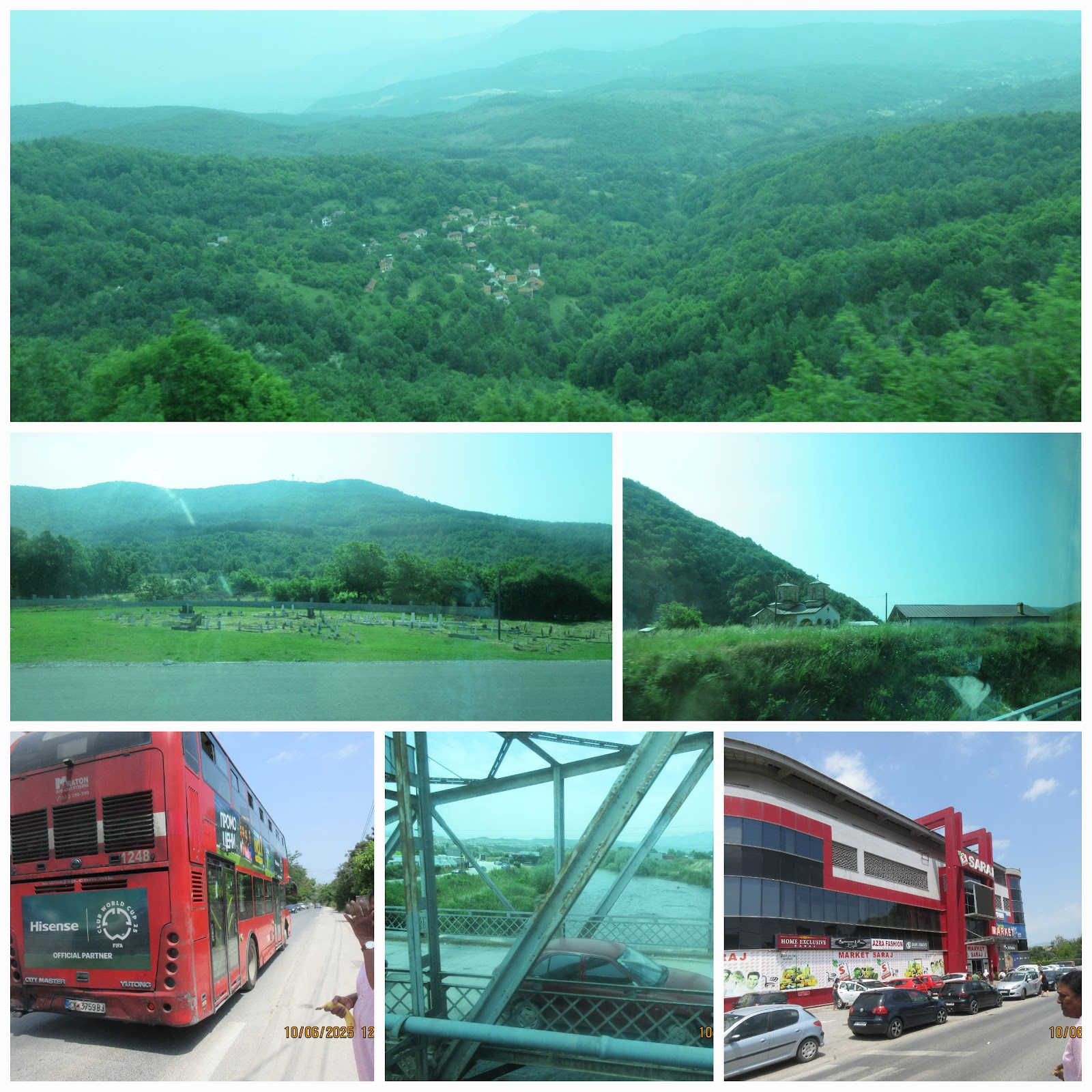
As we travel from Ohrid to Skopje we get a taste of the verdant countryside with picture perfect villages. We come across different graveyards,as is usual, just outside the towns and villages or beside churches.
Notably,the gravestones with Moslem names show the crescent and star symbol. Other graveyards also have very simple rectangular tombstones.
We arrive at a town for lunch and are surprised to see double decker buses plying the routes. DrInk and I walk into a large store to get something to eat and also to spend our leftover Macedonian Dinars for they would be of no use to us when we leave the country the next day. We find only chocolates and Turkish delights that are unique to the Balkans.
A double whammy
Our next stop is Matya Canyon. Once our bus is parked we walk along quite a ways towards a gate. But there is still a long distance to go. Those who have opted to go on a boat ride, that would take them on the crystal clear water flanked by rugged cliffs to a short hiking trail into a cave from where they would hike back, are advised to use the toilets before boarding. It is no piece of cake. A slope leads up to restaurants, and various stalls. At the end of a long laborious walk, after a steep climb over the stone stairs are the public washrooms. Our group is appalled that it costs 1 euro each. Not many of them have the required cash for it. Toilets are free at the restaurants only if you eat there.
The main overlook
We huff and puff towards the dam after which is the water ride platform. Ticket booths are busily selling tickets for a lot of activities like hiking and boat trips here. The restaurants lining the path along the canyon are rustic, mostly built of stone and wood, adorned with rose bushes. What steals our attention most is an open air antique store. The gelato vendors are doing a roaring business. These and the souvenir shops only accept local currency. The restaurant accepts credit cards.
A precarious venture
The path continues further into the higher parts of the canyon. A few people are loping up the path hugging the side of the cliffs. It looks easy and therefore tempting. So I decide to give it a go and ambitiously think it might lead me to the cave. The path is rough rock except for a few steps. Apart from being uneven the path is narrow at times as well slanting down towards the waters way down below. The hand rails look a little wobbly. So I simply hold on to them tentatively and also hang on to the cliff wall. To my surprise a sturdy rope anchored to the cliff at intervals helps boost my confidence. Manipulating the sharp bends and abrupt, heartstopping steeper slopes does sap my energy, so much so that I content myself with great views of the canyon from different heights and angles from where I am. All thoughts of reaching the cave (which is actually not accessible from where I am) are abandoned. The teal waters of the river, rugged cliffs punched with caves, and peaceful surroundings (not many people hiking) are quietly dramatic.

From tumultuous history to religious diversity
As we leave Matka Canyon for Skopje most of our fellow travellers fall asleep from exhaustion. At Skopje we are dropped at the old down in the shadow of a fortress. As always, our local guide has been advised to keep us in the shade as much as possible.
We are standing beside a plateau on which sits Mustafa Pasha Mosque, an Ottoman-era mosque, characterised by its opulent architecture and a serene courtyard. We get a glimpse only of the domes above a wall from where we are. It is reminiscent of the Hagia Sophia of Istanbul. It is certainly as tranquil as is touted to be.
A few metres away is an ancient old oaken door. The guide tells us the door opens into a churchyard that holds the sarcophagus of a revolutionary.
This is the Church of the Ascension of Jesus of Eastern Orthodox heritage, adding yet another historical dimension to the city.

More revelations
We are then led to the well preserved bazaar, the second largest in the world after Istanbul’s dating back to the 12th century. Walking along the stone paved alleys we are shown a traditional hamam(now a museum) , Turkish baths, several mosques and a caravanserai which has been converted into a restaurant with Byzantine touches. There's a synagogue too.The bazaar is famous for its traditional craftsmanship. It hosts numerous art galleries, museums, and cultural institutions making it a cultural center .

Here a statue, there a statue . . .
As we leave the bazaar we enter Macedonia square,a completely contrasting space. It's a spacious square that spans the Vardar River. We see the back of a statue, poised on an extraordinarily high pedestal, ahead of us holding his sword aloft. Wouldn't it be that of Alexander the Great, the very first name that pops up at the mention of Macedonia? The statue looks spanking new. And then there are several modern buildings around the square housing cultural and political institutions. There's also a mall. Only after we come to the front of the statue do we realise that the statue is not of Alexander but of Phillip, his father. Appearances can deceive. In the background is the Hamam.
And then it hits. Here a statue, there a statue, everywhere a statue. Definitely a dense population of past men of note. It may seem all too overwhelming but it does certainly help make history endure and give the city a pseudo classical feel.
The more prominent statues with fountains are those of Alexander's mother nurturing her child in the different stages of his childhood. There's also a statue devoted to mothers.
And there stands Alexander the Great mounted on his horse rearing to conquer more lands.it is an overwhelming 8 stories high!
The other side
Crossing over to the opposite bank across the iconic stone bridge (the Old Bridge),a 214 meter long bridge made of solid stone blocks resting on 12 arcs, we get views of the three modern bridges lined with statues of prominent people, from different generations and different walks of life, who have contributed to the growth of the country over the centuries. Each bridge has a theme. That's when we enter Macedonia Street. This is obviously Skopje's industrial, commercial, and administrative centre.
We are led to a tree which stands in place of the house Mother Teresa was born into an Albanian family in 1910. Ethnically, therefore, she is Albanian. That is the reason why Tirana, Albania takes pride in her through statues in her memory. A few meters away is the humble Mother Teresa Memorial House on the 2nd floor of which is a gallery of pictures and icons related to the Saint.
Italian irritation
Our tour leader has booked us dinner at the Italian restaurant in a vast mall which is strangely very quiet in spite of the abundance of shoe shops and a few branded clothing stores. The waiters are brusque with us since we have asked for late dining. We are served pasta and a dessert that I wouldn't call Italian. They are very happy to whisk away our plates, mostly unfinished portions, and call it a day.
Brand new accommodation
We are in for a surprise. Our hotel for the night is directly opposite the memorial. It's a slim building which makes us conjure up what our rooms would look like. However we are not going in yet for our tour bus has to find a way to get to the closest road where parking is limited to 10 mins. The trees in the vehicle-free Macedonia Street have wrap-around seats. Exhausted, we slump on to these while others waddle into the hotel lobby. It is fun to see night life beginning to pick up all around us and the temperatures falling. Finally, after nearly an hour, our bus driver has been advised by the hotel to pull up at a back street from when we could pick up our luggage. It's quite a trudge. We do get bellboys who handle the bulkier suitcases.
We have the best rooms on the trip so far. Partly it's because the hotel is just a few months old, the Vietnamese staff speaks English, the towels are brand new, etc. There is a weighing machine as well! It's definitely five stars and more.


Living up to expectations
As the lights go on we go out into the city retracing our morning route. At the river bank on Macedonia Street the large green park which is an oasis during the day has transformed into a dynamic space. A large group of people surrounds a few artists- painters, a magician, acrobats- demonstrating their work alive. .it is teeming with people enjoying a leisurely stroll or engaged in various activities. We arrive at the even more vibrant and busy old bazaar with restaurateurs calling out to customers. Craft and souvenir shops take on a magical aura.
It is then that we decide to try the new Bridges of Civilisation parallel to the stone bridge lit by beautiful street lamps. We now notice the triumphal arch covered in marble reliefs that depict important scenes from the history of Macedonia, including images of Alexander the Great. This depiction led into an official complaint by the Greek government since Greece has claims to the man who cut the Gordian Knot.
The street on the other side is awash with colourful lights displaying restaurants that offer diverse culinary experiences

Dawn in Skopje
It's our morning routine to take a walk in the city before breakfast. The square and the street are still except for the occasional pedestrian up and about for work. As we cross the stone bridge the seemingly calm waters of the river reflect the surrounding buildings. The book shop with its attractive shutter and scooters for hire await customers after a busy night.
We reach a space just next to the bazaar where we find ourselves just across the highway to the city under the imposing fort that we only had a glimpse of the previous day.
While on the stone bridge a stray dog follows as though it was protecting us for it barked if birds flew near us and left us abruptly as soon as we finished the crossing.
The bazaar is silent. The stillness makes us more aware of our surroundings and the unimaginable huge statues placed in the midst of fountains. Then there are quirky statues.
As we look up from anywhere in the vicinity, the Millennium Cross( one of the world's tallest) perched atop Mt Vodno, proudly supposed to celebrate 2000 years of Christianity in the region. Also it is twice the size of Christ the Redeemer in Rio. At night it is lit up
On our way back we come across a bull reminiscent of the one in New York City. Its tail is broken. The bull symbolizes the strength and fertility of the Macedonian people.
We also spot the old feudal tower that withstood the earth quake of 1963, before we reach our hotel for an excellent buffet breakfast.
That's when we realize how walkable this city of 500,000 is.
A new Church close to the mother Theresa memorial is nearing completion.
We cover everything on foot within an hour which just goes to show how compact the city is.

Remarkable
The city was destroyed twice. The earlier destruction was caused by a fire started by Austrian troops in 1869 that burned for 2 days destroying the city and reducing the population from 60,000 to 10,000. It is also conjectured that the city was burnt down to eradicate the cholera epidemic.
Around 30 mosques within the city are testament to Ottoman, as are several hamams and inns .
Point of contention:
Greek or not?Ancient Macedonians spoke Greek and had a Hellenic culture. While modern North Macedonians speak a Slavic language from the 5th century onward.
The Greeks believe that Macedonia also encompasses most of northern Greece and parts of western Bulgaria. Calling Skopje’s country Macedonia creates territorial implications. So this should not be used as the name of the country due to the territorial implications this could have.
Alexander the Great is called Warrior on A Horse in Macedonia because the Greeks claim him for themselves.
Internationally, the mini-state still has to call itself the Former Yugoslav Republic of Macedonia – the title it was given by the UN shortly after independence – inspit of the fact that 132 countries have recognised it as the Republic of Macedonia.