Showing posts with label mother tongue. Show all posts

Victoria, Mahe, Seychelles

Quiet dignity
Fancy a capital city with only two sets of traffic lights and a dozen streets? Look no further than Victoria, the capital of Seychelles. The unassuming cosy city of 25,000 is located on Mahe, one of the islands making up the archipelago. 
It is a rainy day and the town seems to be deserted. We trudge through the wet park grounds, avoiding muddy puddles between paving stones, towards a few huge collonaded buildings laid out in spacious surroundings with multicoloured long flag-like streamers greeting us. Definitely the mark of an important cultural and administrative centre. 
There's a bus stop nearby but the area seems to be deserted. Where are the gleaming glass towers that are a ubiquitous to a modern city. Where are the neon lights? Where are the parking lots or garages? The quiet city spoke volumes of its demure culture.
We sense we are at the town centre as we approach the clock tower, a replica of that at Vauxhall Bridge, London. A colonial reminder.Then come the banks, post office, the courts, travel agencies, etc.
That's  more like it
 Walking furthur we are delighted to see more of the vibrancy that we are accustomed to in a city. Most buildings, of wood or stone, have balustrades on the second floor. Shutters and facades are painted in bright colours. They remind us of the 60s shop houses in Malaysia.

Unmistakeably Indian 
Piqued by the many Indian stores and the aromas from the spices we walk into one and have a conversation with its proprietor who speaks our mother tongue. He tell us that the city is usually quiet, taxes are high and the pay for immigrant employees is inadequate. We are not surprised to see a Hindu Temple tower not far away, very close to the other city centre, Sir Selwyn Seylwin Clarke Market, dominated by a large mango tree. The two storeyed market is closed for the day but a glimpse through the iron gates gives us the unmistakeable colours and odors of an Asian market.
Temple surprise
From a vantage point we admire the colourful tapering temple tower, its height linking man and divine through art, the intricate statuary depicting the various gods and values of Hinduism, before entering the temple. The Navasakthi Vinayagar temple is in need of repairs. The rain has caused leaks in the ceiling and puddles on the floor in spite of pails positioned to catch the drips. The temple priest, musicians and helpers all speak our mother tongue as well. ( The muscian is a graduate who is unable to procure a job befitting his degree.)The temple serves about 5000 Hindus - 2% of the population- living on the island. I was surprised the priest had worked at the Southall temple in London when my cousin was a member of the temple committee. It is a small world after all.
Reflection of a culture

The quietness of the city is explained by the fact the citizens do their marketing early in the morning, specially on a Saturday. Leisure activities happen later on in the day. Besides it is the weekend, when government offices are closed. 
Traces of the colonial in rustic charm
Going further up into the residential areas built on the slopes of hills we spy mango trees with lots of fruit temptingly hanging within reach. The houses and their gardens are also typical of Asian residences exuding rustic charm, except that the views, either that of the hillsides or the sea are enviable indeed. We get a good bird's eye view of the bus station before we find ourselves in the driveway of a rambling wood and iron restaurant named Mary Anotoinnette - the oldest restaurant in Seychelles. I don't think the name is supposed to remind us about her beheading! In the garden is a series of cages with fluffy rabbits. Hopefully not to be heheaded for a Creole meal! There are also a few of the endemic turtles in its backyard. 
Tortoise mail
On the way back to the ship we spy a replica of the giant tortoise (unique to Seychelles, since these almost extinct creatures survived here because the archipelago is a sanctuary that has few of their predators). It is, ironically, at the entrance to the Post Office! We hope it is not representative of the speed of the mail. 

The two churches are also simple with some interesting but modest stain glass windows. 82% of the population is Roman Catholic. 
A place like no other - obvious Indian, South Asian, Creole, British presence and co-existence of two major religions of the world.

ABCs of Orangestad, Aruba

Anything other than the stretches of sunny beach ?
When we did the Panama cruise to the Caribbean in 2013, Orangestad, the capital of Aruba,  was one of our ports of call. Most travellers to the Caribbean head for the beaches. 
DrINK and I are least comfortable on the beaches simply because they are mostly treeless and too hot (we are baked enough back home). But surely there's more to the country. We find a group of people at the dock engaging a van for a tour of Orangestad, the capital, They could accommodate us. Our driver, a cheerful lady, does her promos - how wonderful the sights are and how popular the beaches are. We are prepared to be amazed.

ABCs
We are already aware that the island we are in belongs to the Netherlands ( a 9 hr 30min flight away), that also includes Bonaire and Curaçao, thus the name ABC islands. Our guide drives us along the beaches, the residential areas. We are made acutely aware of the Dutchness of it all. Even at the port the kiosks have unmistakable baroque Dutch characteristcs  - little ornamentation, symmetrical façades, flowing curves. The same is reflected in the tombstones. In the main shopping thoroughfare domes are also incorporated. There is lots of colour as we have seen in Dutch colonies in Luderitz(Namibia), Medan (Indonesia) and Malacca (Malaysia) to name a few. 

This rock is an attraction?
The biggest source of amusement comes next. We arrive at a park, alight and follow the guide. A few feet away there is a rock, more like a pile of rocks with a gap in the middle that seems like a cave. You walk up the steps to the top of the rock which is only a couple of metres high, about two storeys. This is a view point! We see a residential area spread out before us. 

Not a chance of losing your bearings
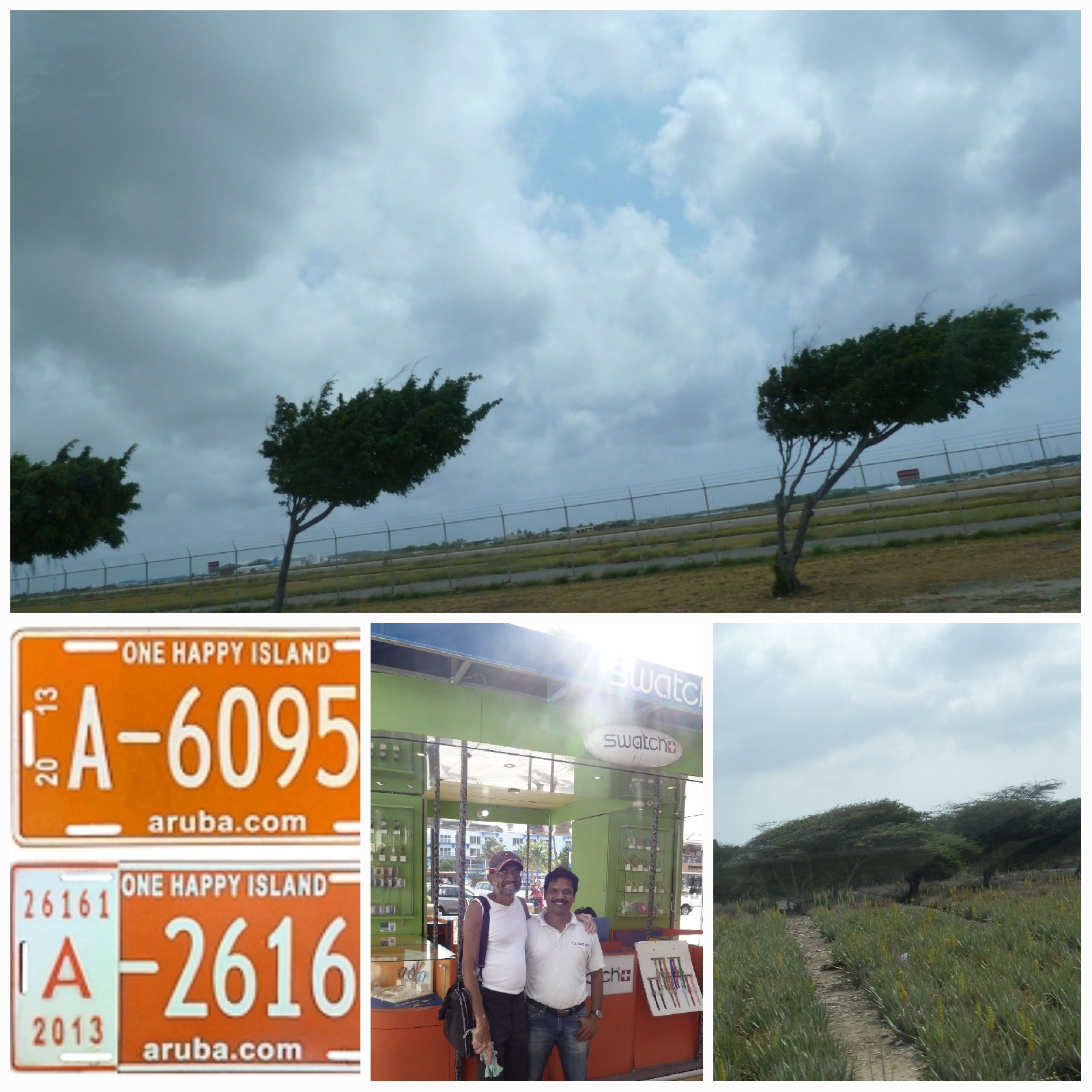
The trees are permanently bent in the direction of the wind, becoming a natural compass. They are the famous Divi Divi trees, unique to Aruba climate and terrain. They all point in a southwesterly direction due to the trade winds that blow across the island from the north-east.

Iguana soup anyone?
As we drive around the suburbs we have goat crossings and several iguana sightings. A few crossed our paths. It does not worry our driver. She shrugs it off, 'It'll makes good soup. Next time you visit come have dinner with me. I make a m_e_a_n soup.'  Check out the anatomy of an iguana and you'll see why it is highly prized for virility. Apparently iguana soup is common fare. 

Licence plates stand out 
We notice that the number plates are all in orange with white lettering, but don't think beyond that until we walk around the town. Many souvenir  shops had number plates in various colors for sale! Here's the low down. All vehicles in Aruba,  as in any other country, display licence plates as proof of registration. Owners renew their licence every year. In most countries the plate carries a validation sticker for the year renewed. Not in Aruba. How do you know if someone has not renewed his vehicle registration? Look at the colour of the plate. Guessed it ? They come in different colors, one for each year! The year we visited it was orange, the colour after which the city was probably named. If you have the wrong colour everybody will know you have not renewed your licence.That's  not all. The plate is valid only for the first half of the year. After that a metal tab is added to show validity for the 2nd half and that tab sports a reverse colour scheme.
Cool: Aruba Aloe
I've seen aloe in pots. My mother had one in a pot. But a whole field? Of course, tours almost always include a sovenir shop stop. But our stop is unusual. We are in Aruba Aloe factory where we're allowed to see how the gel is extracted and made into beauty and medical products. A must have for sun bathers. And, of course, visitors are keen to buy from the company which processes the finest Aloe in the world. The Aloe is grown and harvested and processed by the factory. The factory also has a museum because it has a history -- it was started in 1890.

Unabashed
We have time to ourselves after the tour so we walk around the colorful and vibrant shopping thoroughfare and then along the beach front hotels and beside the cars parked along the road beside the beach. At one point we were simply speechless and quickly turned to look elsewhere trying to suppress giggles while raising our eyebrows in disbelief. Right in front of us and elderly man opens the hatchback door of his wagon, pulls off his speedo and casually pulls on clothes. Too old to care, or is it a commonplace act? I  certainly do not want to find evidence to prove the latter.

Mother tongue unleashed
In the shopping area we come across a Swatch ( Swiss watches) kiosk. We speak to the salesman who seems to be an ethnic Indian. The accent gave it all away. He spoke our mother tongue, to our mutual delight. Tamil words rolled off our tongues as though unleashed with a vengeance after a few months of social exchanges predominantly in English.


Harbouring hopes at The Harbour Le Havre is the port closest to Paris, sitting on the English Channel – at the estuary of the river Seine –w...

Follow by Email