Showing posts with label Morocco. Show all posts

Casablanca, Morocco: Far from romantic

 Where is the romance?

When we arrive at Casablanca, Morocco's chief port, an artificial one, we expect to see Rick's Cafe as in the movie of the same name as the city. In reality, the movie was not shot in Morocco but almost entirely in a Hollywood studio. The cast was international but not a single Moroccan was on the list. No enchanting cafe near us. A blanca (blank) as far as it is related to the movie. 


In the distance we spy a tall minaret glimmeringly sitting partly on water. But something else catches our eye.


A diversion

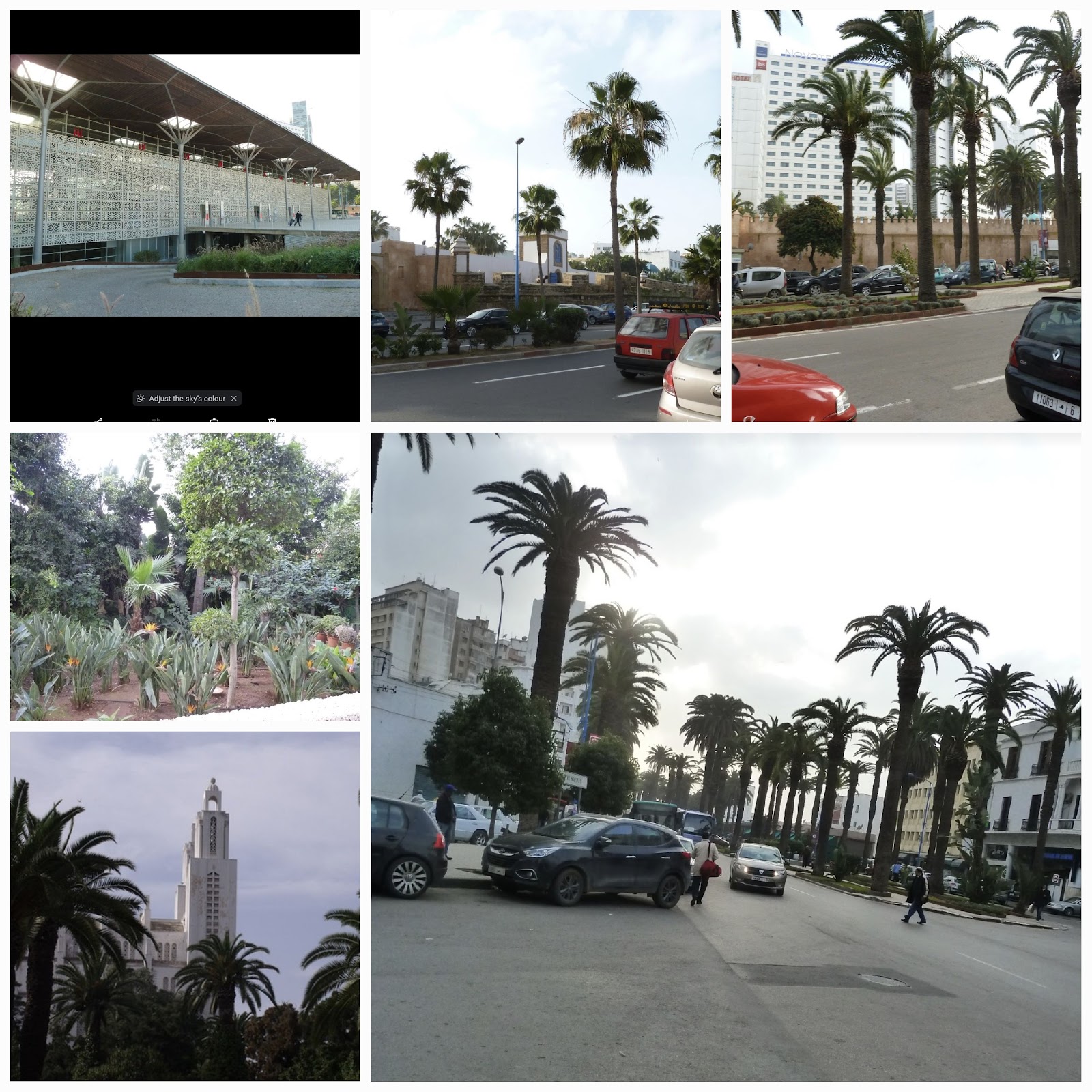
As we walk out of the port a most beautifully intricate facade, a combination of Islamic art and Art deco beckons more than a once-over. It's the railway station! Walking in we find that a train is due to leave for Rabat, the capital of Morocco. Why not? The ride will take an hour but perhaps we'll be treated to rural scenes.

The visit to Rabat warrants a separate blog


A rich history

Upon our return after several hours we take a stroll towards the medina. As always a minaret beckons. It is actually a square clock tower, conjoined to the rampart, standing ideally between the medina and the French quarters. Walking along the protective walls of the medina, and a gate to its entrance, which we skip, leads us to the French quarters. The clock is special for it emblematically stands for the rich cultural heritage of the city: French colonialism and the then European institutions and culture. Being the residential quarter for expatriates the buildings are said to have been financed  from French ministers, Jewish industrialists, and even Moroccan pashas. Appropriately the architecture is a blend of  French, North Africa, and American.


Living it up: vibrancy

Our 3 km ramble, past the Mohamad V square, leads us further into United Nations Square, radiating from which are several boulevards. A bustling place studded with exclusive shops, hotels and restaurants. It is well connected by the tram system.The architecturally majestic buildings befit the largest city in Morocco, the eighth largest in the Arab world, and also the nation's economic and business centre.  A white spire in the distance is not to be confused with a minaret.

To press it further, noticeably almost every building is white. No denying that it lives up to its name, White (blanca) House(casa), after all! As the name indicates, French is widely spoken in Morocco. Road signs appear in French as well.Manicured squares tree lined boulevards startlingly contrast with the white.


The ‘floating’ edifice

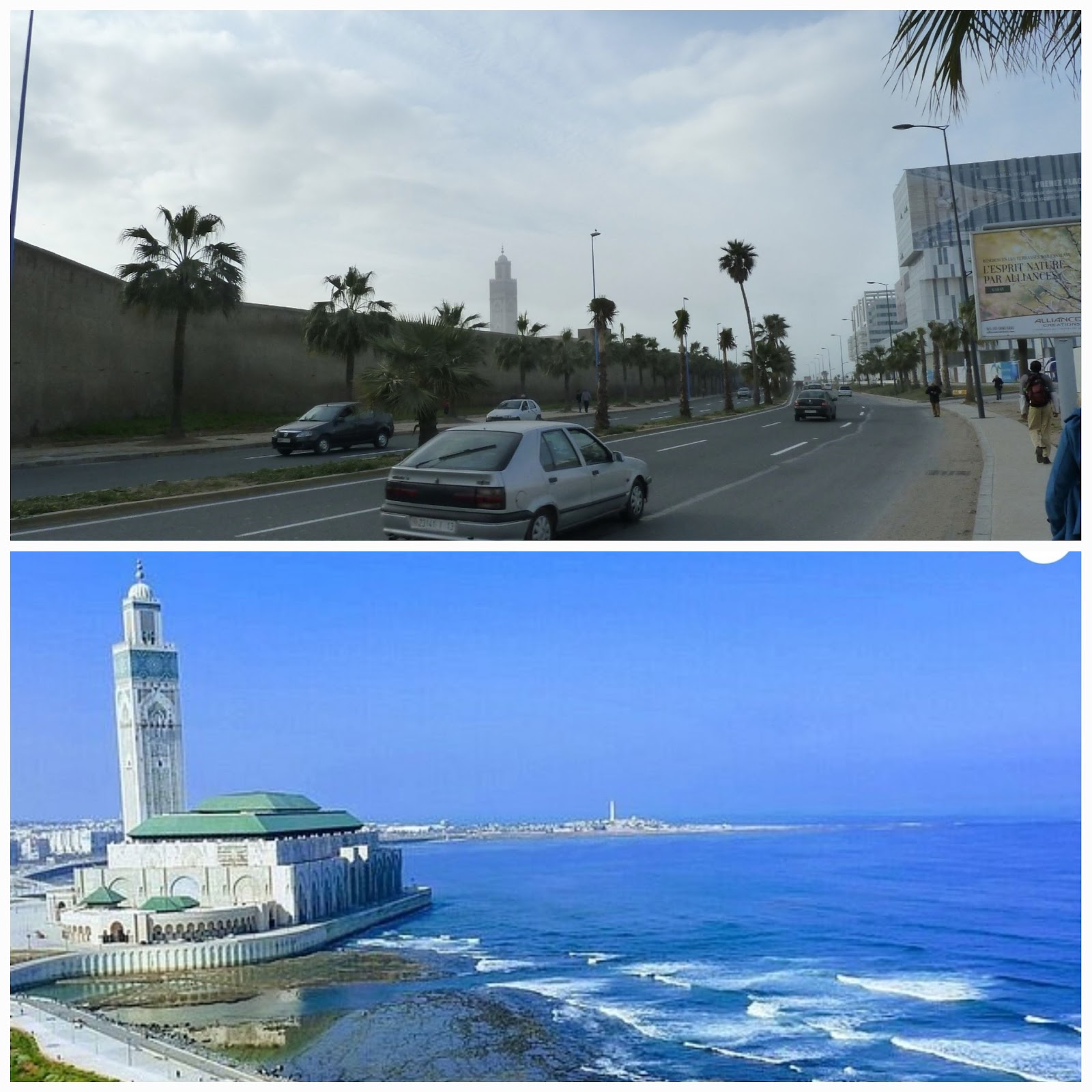
The glimpse we had from the port of a glittering building with a minaret in the far distance is now just beside us but we are cut off by the wall bearing numerous hoardings. All said and done , the Hassan Ii Mosque is not something we are going to visit. For one it is late in the day and we may not be able to take it all in before we set sail.

Situated right on the shore of the Atlantic Ocean. It is  the second largest mosque  in Africa, the seventh largest in the world. Its minaret is the second largest in the world.

The stupendousness of it all hits home when in the realisation that the vast complex encompasses a madrasa (religious school), museum, conference facility, library, and hammams! Virtually a city in itself.

Unfortunately, the interior of the mosque can only be visited on a guided tour. Fortunately for us we have no regrets not visiting it.

But it is not all white and sleek


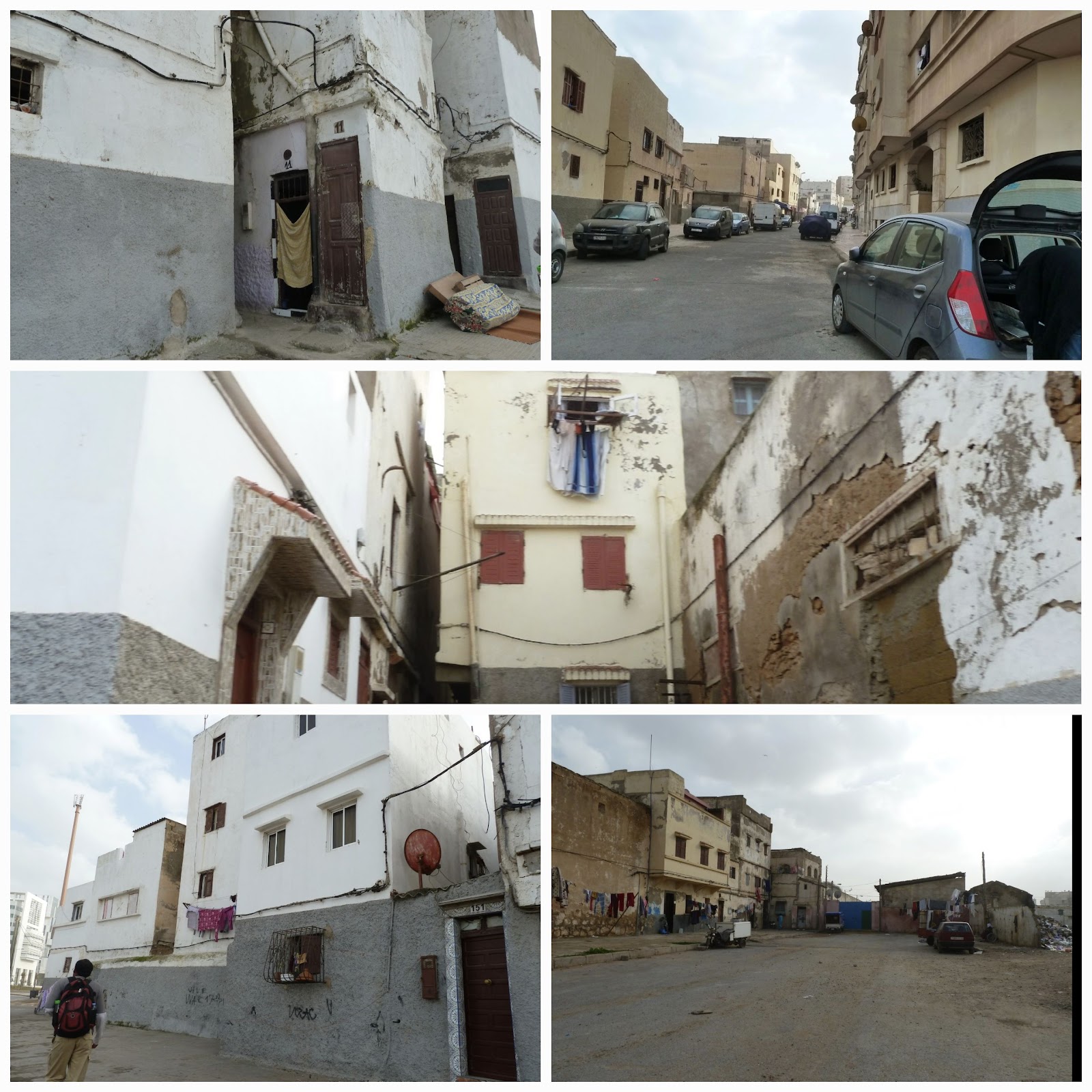
A little detour into a side street lined with cars and elegant homes leads into the old medina that shockingly reveals dilapidated homes. It is all quite eerie as we do not see anyone out and about. Right next to the royal palace of Casablanca which is closed to the public. But there are cats, and then cats!  Had we come earlier in the day we would probably have seen a little  more life especially with what looked like little shops. It was a Friday after all – a sacred day for Muslims.
Wound in a Culture: Tangier, Morocco (2014)

The ascent 

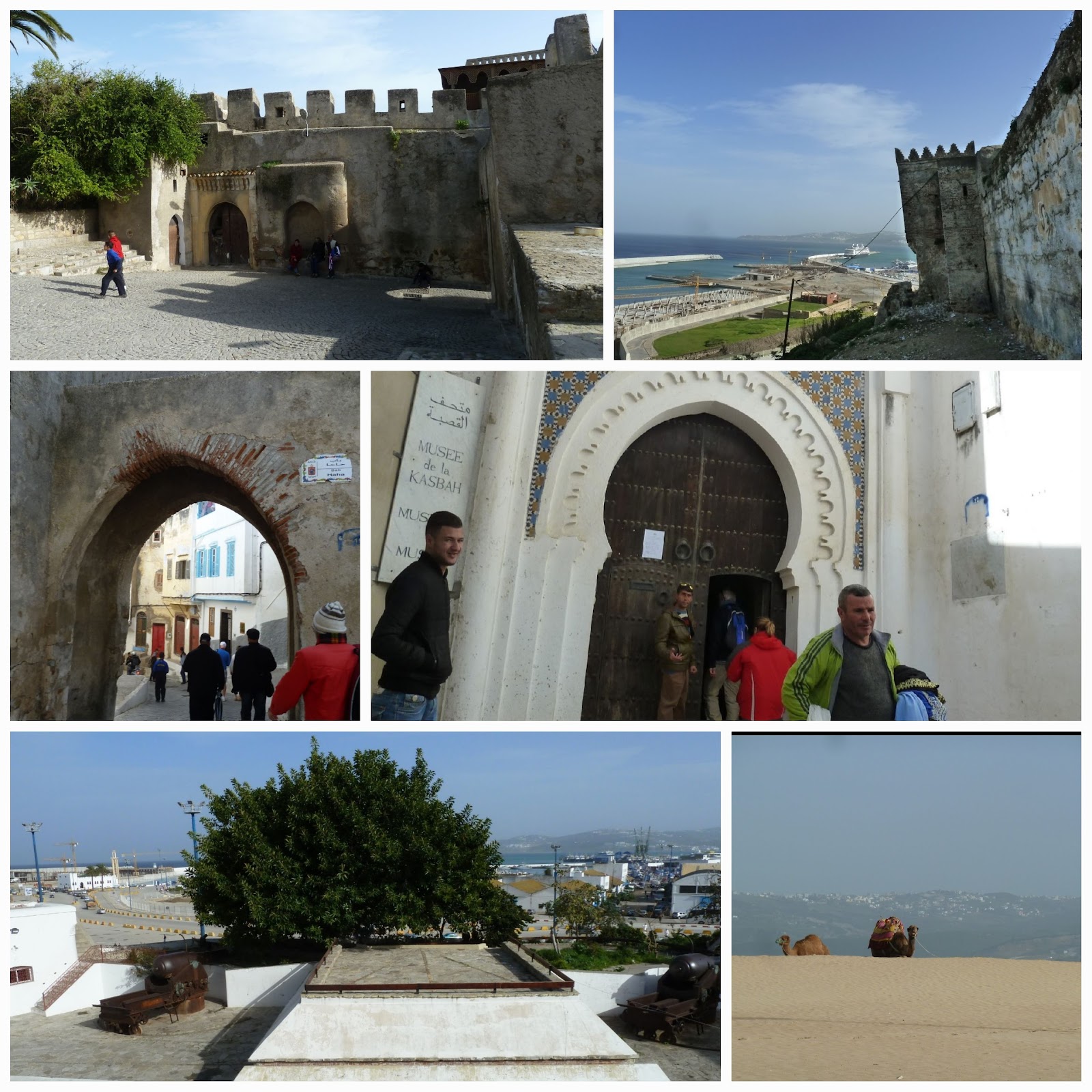
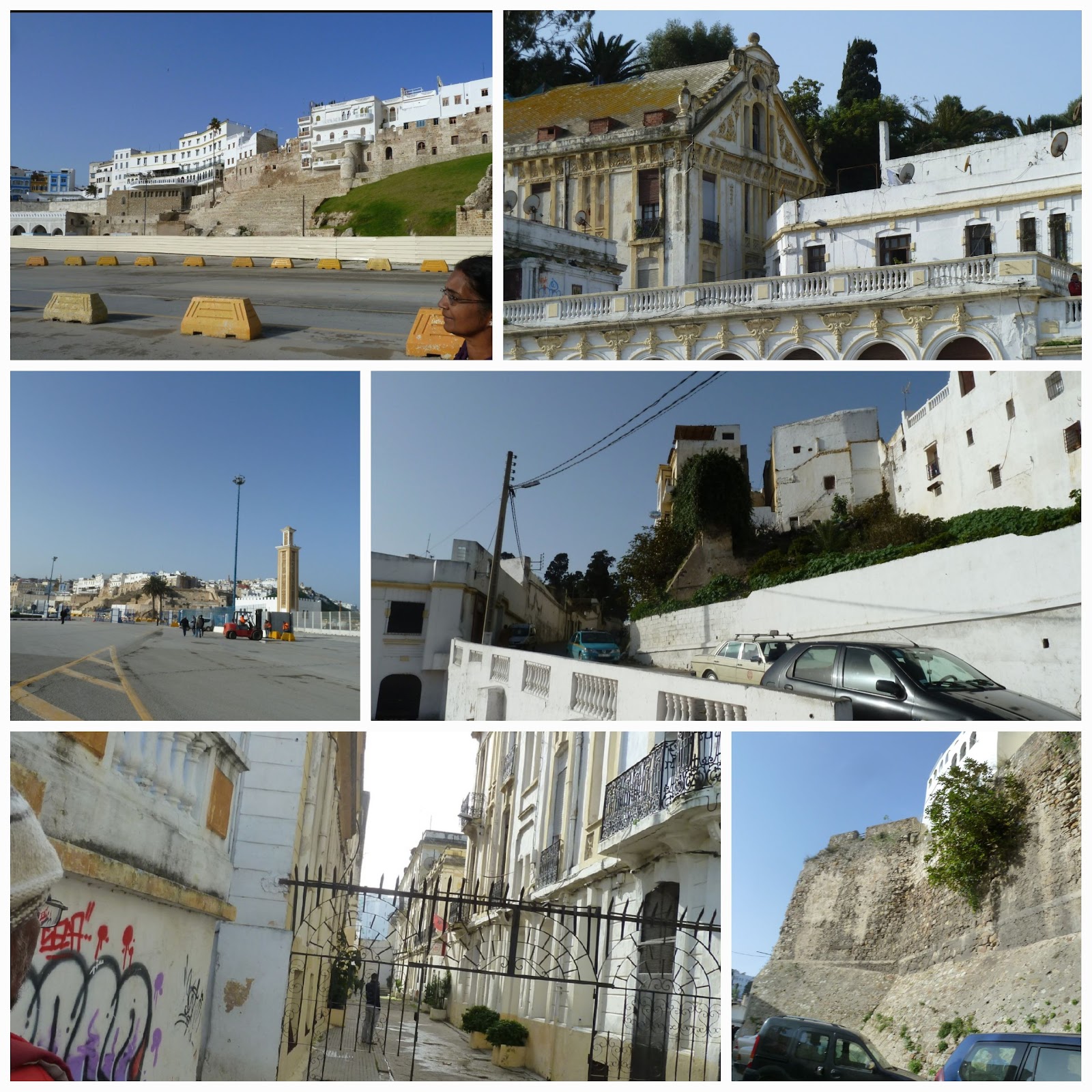
As we disembark at the Port of Tangiers a wide road devoid of cars and pedestrians leads our eyes to a fort-like structure on the hill, overlooking the buildings on the slopes. Our strategy has always been to tackle the strenuous first and then ease our way down. So here we go. Right beside us is a road leading up the slope lined with official looking large buildings. One of the buildings that makes us pause has Spanish Architecture and colours. We continue our walk uphill, simply following the curvy road. 


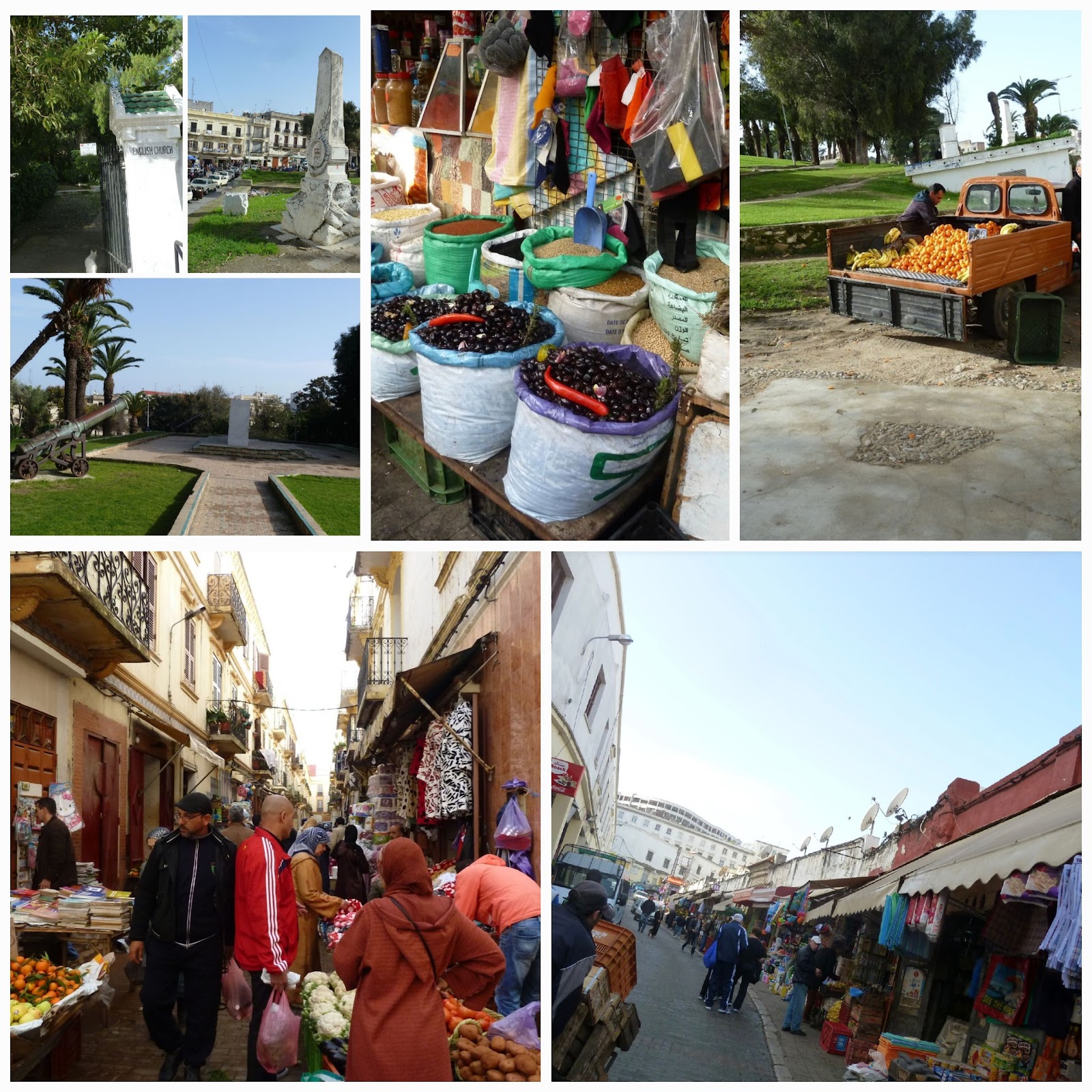
We arrive at flat land with green lawns and gardens, having passed by a Jewish cemetery. St Andrews English church is nearby. This is Mendobia garden.

As we sit in the park to catch our breath there's much activity in the open air market around us. We are just above the Grand Socco (souk/market) filled with shops and stalls overflowing with fruits, vegetables, ceramics, spices, clothes etc. Just down the slope beside us is a pick up truck loaded with bright golden oranges making a brisk sale. Tea shops are patronised by men sitting all day chatting. Hardly any women there. The few women out and about are either selling or buying.  Shouldn't be surprised.


Protector of the city: All gates lead to the Medina

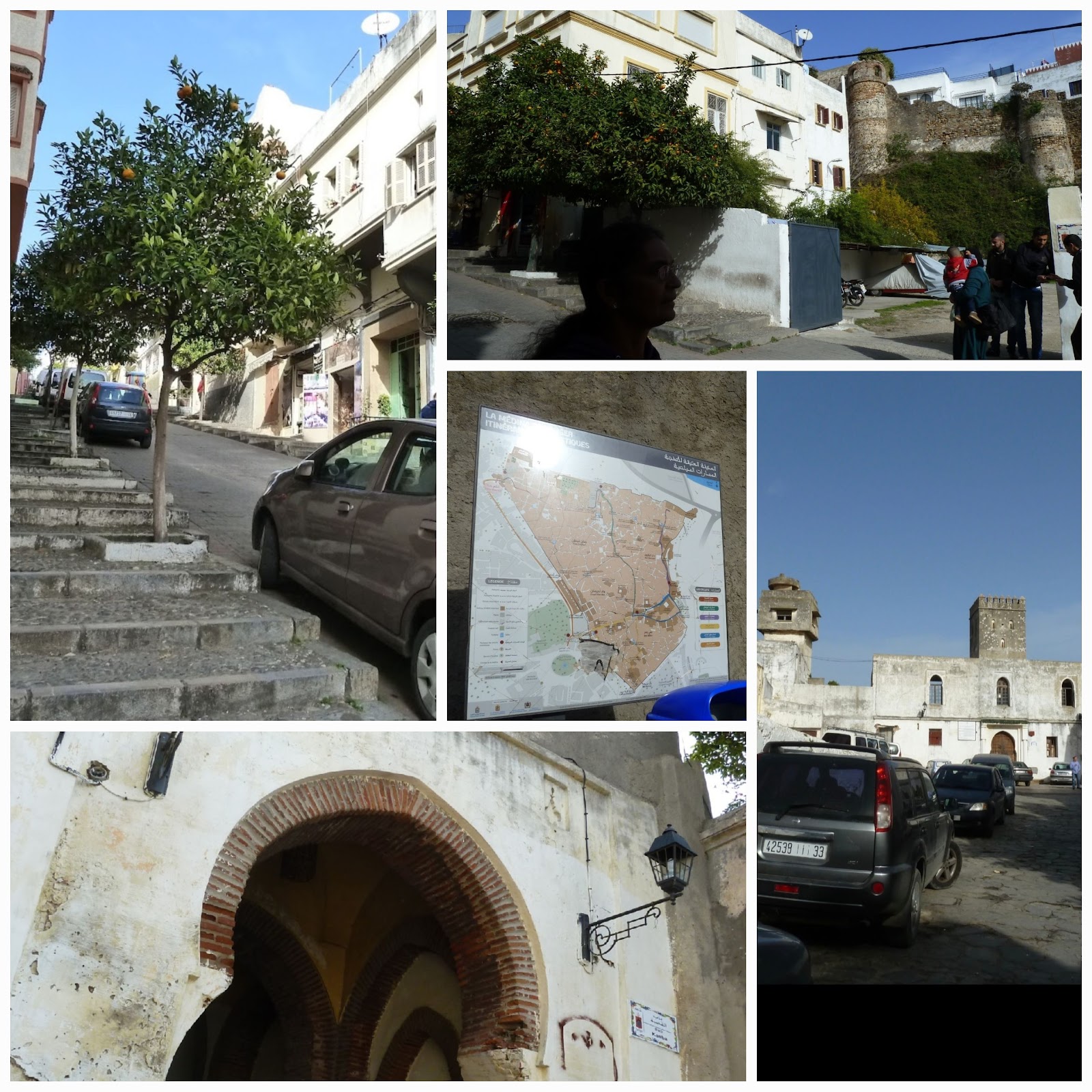
As we walk further up a slope lined with houses and a staircase sidewalk with lush orange trees, in full foliage dotted with gold globes, planted at regular intervals, we are on the outside of the ramparts and towers that were visible from the port. A gate and a notice board are close by. It's a map of all the 8 gates from the Royal Citadel (Kasbah) into the old town (Medina). Taking a chance with the nearest one, Bab(gate) Kasbah, just a few steps away, we enter to find ourselves in the Kasbah courtyard with its historic towers.


The commercial and cultural centre

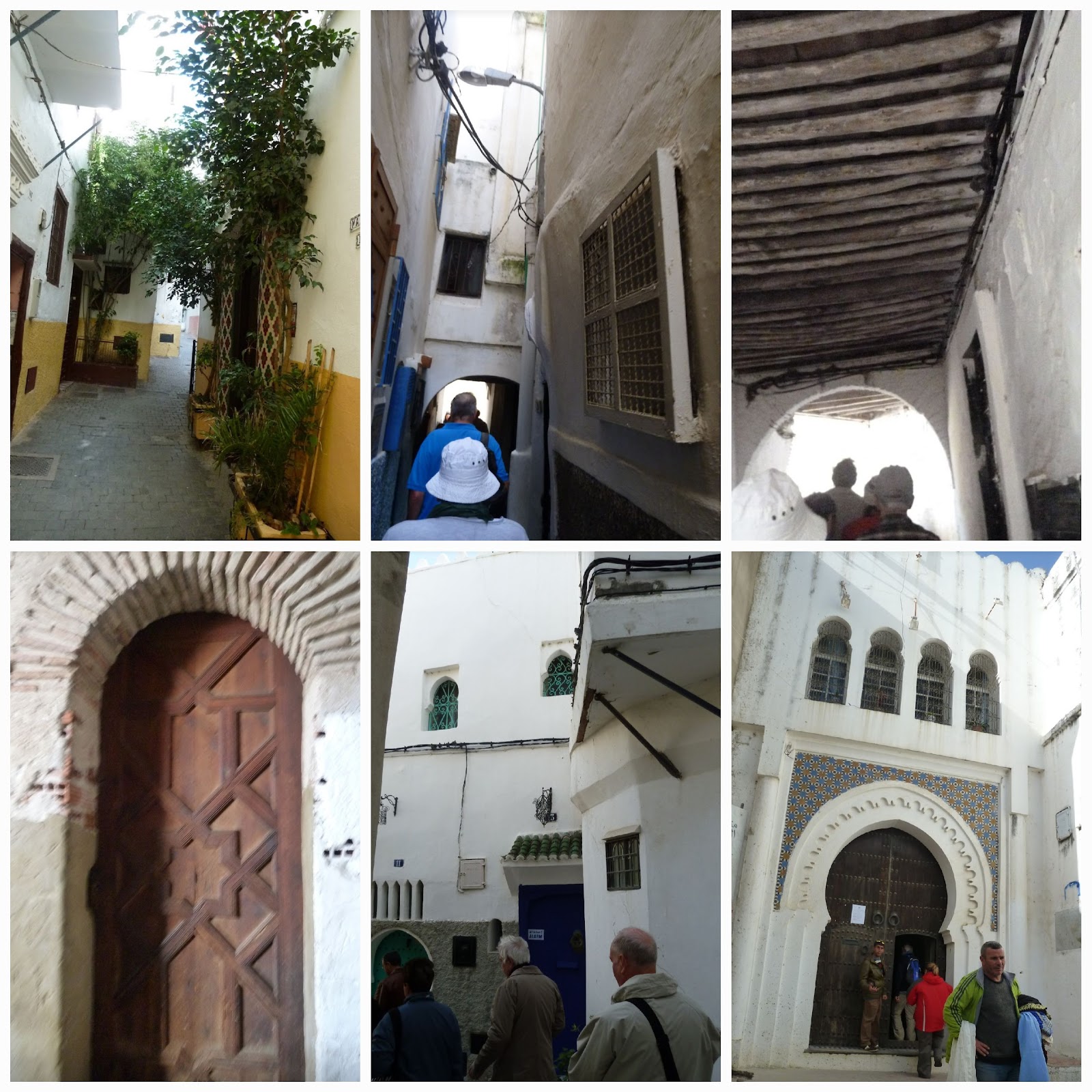
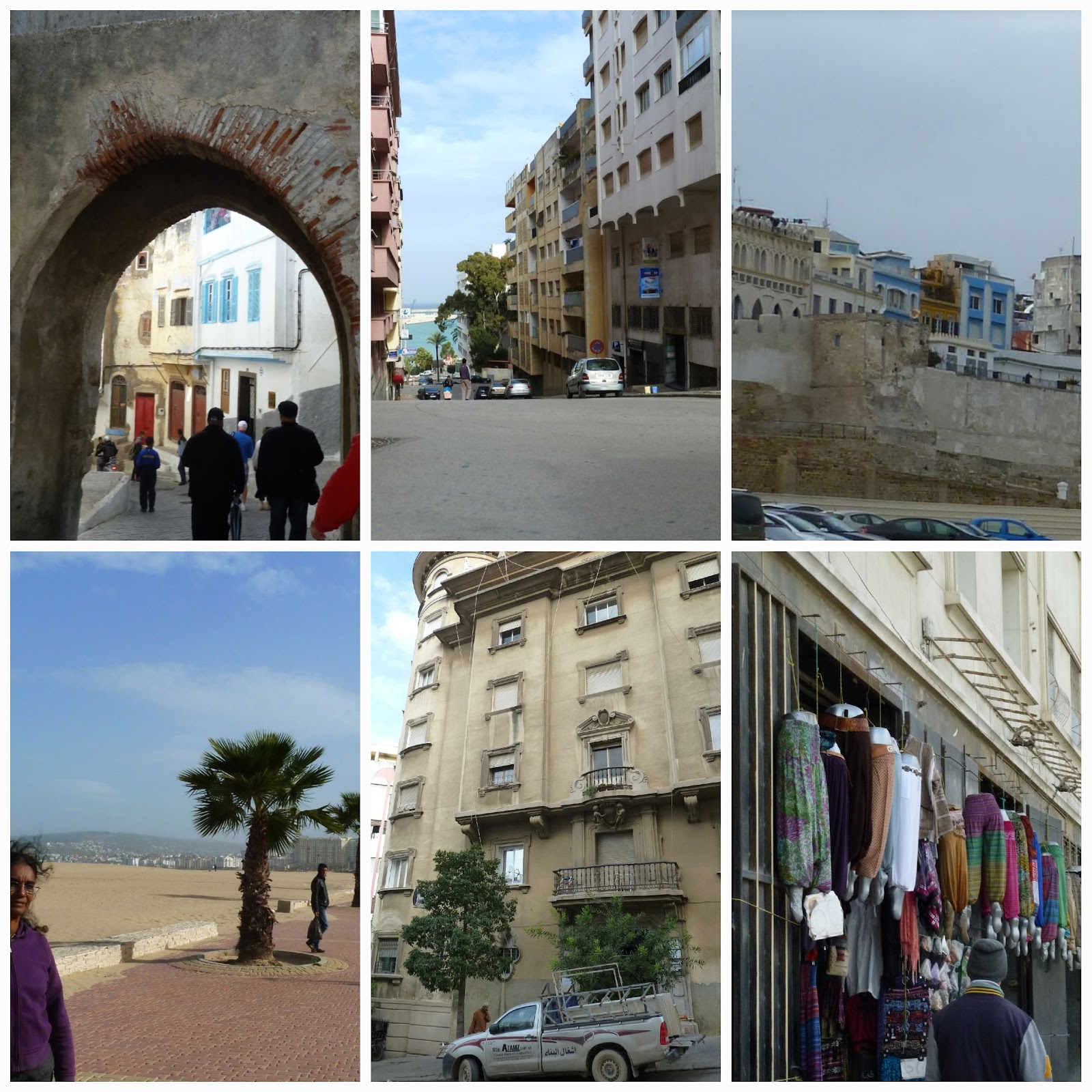
Another Bab leads us into the Medina. What we see are winding alleyways, some so narrow we have to walk single file. In some parts the paths are arched over. In others staircases lead to the different levels. 


America's historic first

We have just passed by what we think is just another Moorish building with an impressive wooden door topped by colourful tiles.. We are surprised that it is the Tangier American Legation building. The United States diplomatic mission to Morocco was originally housed here. It bears the fame of being the very first American public property outside the US. It is also the only U.S. National Historic Landmark in a foreign country. Presently it is a museum.


Life in the spiral

There are street lights and running water in spite of the tightly knitted streets.. Doors of most of the dwellings are closed. Some have plants adorning their outside walls. In wider areas children find space to play. We even see a crib against an outside wall.


Traffic.

Mostly pedestrian but there are cyclists and an occasional motorbike too! No harmful fumes. We can walk forever, if only we could be sure we can find our way back to the port well before departure time. It would never do to miss the boat.!


All Quiet 

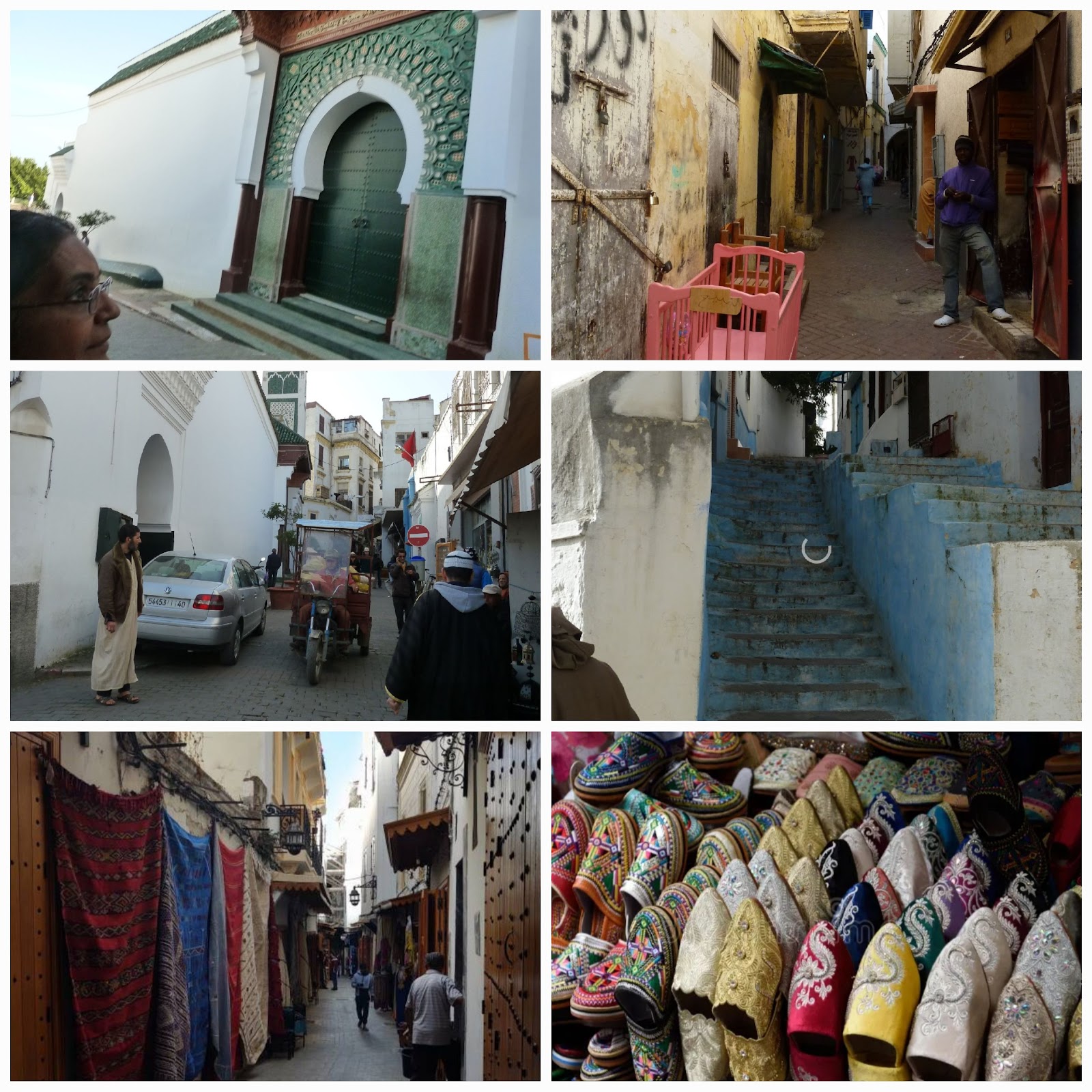
Vegetable and fruit shops have basket lined fronts. Carpet shops display samples on the outside walls. Arrays of colourful Morrocan shoes line another opening. Most pleasing is the fact that the salesmen are not pushy or loud. We are not hassled by touts hindering  us from savouring the splendour and cultural richness of it all.


Tourist etiquette 

At one point, as a group of tourists pass by a blue door, a woman seen through a crack in the door angrily tells people not to look into their private space. Responsible visitors have to remember that this a Muslim country and anything to do with Muslim culture is highly sensitive.

As though to reinforce it, the incident happens close to the ancient mosque with its green minaret and doors.


We are lost

When we think we've seen it all we try to find our way back to the port. It has to be easy for we have only to follow paths going downhill. We get it all wrong. It gets very confusing. The labyrinthine network of cobblestoned streets throws us off. Our best bet is to look for a gate, peek out, get our bearings, and then try again. 


Gateway to discovery

We do find a gate. Not done yet. We have more to savour. We are at the crumbling walls facing the Strait of Gibraltar and the Mediterranean sea with a view of Spain across the waters. We should be able to see the African coast too. Below us, somewhere further away are ancient Phonecian tombs. Over a sandy ridge are two dromedaries waiting for rides! Another view gives us a clear view of the path that took us from the port to the Kasbah.


Sounds of the city

We have our bearings now. Back we go into the Medina and tackle the streets with more confidence. We can still get lost. Sounds of the modern city, motorbikes honking and revving up their engines, clearly indicate that we are almost out of what seems like the bowels of a city.


Now we are on the broader streets leading to a wide promenade. The bigger shops are all her. More carpets, harem pants, vibrant tapestry and leather goods. The downhill walk offers us a vista of the enticing bright blue Mediterranean  Sea.


Geographical location

From the upper levels of the Medina, on a clear day, both the continents of Africa and Europe can be seen. Except at the Gardens we did not see lawns in the city.


The tapestry that is Tangiers 

Definitely the fact that it is not crowded with tourists.

All the signs are in French as well as Arabic

It is  immersive in that it reflects a rich history in its bustling souks and  historical buildings depicting various architectural styles all within the Medina. There is a unique blend of Moroccan, Arab and European influences all reflecting the past, from the Phonecian origins  to the Romans and then the Arabs. It was later occupied by the Portuguese, passed on to the Spanish and then gifted to the English as a dowry and then taken over by a Sultan. No wonder it has a vibrant culture.


Visby, Sweden: ringed by roses and ruins

Picture perfect As we step off the cruise ship onto the pier at Visby, we are greeted by a cheerful flutter of flags high above us. The town...

Follow by Email