Showing posts with label monuments. Show all posts

Le Havre, France(2): an identity

Cont'd from Le Havre, France(1):  Recovery or Restoration?

The lantern whose colours speak 

St. Joseph’s Church is a striking modern concrete landmark, dominated by its 107-metre octagonal tower, known locally as the “Lighthouse.” Built as a memorial to around 5,000 civilians who died in the war, the church combines remembrance with a sense of hope. Inside, thousands of stained-glass panels fill the space with changing colours rather than traditional religious imagery. The effect is calm and contemplative, inviting visitors to pause and reflect on the church’s history and memorial purpose.

Promenading the esplanade

And then we walk along the coastal Boulevard Clémenceau, catching glimpses of the pebbly beaches and the sea beyond. The day is becoming too warm, and I reluctantly abandon the idea of visiting the Hanging Gardens, with their flights of stairs, developed among the ruins of the fort once commandeered by Napoleon. It feels like a small loss, knowing that we will miss the gardens and their views, but the heat makes the climb seem less inviting.

Impression(ism) 

The coastal promenade takes me to The Signal, the distinct monumental concrete sculpture,like a stylized human eye, cantilevered in the ​MuMa (Musée d'art moderne André Malraux) Plaza. 

It seems appropriate for the museum houses some paintings of Claude Monet, Auguste Renoir and others. An 1872 painting by Claude Monet called  Impression, Sunrise depicting the port of Le Havre, Monet's hometown, is thought to have inspired the Impressionists movement.    

Symbols of wealth and success

And then a board that says Gold Coast grabs my attention. I don't see anything like the Australian Gold Coast. I have to go very close to the brick parapet and peer over the breakwater before I spot the glinting rocks,contrasting sharply with the colours of the sea.Had it been sunset or sunrise, or even moonlight,  I would have noticed it immediately. Again, this is an installation made of several rocks of hybrid material, painted gold. 

From there, in the distance, at the tip of a long breakwater, I catch sight of a statue of a father on whose shoulder sits his daughter. The father, an artist,  and the daughter are gazing out over the sea to a future? NY ( based on the imaginary line of the gaze)? the old transatlantic routes?

 Hut handed down 

And then there are the colourful beach huts . Interesting that they are passed down from generation to generation. 

The monuments referred to my previous blog:

The childlike figure captures the carefree joy of life by the sea.

Mr Gull seems to embody a longing for the ocean. With his seagull’s head, sailor’s peacoat and perch atop a ship’s mast, he becomes a whimsical symbol of the maritime world.

The iceberg provides a striking contrast to the volcanoes—ice against fire. Intriguingly, Saharan dust carried on atmospheric winds once settled on the sculpture, giving the iceberg a yellow hue: an unexpected, natural addition to its symbolism.

A tribute to maritime history and engineering

As we make our way back to our cruise pier we take a closer look at an astonishing upright chain link formed of colorful containers at the entrance to the port. The statistics are mind-boggling. Height: 28m. Weight: 248 tons.

 Back at Basin du Roi

All along we see that the quiet morning has given way to a vibrant evening with restaurants doing brisk business. The tide is in and the boats are available for rides. Families stand on the bridge admiring it all. Others walk along the banks.

A high rise building in the distance displays figures/apparitions, on uninstalled window frames The seafood stalls are brisk with business.

 After that it is a lonely walk back to the ship.

Why so many monuments?

To celebrate the city’s 500th anniversary in 2017, “A Summer in Le Havre” was launched, inviting international artists to create works inspired by the identity of this historic port city. Some of the installations became permanent fixtures, while the festival continues to take place every year.

A walk that turns the  pages of history

Le Havre is, without a doubt,a city you have to walk to understand. Its story unfolds with every step: the rigid grid leads you through a bold landscape of concrete, where streets, buildings and open spaces tell the story of a city reduced to rubble and reborn in the daring modernist vision of one man, Auguste Perret. It is no wonder then that the unique postwar reconstruction and architecture  earned the city center a UNESCO World Heritage listing in 2005.

And as you walk, the city’s gaze keeps returning to the sea. The streets lead towards a port that has connected Le Havre with the wider world for centuries—particularly Asia—and remains a powerhouse of trade and industry.

Trivia

  • The AREVA has a factory for building wind turbines designed for Offshore wind power in Brittany, the UK, and Normandy. It created some 1,800 jobs.

  • The largest industrial employer (2,400 employees) of the Le Havre region is the Renault public company 


Le Havre, France(1): Recovery or Restoration?

Harbouring hopes at The Harbour

Le Havre is the port closest to Paris, sitting on the English Channel – at the estuary of the river Seine –where France has long faced England across the water. That alone makes me curious. This was once a gateway for commerce, but also shaped by centuries of rivalry. Somewhere along this coast, William the Conqueror crossed the Channel on his way to claim the English throne. Centuries later, the Normandy beaches would see D-Day.

And yet, today, it is simply our port of call. The 21/2 hour journey to Paris, a city in which we spent a few days many years ago, is a definite “No”. We could wander through picturesque Honfleur, but somehow Le Havre itself is drawing me in. From the ship, the city looks unexpectedly modern, its architecture hinting at a past.

I’m eager to step ashore and see what lies beyond the waterfront. Perhaps there is more to Le Havre than first meets the eye—and perhaps that is exactly what makes it worth exploring. Maybe Le Havre will surprise us.

Not so simple

There are paid shuttles into the city, but we decide to walk—only about two kilometres, or 20–30 minutes. Easy? Apparently not. Almost immediately, we realize we have absolutely no clue.

Surrounded by acres of enormous wind-turbine blades, neatly lined up, the port is like a maze designed to discourage tourists. We follow the fences until we reach a swing bridge. The light is red. We wait. And wait. Nothing. Not our lucky day.

We backtrack, find another bridge and a crosswalk, and finally make our way through the working port and industrial docks. It’s a long, lonely walk—not the scenic grand entrance to Le Havre we had imagined!

A basin dug out of a bay

Still, we keep going, wondering when we would finally reach the city. At last, we come upon a beautiful stone bridge spanning the Bassin du Roi, Le Havre’s oldest wet dock, commissioned by King Francis I in the15 hundreds. The basin was actually dug out of the existing bay! The tide is low and so the sides are exposed. The colourful boats appear stranded in the middle.The stairs leading to the boats below are quite tall. There is no human movement at all. 

Near the beginning of the bridge, perched high on a building, is an unusual bronze sculpture of a girl which serves as a weather vane. But a closer look at the details suggests that she is a creature of the sea happily providing a refuge for marine life. Perhaps she represents the close relationship of the city with the sea. We are finally getting somewhere.

Are we going to have the city all to ourselves?

We walk along  a row of empty stalls stacked with crates. Some have stoves and ovens. I can almost imagine crowds gathering here for sea food. But where are the crowds?

Across the channel we walk along closed store fronts and then we turn into a residential area. 

Stark and solemn

We have wandered towards Notre Dame Cathedral and the older part of Le Havre. This cathedral sits in the heart of the city. We are in one of the oldest thoroughfares of the city. The cathedral was built in the 16th century but of the original only the bell tower remains. It and many of the older buildings in the neighbourhood were severely damaged in WW2.  Hence what we see around us are modern concrete buildings replicating some older features. The streets, in a grid layout, are broad as are the squares. The church itself was restored. Only a couple of people are up and about walking their dogs.

The city is stirring

Since we are already in the heart of the city we decide to find the town hall. We instinctively slow into an amble when we turn into a broad treelined avenue bordered by stark, modern residential apartment blocks. A lot more people are walking about either leisurely or business-like. A building hidden behind bushes draws my attention. It seems like a community centre and I take pictures from the little opening in the bushes lining the fence. We are looking at a public nursery school reconstructed post WW2 with the unique architecture of the city.  

Perked up:A vibrant atmosphere

As the sun climbs higher, the pace of the town changes. Almost before we realize it, we are swept up in a wonderful whirl of colour, noise and activity. It’s market day, and somehow we have wandered right into the middle of the weekend bustle.

We have stepped into Les Halles Centrales, the covered market hall, with the surrounding streets alive with stalls. Everywhere we look there is something to catch our eye—local arts and crafts, colourful clothing, jewellery, woven baskets and all sorts of treasures.

Inside the hall, butchers, greengrocers, wine merchants, cheesemongers, fishmongers and pastry stalls compete for our attention, filling the air with enticing sights and aromas. Outside, the cafés are packed and abuzz with conversation.

We pause for a moment simply to absorb it all. What a delightful surprise to stumble into such a lively, colourful slice of local life!

A welcome respite

Not too far away are St. Joseph's Church and City Hall. Knowing the church is closer to the port, we decide to continue walking toward City Hall, or Place de l’Hôtel de Ville. The original city hall was destroyed by British bombardment during the Second World War, and what stands before us today is its modern reconstruction.

The square in front is unexpectedly inviting, with tiered fountains, shady trees and neatly manicured gardens. After the slowly building excitement of the morning we are glad for a quiet place to catch our breath, take in our surroundings, and simply enjoy being here.

More wandering: is there a story?

A walk through the remarkably quiet neighbourhood leads us toward the old market square, where we come across a light-stone building that appears to have retained much of its pre-war architecture. This is the city’s Natural History Museum that stands out among the modern buildings around it. Standing nearby is a rather curious statue, adding an unexpected touch of character to the scene. He is Mister Gull. There must surely be a story to this one.

Cultural and shopping centre

The white structure that has been visible from the different streets now looms up before us. What I had imagined to be the top part of a boot has more beneath it, for the structure sits below street level. Yes, it is shaped like a volcano with smooth white sides. There are not one but two volcano structures. The larger Grand Volcan houses a 1,200-seat theater and a 350-seat cinema. The smaller, Petit Volcan,  is now a public Library.  Both were designed by a Brazilian architect called Oscar Niemeyer. The two buildings that form the cultural  center stand in stark contrast to the post war concrete buildings all around them.  Climbing out of the sunken area brings us into rows of eateries and bars preparing to open for the evening crowd. 

Apt war memorial

Our eyes are next drawn to a statue in a large square called Place Général de Gaulle. The square faces a pond lined with seats and benches. If the sun had been more merciful we would have sat there in the company of two others who were sunbathing on the boardwalk! In the middle of the park stands the enormous statue that pays homage to the lives lost in WW1 and  WW2 and other major conflicts.. The fountains were not activated the time we were there. 

The pond/basin also has a quirky artistic installation called the ‘Ice berg’.

To be cont'd in Le Havre, France(2): Monuments


Maribor, Slovenia: Unruined

 ‘Curiouser and curiouser’ as Alice would say

After 2 days in Opatija, Croatia, we drove via Ljubljana, Slovenia, on to Maribor where we were going to spend a night before going on to Vienna, Austria.

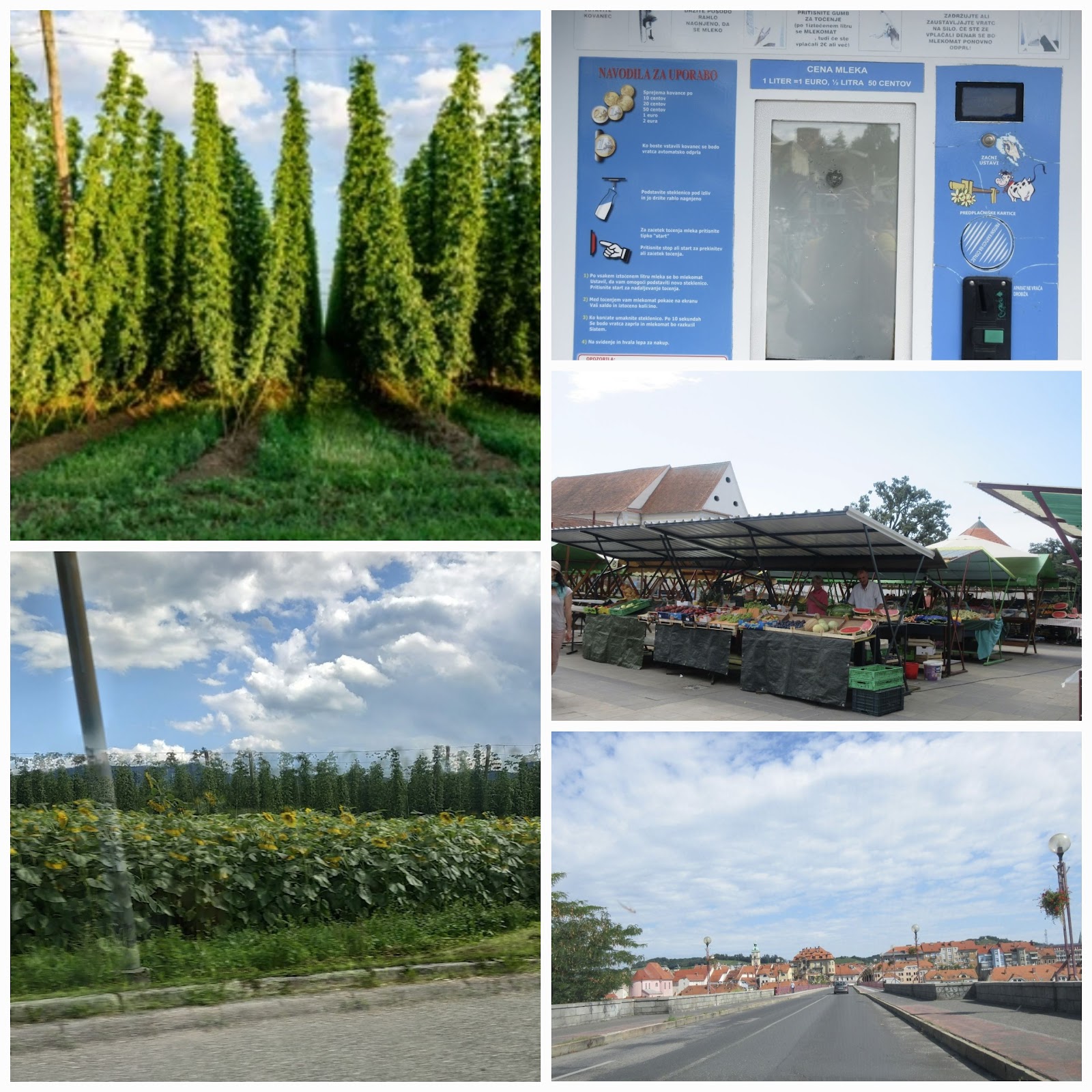
The route was lined with vineyards and acres and acres of, what seems to the untrained eye, pepper vines. But were they really? These are shady plants. The greenish conical ‘fruits’ are drooping with their weight. The foliage seems dense. As they grow they cling on to ropes! 

What are they?


Acquired taste: more to experience

We did not have difficulty finding our accommodation. A series of rooms with a hodge podge kitchen in the half basement. Our host is a school teacher. She welcomes us with shot glasses of home-made yellowish wine garnished with tiny flowers from her garden. Should we have taken the shots right away? Being teetotalers and unsure of the custom we set it aside for ‘later’. 


Since it's close to sunset we simply make ourselves comfortable, quickly prepare dinner, connect to the Internet, contact our host at the next destination, preview our itinerary for the next day and then just before we retire for the night, believing that our welcome drink would be stale enough, we take sips. Our faces immediately contort. Our tongues are not ready for what we unanimously felt was unpalatable. 


The burning question 

What were those vines we saw on our way to Marbor? Hops. So says our host proudly. They are a vital ingredient in beer making. Was it beer that she had offered us the day before. Not in shot glasses! At least, that much I know.


More to discover

As usual we have a hearty breakfast and pack our picnic lunch before driving into the city centre of Maribor.  The town is very quiet. But as we find a place to park we notice a hub of activity. It is market day. Fresh vegetables laid out on simple foldable tables in rows of covered stalls . As we get closer we notice that the stalls have only the discards. After all, it is late morning. Only one stall has some fresh undamaged beans left and so we buy some to cook at our next place of stay. The fruits are tempting but we already have a generous supply.


Drawn to a curious booth we approach for an inspection. It houses a recess with a glass door. You could place a milk bottle in it under a spigot, press the relevant button and fill up to a litre of milk after having tipped the coin slot. A basic vending machine that serves its purpose very well indeed.


The Old Town

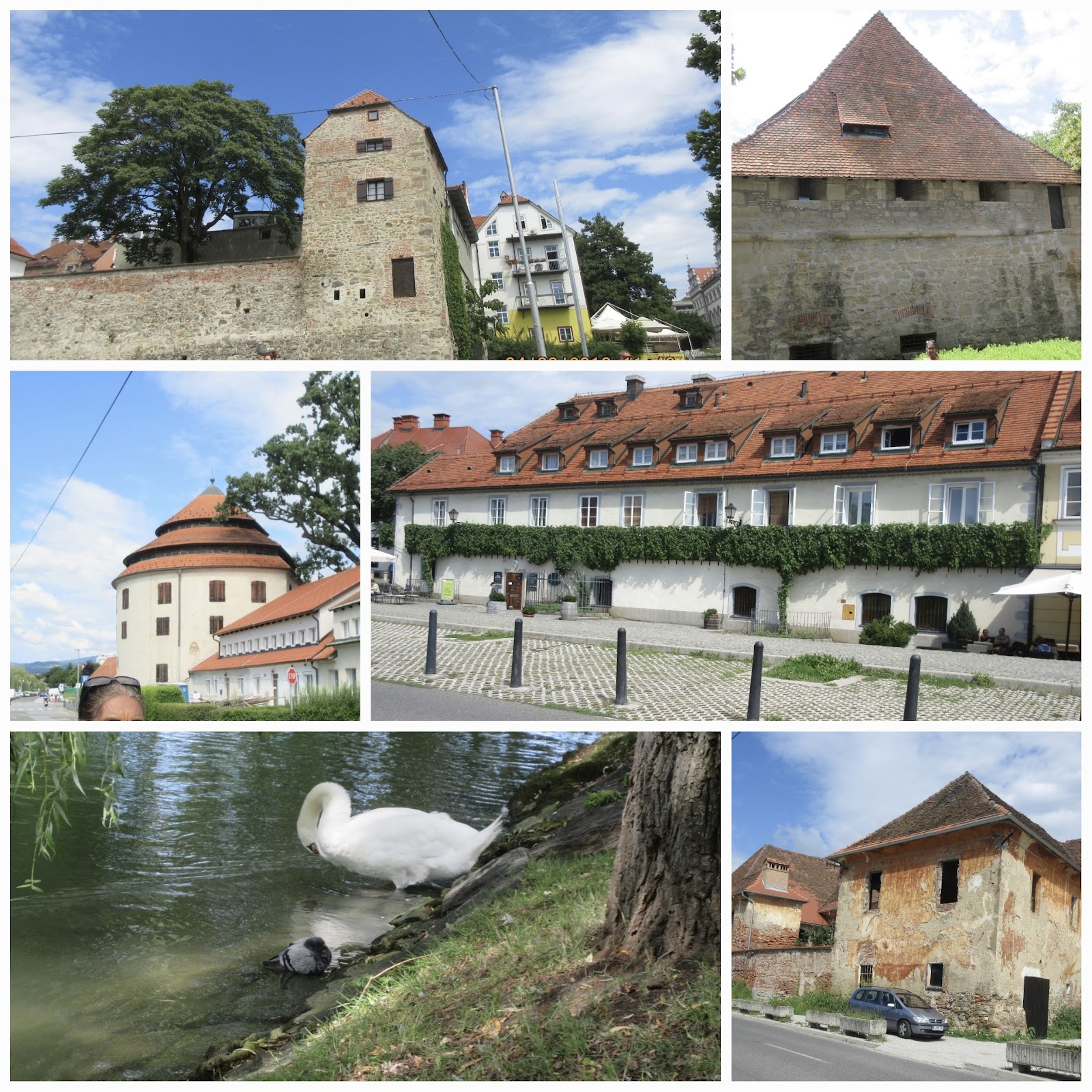
The excitement over, we begin to explore the city laid out on the banks of the Duva River, with swans gracing its banks and gliding across the waters.

The ruins of mediaeval walls and buildings are hard to miss. The plaques tell us of the squat Water Tower (that doesn't look like one), and the Judgement Tower, both built for fortification while Slovenia was still part of Austria. The Jewish tower and synagogue (second oldest in Europe) attest to the Germanisation of Austria and the consequent suffering during WWII when most of the city was destroyed. And then of course the area became part of Yugoslavia before becoming independent Slovenia (1991).


Idyllic and record breaking

The long building with a dense vine stretched over its length draws our interest. We could have easily dismissed it as a decorative creeper.  It's actually a 400 year old grape vine, the world's oldest according to the Guiness Book of World Records.. Yellow walls and red roof tiles ( same as our host's residence) and a dense dark green vine. It can’t  get more picturesque.


A greater appreciation: history and agriculture

We stroll towards the city centre to be greeted by even more ‘curious’ monuments: 

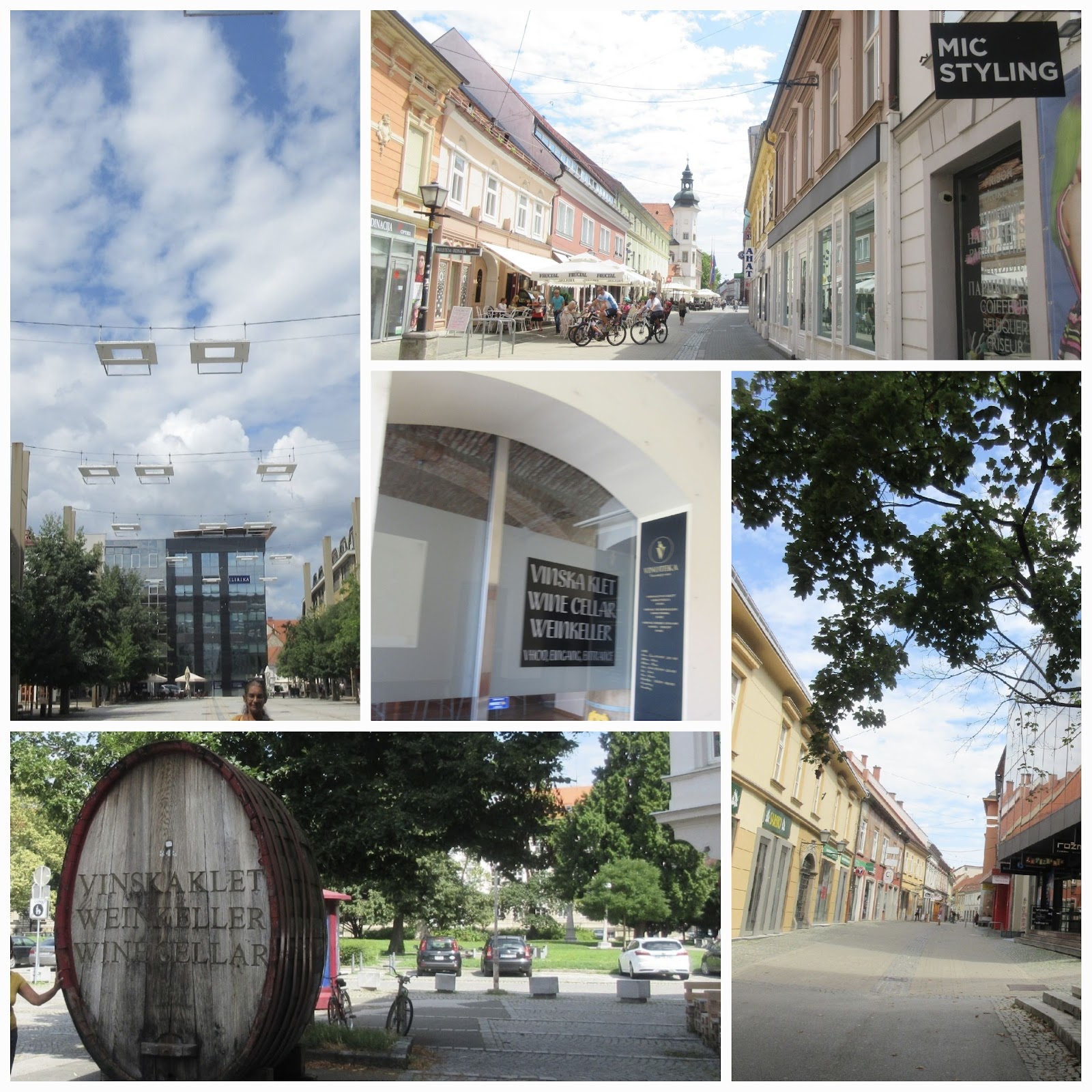
A huge wine barrel. The sign at the entrance to the building nearby tells us that this barrel is not simply whimsy. Maribor is surrounded by vineyards. The building is a wine museum with one of the oldest and  largest  wine cellars in Europe.  It has wine tasting sessions as well. It makes no difference to us that it is closed today. Now we truly understand our host's welcoming gesture. 


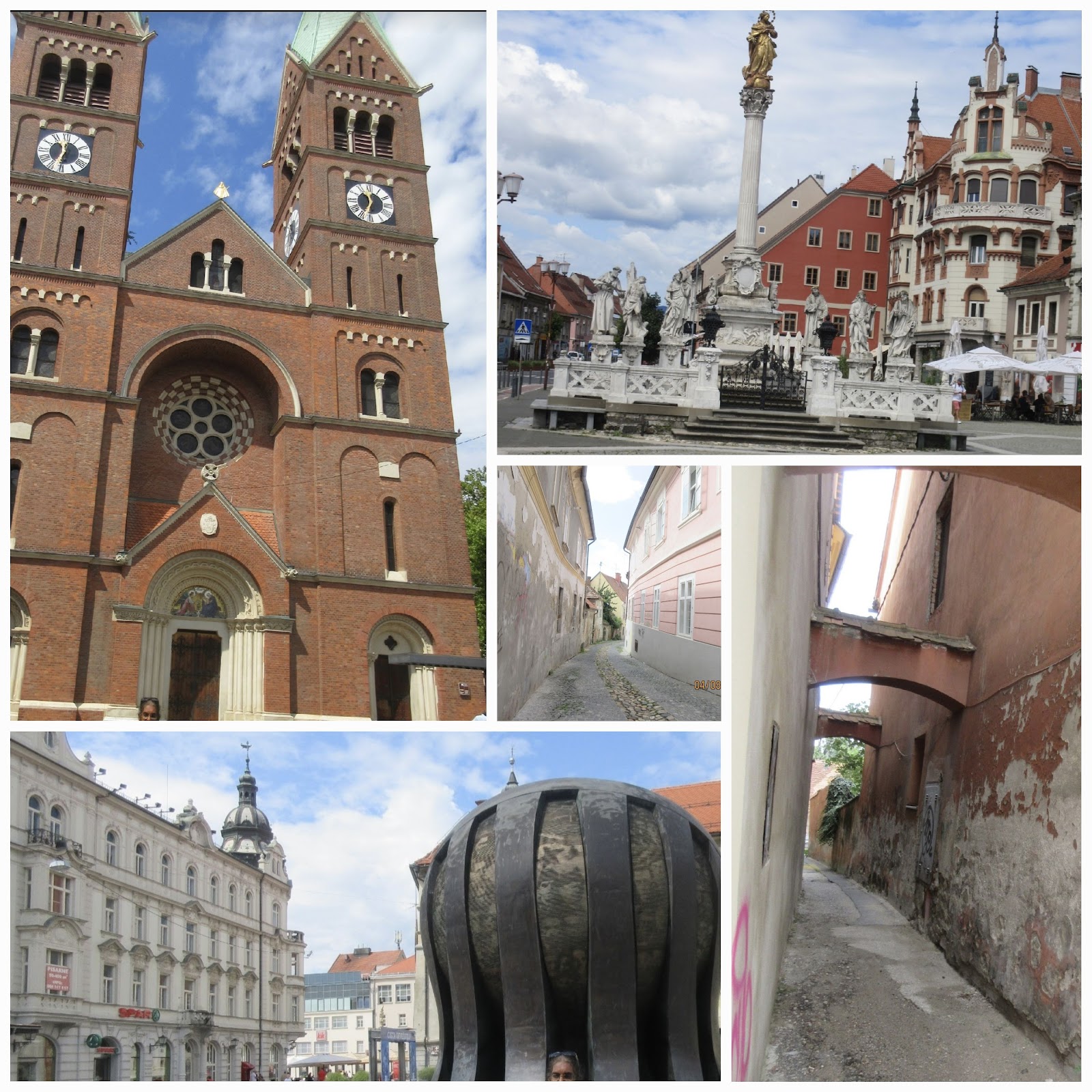
Another oddity loomed up: a huge rotund sculpture. It resembled a spherical head with neat swatches of hair neatly combed down the sides to conceal baldness! Seriously, it's a  monument to the monument to the nearly 700 hostages and rebels who were killed by German forces during the National Liberation War (WWII).


In the main square of the city is yet another monument.  This time it is an elaborate marble structure with intricate details to memorialize the nearly  one third of the population that died during the Plague.


Two modern and one  baroque style monuments. What next? Our ramble takes us to a Gothic Cathedral and a Renaissance style town hall. 


European Capital of Culture: Who would have known?

Leaving the cobble-stoned old city and its narrow alleys and courtyards we saunter into the paved modern streets in the new part of the town.  It is all so quiet it's hard to believe that Maribor is the second largest city in Slovenia as well as voted the cultural Capital of Europe in 2012.  

It goes without saying that travellers like us who enjoy discovery, who want to truly appreciate the local inhabitants, get the full deal when there are few tourists of the kind who simply follow guides, arguably for a better appreciation, afraid that they might miss something they had read about or had been touted.


Trivia:

The Duava River connects Slovenia to Italy, Austria, Croatia and Hungary.


Sitka, Alaska: once the Paris of the Pacific

Momentous events that shaped Sitka Originally a native Tlingit settlement, Sitka became a battleground when Russia fought to establish it as...

Follow by Email