Showing posts with label fog. Show all posts

Cape Town, South Africa: a cautionary tale

Berth rights

The day before our arrival in Cape Town we have an unusual  presentation at the Theatre that seats 800. We are to be briefed about immigration procedures at the upcoming port. What could be so complicated that it would require 45 mins to explain? It is all rather fishy and strange. Conspiracy theories abound. First we hear that we will not be docking at the passenger terminal for it was occupied! We have permission to dock at the container/cargo dock. A rather inconvenient proposition. It would be about a kilometre from the passenger terminal and most unsafe because of the heavy equipment operating there. Only the cruise terminal has immigration clearance facilities. 

Mobility and red tape

Now, how can it be made more conducive to the mostly elderly passengers? With great effort from the ship's officers the port has agreed to supply shuttle buses between the docks. Each shuttle bus would make a 20 min trip inclusive of  boarding and alighting time. The officers at the cruise terminal would need at least 4 hours to clear all 4000+ of us. How long can older folk wait in line? Solution:Get the immigration officers on board. One of the lounges will be prepared for them with seats and tables to place the necessary equipment. Passengers can line up in the comfort of the ship's corridors.

The air clears

Incredibly, it is announced later in the evening that the passenger pier is available. And that means as we get off the ship we will queue up at the cruise centre. The lines could be long and the waiting could be agonising. Besides, we haveo consider those who booked shore excursions. Then there are the independent travellers besides those who are disembarking. Those who have flights to catch risk missing their flights because of the delays. Priority goes to shore excursions. Next come the independent explorers who have to hope that the transport and guide they have booked will allow for the delay. The officers do their best to accommodate all their needs. 

As it happened

We arrive in Cape Town in dense fog with 0 visibility. Only the lighthouse  beam is visible. Fog horns are sounding frequently. The port is closed and so our pilot boat and tug boats are unavailable. Our ship idles for nearly an hour before the fog hesitantly and gradually lets up. The moment we can make out the sea the said boats arrive and guide us through a narrow passageway that requires meticulous navigating between jutting piers and docked container ships.

We couldn't have gotten into the breakwater without them. Instead of docking at 7:30 am we only do around 10:30, All well made plans could easily be thwarted. So, most of us stay put, having a relaxed breakfast, and then lunch, before it is announced that the priority guests have already been processed. We have ours processed at 2:00 pm. 

The day is now quite sunny and bright. It's all looking up for us. The cloud over Table Mountain clears in the afternoon.

Weathering the weather

The next morning is rather cloudy and there's heavy rain to boot. We sit it out. It clears a little after 9:00 am and then the day is bright and shiny again. But table Mountain is covered in clouds and cable car rides have been cancelled.

At departure we see that the breakwater is agitated. We are experiencing strong winds that make maneuvering a ship in a narrow channel highly dangerous. Waves dash against the pier. We have to reverse and then turn into the channel into the open sea. The wind is so strong that besides the normal pilot boat and two tug boats we need a third one to help nudge us away from collisions with the other moored ships. Finally we are out in the open sea.


Do's and don'ts

We have been warned repeatedly about unsafe drinking water,  advised to dress down to avoid being mugged, as well as to avoid lonely streets,and about capricious weather.

At least two more people on the streets, a well dressed and well spoken woman of Indian origin and a friendly traffic policeman have given us the same advice. 

The Cape of Good hope: Something to celebrate and respect

There have been many other times when cruise ships have had to miss Cape Town mostly because of the fog and strong winds. The ship wrecks of explorers from past centuries caught in the cross currents of the Indian Ocean and the Atlantic while rounding the continent at Cape of Good Hope have tales of courage to tell.


Swakopmund, Namibia


Expecting the unexpected
If our cruise ship had not overnighted in Walvis Bay, Namibia, we would never have known of Swarkopmond. Incredibly the biggest coastal town, a popular local and foreign tourist destination in Namibia, and yet we had been ignorant about it. One of the best things about cruising is docking in ports that are gateways to famous cities. Passengers generally tend to book excursions to places that are touted as attractions. Many a cruiser has lamented not exploring the immediate surroundings of the port. This was an occasion where the capital,  Winhoek, was too far away from the port to explore in a day. That means we get to see the side of Nambia that the ordinary 'have been to Namibia' tourist does not get to see.

Thin strip between desert and sea
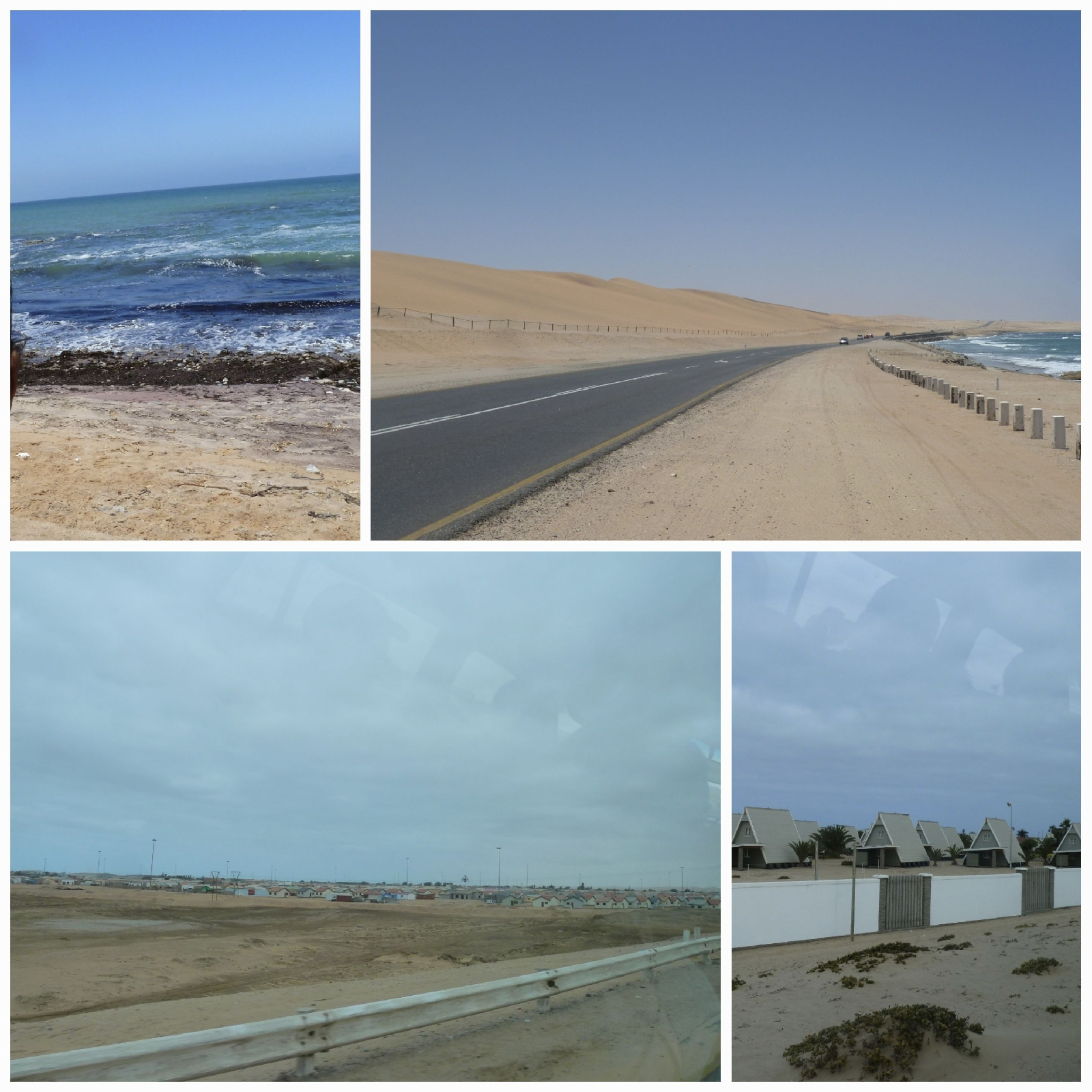
Public transport between Wavis Bay and Swakopmund and within the town is practically non- existent. Hence we hire a van (driven by a Zambian woman working in Namibia)) for the  30 km drive on a highway with hardly any traffic. We are dumbfounded  by  the unique geographical features along the way. The edge of the Namib desert meets the right edge of the highway, while on the left is the Atlantic sea whose waters have formed a salt edge along the shore.  There are sub-urban settlements that seem like oases. One is a housing project and the other, closer to town, is the Swakopmund Municipal Camp with its distinctive A-shaped chalets, the mark of a beach resort. The town itself is an oases surrounded on three sides by the Namib Desert.

A well-ordered modernized town
Our driver drops us at the lighthouse around which is a lush park. The park is watered with treated waste water! It has everything one would expect in a park-- a promenade, shady copses, a play area, a variety of colourful decorative plants (some with leaves resembling  coins) and benches facing the sea, etc. 

The local flavour
As we walk around the lighthouse our eyes are treated to a zoo of sorts. Of course, these are sovenir shops with wood carvings of African fauna, all neatly laid out in rows. Again, as in Walvis bay , we are not harassed to buy. There is also a group of thatched huts. We almost dismiss them as shops before we realise that this is a set up by the powers that be. Topless natIve women are sitting around with their children engaged in traditional craft. It is quite obvious they are not too happy to have tourists gawking at them. 
History speaks volumes
Just behind the lighthouse that houses a museum is the State House. We know we're are already in the city when we are surrounded  by unmistakeable German colonial architecture. In the late 19th century  the coastal town was the main harbour for German South West Africa. Elegant church spires and dozens of homes with Tudor Revival facades and gingerbread trim line the streets. Most of these buildings were built as business centres in the 1910s. They have since  been repurposed, mostly into hotels, condos and museums. Bavarian bars and shops selling German goods reinforce the Germanness.
A  building stands out for its red sandstone foundation and yellow walls, pale green half-timbering, gables and a small tower sticking out from the roof. Who would have known that it was a prison! 
Another unassuming but beautiful pinkish building used to be the barracks.
More delights 
The town has a lot to divulge as we rove the lattice of streets and turn unexpected corners. No gutters. No drain pipes. No litter. Enticing boutiques and pastry shops. Attractive potted plants. Cool air.
Dune revelations
Our driver picks us up at the appointed time to drive us back to the port. We stop to get a feel of the dunes. It's amazing how the sand has different textures (at different stages of erosion), and takes on different shades.  The wind has sculpted ripples and waves on the slopes. The sand glitters and offers us glimpses of buried remains of desert fauna. The straggly brush that hold together the sand at different spots is unique to the Namib desert.
The Welwitschia plant has only two leathery, strap-shaped leaves that keep growing. They continue to be shredded by the elements lending them the look of a straggly bush. We may be on one of the oldest deserts on earth since these plants can survive for a 1000 years and more.
Geographical sense
Why are there no gutters and drainpipes?  There's hardly any rain, of course. When it does rain on the desert rivers flow. The water seeps into the ground.  The ephemeral rivers are  harnessed. But this supplies only half of the water needed. A desalination plant accounts for the other half,

Geographical surprise
You’ll notice that I'm wearing a jacket in a desert.  The proximity to the sea helps mitigate the temperatures.
The desert supplies moisture for the area in the form of fog that can reach as deep as 140 km.  When  heated air over desert land  blows towards the cool water currents in the Atlantic ocean it condenses and fog is formed.  It occurs early in the morning and late in the evening. The fog gives the town a fairytale look. It is said that fog occurs 300 days a year and sometimes hangs around for several days making the coast dangerous for sailing. 

For Namibians Swakopmund is equivalent to hill resorts for those living in hot climates.


Drained by the Weather


Weathering floods, fogs, torrential rains

From Venice to Rome via Orieto
After spending a night and a day in Venice, dazed by the labyrinth of canals, alleys and bridges, a city that stood the test of time, we picked up our car from the valet parking garage( it cost us as much as our budget room rental), starting our nearly 10 hour drive towards Rome that took us through rolling hills and olive groves as well as numerous picture perfect mideaval  towns. Sign boards on the Estrada indicated Verona, Padua, Bologna and Florence stirring up a flood of images of Shakespearean plays in my mind, while another storm was brewing.
Almost 6 hours into the drive  we are drowned in a flash. The sky splits with a crack and a boom, breaking the dam in the heavens, letting loose a watery fury. Visibility is zero. Stunned I almost floor the breaks and hope to veer towards the verge and stop there till the visibility improved. The driver's sense kicks in. My hand automatically reaches for the hazard light button. If I slow all of a sudden wouldn't I be in danger of being hit by a vehicle  tailing me? Did I really know anything about the verge? Gravelly? Muddy? Sloping away? Will I drive myself into a worse situation? 
As I continue driving at a slightly reduced speed the turmoil in my mind subsides. We had only about a half-hour drive to Orvieto where we were scheduled to overnight. My agitation subsided but the sheets of water pounding furiously, not only on the winshield but all around the car, did not. Are we submerged? Did I imagine a shark winking at us and flapping its tail? It is all surreal.
Still blinded, I hear honking behind me, definitely from a truck. I'll be crushed if he can't slow down. Ha! I see a vague red light blinking just ahead of me. The best thing to do is to tailgate the vehicle before me, driving close to the centre of the road. After nearly half an hour of this nightmare the heavens decide to take pity on us. The rain subsides and visibility improves, but I am still shaking.

The shakes didnt leave us till we were comfortably ensconced in our hotel room. Had we come at a different time we would have enjoyed a walk through this beautiful town with mideaval buildings connected underground. 

A watery Texas welcome
The next time we encountered a flash torrential rain was just as we crossed the border, near Orange, from Louisiana to Texas. We were driving from New Orleans to Houston.  We had just driven by Baton Rouge passing ruined homes devasted  by  Hurricane Katrina. We were already on a downward slope leading from the border when the water began gathering in the dip. By the time we reached the bottom, only a couple of minutes, the waters were almost as high as our chassis. Luckily we had momentum and managed to climb out unscathed. As soon as we clear the flood the rains stops. The sun peeks out with glee at the short drama.

A peek under the veil
On the same trip, in fact, the very next day, we drove from Houston to Austin very early in the morning. The country side was covered in dense fog. As the day got on the fog gradually lifted, revealing the farmsteads and the blue bonnets bordering the highway .  Did Nature unveil her beauty gradually so the appreciation would be greater?

Frolicking in a flood
A couple of days later we found ourselves in Garner State Park. As we trekked through the park we came across a stream fed by a waterfall. It flowed over the service road. An occasional vehicle would drive by and leave ripples. When safe, children would merrily go up to the ripples and ford the stream walking through the reflection of the hill and the blue bonnets.

Foggy Jocundity
After having visited the Lake District, associated with my favourite  Romantic Poets, also the Yorkshire Sculpture Park,  we were driving towards Wakefield when we were engulfed in fog. We we were not worried about obscured panoramas since we'd had our fill for the day. It was nostalgic seeing the signs for Leeds, and Haworth where I had spent some time during my University days. As we were getting closer to London I was reminded of TS Eliot's lines from The Love Song of J. Alfred Prufrock :

The yellow fog that rubs its back upon the window-panes,
The yellow smoke that rubs its muzzle on the window-panes,
Licked its tongue into the corners of the evening,
Lingered upon the pools that stand in drains,
Let fall upon its back the soot that falls from chimneys,
Slipped by the terrace, made a sudden leap,
And seeing that it was a soft October night,
Curled once about the house, and fell asleep.


Harbouring hopes at The Harbour Le Havre is the port closest to Paris, sitting on the English Channel – at the estuary of the river Seine –w...

Follow by Email