Showing posts with label train. Show all posts

New port in Adelaide(1): shock and surprise

Caught Unprepared

I'm almost nonchalant about our stop in Adelaide, Australia. When we first visited it in 2016, it was one of the easiest cruise ports. We'd simply stroll from the terminal into the city centre—no planning, no stress. Once there, we'd hop onto the free City Loop bus that circles the main attractions.

At the tourist information booth, a cheerful, courteous lady hands me a city map and patiently answers my questions. Our main destination is the Botanical Gardens, a place I hadn't fully done justice to on my previous visit and was looking forward to exploring more this time.

But. . . . The "new" cruise terminal is no longer within walking distance of the city. It's about a 40 minute ride away. We can either take a train or catch a bus. The train departs every twenty minutes and takes about forty-five minutes, winding through Adelaide's suburbs. The buses take roughly the same time.

‘Poof’ goes our carefree plan. Our brains go into a furtive rethink.

Outside the terminal, two buses appear to be waiting. Almost at the same moment a train pulls into the station. Which one now? Do the buses leave immediately, or do they wait until they're full? Will the train get us there faster? For a few addled moments we stand there, map in hand, trying to make sense of it all. What had been the easiest port of call has become a head scratcher.

Global influence:Tactics to Reduce Fuel Consumption

We decide to take the train into the city. Buying a ticket proves less straightforward than expected. A long queue snakes its way to the ticket machines, and cash isn't accepted.

As we wait, we learn something interesting about Adelaide's public transport system. Australian seniors pay just A$4.60 for a single journey, and if they return within three hours, the trip back is free ( for this month at least). The catch? You need to be an Australian senior with the appropriate concession card. The local passengers are delighted by the arrangement.

The concession isn't simply an act of generosity. At this time, concerns over the disruption to global oil supplies caused by the US-Iran conflict has prompted measures to encourage people to leave their cars at home and use public transport instead. It is a reminder of how quickly events unfolding on the other side of the world can influence everyday life in a city thousands of kilometres away.

For visitors like us, the best option is a A$10 day ticket, allowing unlimited travel without time restrictions.

Once aboard, we tap our cards on the electronic reader. The train is crowded, so we count ourselves fortunate to find seats.

The journey is the destination

As the train rolls through Adelaide's suburbs, it offers something we would otherwise have missed. Instead of arriving directly in the heart of the city from the old port, we pass neighbourhoods of neat older homes standing beside modern developments. The journey becomes a revelation of how the city has quietly grown beyond the city and tourist centres. 

Another thoughtful touch

We emerge from the cavernous railway station and are greeted by a set of steps wide enough to host a marching band. For those with weak knees, there's a rather broad ramp leading to street level. Adelaide, it seems, believes in giving everyone options.

More than just a stroll

The city is a cheerful hive of activity. Trams and buses in bright green, yellow and red glide through the streets, each colour marking a different route. Add these colours to the traffic lights and it becomes a constant kaleidoscope of colour contrasting with the dignified older government buildings. Despite all the movement, nobody appears to be in a hurry.

Slowing down to appreciate 

The Botanical Gardens are about a 30-minute walk away. When we arrive our pace naturally slows to a leisurely pace. Some sections of the garden have begun to wilt. Only a rose or two clings to the bushes. Many patches are being reworked. Still, the beautiful conservatory, the arbours and the fascinating collection of plants keep us happily occupied.

The liveliest sight of all is a covey of wide-eyed preschool children enthusiastically discovering the wonders of plants. Their teachers point out leaves and flowers with great seriousness while the youngsters seem far more interested in running from one exciting discovery to the next. Their infectious enthusiasm brings a burst of joy to an otherwise wilting garden.

From quiet streets to busy boulevards

We check the time. All aboard is at 4.30 p.m., so if we're back at the station by 3.30, we'll have a comfortable margin. That gives us another hour to wander before retracing our steps. All we have to do is return to the major intersection, turn towards the old city square, and continue to the station.

Strange how familiar streets can feel so different only a few hours later. The quiet roads we walked earlier have come alive. The afternoon rush is in full swing, with office workers, shoppers, students and tourists all weaving around one another. Trams rumble past at regular intervals, buses glide in and out of stops, and the city hums with an energy we hadn't noticed before.

As we walk, we're struck by how effortlessly Adelaide blends its past with its present. Elegant sandstone buildings, reminders of another era, stand shoulder to shoulder with sleek glass towers. Neither seems out of place; instead, they complement one another, as though the city has found a way to embrace both history and modernity.

The city square is a hive of construction activity, fenced off as major upgrading works continue, so we don't linger. Instead, we turn towards the station, satisfied that we've seen a different side of Adelaide than the one that greeted us that morning, or in an earlier visit.


(


Seattle to Malta: Did you hear that right?


Cruising? Flying? Driving? No, we were riding!
Aha! Got you there! The Malta referred to is not the country in Europe but one of several cities in the US. This particular Malta is close to the border between the US state of Montana and the Canadian Province of Saskatchewan where our son lives.
After cruising from Yokohama  to Seattle  via Alaska on a repositioning cruise across the Pacific Ocean (passing through numerous time zones and gaining a day) and spending a few notable weeks with close friends somewhat close to the port city, we are to head for Saskatoon, Saskachewan. 

Options
We have several modes of travel to choose from: 
•Drive an hour to Seatac, take a flight to Vancouver, Canada, and transfer to a domestic flight
•Drive three hours to Vancouver Airport and take a domestic flight to the destination
•Drive 40 mins to Seattle King Street station and take Amtrak's Empire Builder (a trans- Continental train) to Malta (Montana, USA) from where a five hour drive north would take us to Saskatoon.
Preference
The train journey, which would take us about 24 hrs, appeals to us for various reasons:
▪︎Unlike airports, there is no need to arrive at the station long before the train arrives:
▪︎There is no cumbersome security check.
▪︎One check-in bag is allowed for each passenger (that is all we had)
▪︎We could ask for assistance while boarding, and disembarking.
▪︎We could take a walk through the train -- no cramped legs. 
▪︎There's only one time zone to cross over a day and therefore no jet lag.
▪︎Passengers are generally very sociable.
▪︎Most importantly, the train would chugg and weave through the scenic Glacier Park in the Rockies. 
We have flown over the Rockies and driven through them on the Canadian side several times but have never really seen it from the US side. Besides, years ago, we did the Amtrak CoastStarlight Express and Amtrak Sunset Limited, both overnighters, one in a roomette, and the other, in the coach. They were both remarkable in many ways. (More about those in another post.)   

Pre-boarding: No time to fret
We are to arrive at least 45 mins before departure if we are to check in baggage. Thanks to GPS we know that we are likely to encounter delays due to traffic jams close to Seattle. Our friends are savvy about this and have planned an alternative route, albeit longer in distance, but with less probability of congestion. In spite of it we have some moments of doubt. Happily we arrive well in time. It takes a few minutes to get our bearings in the beautuful station. We roll our bags to the check-in counter, the path to it blocked by several huge pieces of luggage. The officer at the counter tells us to just push them out of the way. He takes one  look at our ticket and staidly utters, "I can't. " We look up in disbelief. Is it because we are just coach passengers, not top tier?

Uh-uh. An explanation comes forth: Malta is an unmanned station and the train stops there for only one minute. It is not equipped to handle luggage. What next? The train floor is so high above the platform level, in most stations, that passengers have to step on a stool to board. I have a weak wrist due to an injury just before the cruise. DrInk has just got back to normal walking pace after his fracture. How to we carry our bags up into the coach? How do we unload the heavy items within a minute? 

What he told us next helped nix the problem.There's a corner section in the waiting room marked out for passengers who need assistance. There is already someone sitting there. We join her. A few more people come. The portly person, donning a red t-shirt, who is going to assist us strides in and sits among us jocosely introducing himself and expertly outlining how he would facilitate our boarding. We are in good hands.
The process: In a twinkle
We're at the gate closest to the train. Passengers who do not need help are a few gates further off. The train pulls in about 15 mins before departure. It is made up of a couple of Superliner rail cars that have two levels. In addition to coach seats, there are also sleeper cars where you can choose from a roomette, bedroom, bedroom suite, family bedroom or accessible bedroom. We have chosen coach seats at the lower level for various reasons, especially the proximity of restrooms. 
Our assitant has parked a golf cart at the gate nearest to us. First he takes the elderly people who have booked roomettes. Priority for more expensive tickets. Then he comes for the rest -- 3 of us for coach class. He effortlessly hoists our luggage on to the cart, and we board armed with our cabin bags filled with food for the journey and important items that we cannot afford to lose. Within 5 mins our luggage has been stowed in the dedicated rack close to our seats and we board. He does it all so efficiently and quickly that we are comfortably on board before the announcement for the rest of the passengers is heard. Most stream to the upper level.

The conductor checked our tickets against the manifest as we boarded but no seats were assigned. The coach attendant affirmed we could choose any seat at all of the twelve available except the two in front  meant for the disabled. We chose seats on the left, since we were travelling eastward, so we could get good views of Glacier Park the next morning.  The restrooms are just two automatic doors, a few feet apart (flanking the pathway for the boarding ) away. Our seats are comfortably broad recliners with leg and arm rests. Almost immediately 5 more passengers board our coach. Most passengers had booked the 

Going the wrong way, but don't panic yet
It has taken only about 15 mins to board all the passengers. The train pulls out of the station  exactly at 4:55 pm as scheduled. We chose our seats for the side that would give us good views of the Rockies, believing that we were facing forward,  but we were actually facing the back! Consolation: the other passengers in our coach are all in the same boat. Besides, the windows on the right are so dusty that the views wouldn't have been great. The attendant has come by and placed a little strip of paper above our seat with an abbreviation of our destination.

We'll be doubling our length
An announcement tells us we have a cafe in the upper deck and the train will double its length overnight when we make a short stop in Spokane late at night. Phew! Just in time for the great views. Two coaches from the Portland line would join us. Those coaches would include an observation car and a lounge.

A word of caution: get off at your risk
Most of the stops on the route are 3 mins or less. No one is allowed to get off unless it's the destination. Every few hours a 10 to 15 min stop is scheduled. It is appropriately called the fresh air break. A quick smoke perhaps. But never wander too far off or you'll miss the train. The 30 min breaks at some stations are called crew-change stops. ( We had the same attendant throughout but the conductor did change). 

A climb from sea level to 80m
The first section of the ride is coastal, taking us along Puget sound, with views of  Seattle's port and the Space Needle, towards Everett (known for Boeing's aircraft assembly plant) and along different rivers, sometimes crossing them and at other times looping around the hills defining the rivers. Blueberry fields give way to cherry trees and forests.
As we are heading towards Leavenworth (a beautiful Bavarian village in the Cascades) a forest ranger comes on board. Even though her announcements were hazy , probably because of the sound system, it helped that she pointed out some features and gave a little history of the railroad. 
Seemingly all of a sudden, we are plunged into darkness. We have entered the US's longest railway tunnel at 12.5 km. The train worms up through the Cascade Mountains. 

Ah, missed it!
As we exit we are following the Kooteney River, offering us views of rapids and falls on both sides and practically underneath us. Needless to say, travelling at an average speed of 80 kph, and sitting on the lower level, the views disappear by the time we get the direction right! We could have ended up with  cricks in the neck.

All great stories have to come to a hush 
We are travelling in summer and we have sunlight till about 10 pm. We would be reaching Spokane only after midnight and we have to forward an hour since we'd be crossing a time zone. We have already dined on sandwiches and so we turn in for the night. The attendant comes around at 9:30 pm to remind passengers that fellow passengers would value silence. The men sitting before us, had met at the lounge at King's station but were talking away as though they had known each other forever. One had been a railroad man and the other a dairy farmer. Their stories were very interesting. They were also conversing with the couple across the aisle who had been reluctant farmers, made a fortune, quit and live in three different countries where they own homes. But out of respect for others they hushed up.
Overnight 
While we are trying to catch twenty winks we roll into Spokane which is a hub of activity. Morning ablutions are not too bad, with a choice of 6 toilets, a separate area for grooming, and one for the disabled all in the same section. Most people who use washrooms leave them clean and dry for the next occupant. 
At 8am it is announced that the observation car had been shunted to our train overnight. We breakfast on sandwiches and water from the water dispensers on board and quickly make our way to the observation deck on the upper level in the next car.

Just in time
We manage to snag two outward facing seats on the right (facing north) this time. The observation car has panoramic windows and a transparent dome providing clear views all around. Now we are feasting on stupendous views of glaciers, carved valleys,alpine meadows ,snowcapped peaks, plunging waterfalls of Glacier Park. The route is dotted with historical lodges. To our disappointment we do not see a single wild animal.

A retired nurse joins us and tells us how she is now caring for her frail father lessening the burden on her nanogeranian mother. She clearly enjoys the scenery. After she leaves her husband joins us and share stories about being a tree - doctor, now hoping to become along distance truck driver. There are some train enthusuasts who share trivia about the route. At least one person is sitting with her lap top tracing our journey.  

We are now already in the Prairies with the purple profile of mountains afar. Time for a quick lunch. We are in the last stretch. We get back to our seats and watch the fields and towns go by. We are on the stretch where in September 2021, the train suffered a terrible accident when 7 out of 10 cars derailed.

Crossings, delays, yet punctual.
In some stops our train was late due to various train crossings. But the locomotive can go at 112 km per hour and so we able to arrive at Malta on the dot. We realise that we are not the only people getting off. There are two mothers with their children who are at the end of a day trip. The train has to line up right so that the stool can be place on level ground. The train moves back and forth until the alignment is perfect before we step off. DrInk and I have rolled our bags to the entry way keeping in mind that the train will only stop momentarily. The others do not have suitcases. The attendant graciously unloads ours and almost immeditaely the train chugs off! Phew!

Our son greets us and immediately our cares vanish.
Note: 
1.If you take the Empire Builder from Chicago westward to Seattle you will be in perpetual sunset over a few states because the time zones progressively move backward. 
And so the route is also called ' going to the sun road'.
2. The border to Canada is about an hour's drive from Malta. The checkpoint, we discovered too late, was closed on Saturdays and Sundays -- rather strange. We wonder if we'll be able to enter Canada but take the risk anyway. To our relief, it is only the US checkpoint that is closed, not the Canadian. 


Worming through the Alps: ferried through a railway tunnel, 2003

After our misadventure and a fitful night in Milan, we drive north towards Interlaken, Switzerland. We have a rough idea of our route but we must have missed a sign somewhere. The Alps stood before us but how to we get across them? The directions all point elsewhere. 

When in doubt, ask. 
We notice a restaurant/bar with convenient parking lots. So we enter with  inexplicable unease only to be greeted heartily by a jocund, bearded, stocky male. That helps to settle our nerves and, in halted English, ask for directions. We need not have worried. He spoke fluently with a strong Italian accent. Apparently we were nowhere near the road that would take us over the Alps. 
With an impish glint in his eye he reveals a surprise. He utters the magic words. Nearby was the entrance to a tunnel, a railway tunnel, an inclined railway tunnel that would take us to the Swiss border!

Excitement
Still under the spell we drive forward following the signs for the station. There's a huge parking area that could fit 50 cars. As we purchase our tickets an attendant tells us where to park. It's done in such a way that the order in which you park determines the order in which you board. Is there valet parking? Will there be a separate carriage for the passengers as in ferries?

Surprise surprise
We are asked to drive forward when the lights in front of us turned green and then follow the arrows. We find ourselves on a ramp over which we drive onto the train. Once parked we are told to put the car in first gear and switch off the engine. There was probably some contraption by which the car was secured to the flatbed. 
Once all the cars have been loaded and its time for take off the real  thrill begins. Within a few metres we are in a pitch-dark tunnel. Only our car alarm light is blinking. The musty air seeps in through the slits in our windows. The experience could have been creepy had we been less adventurous or had a fear of heights and dark spaces. The ride must have taken less than 10 mins but it remains one of the most remarkable experiences in our travels.

Experiencing the Alps inside out
Instead of driving through the Gotthard Pass as per our original plan we were riding through the Gotthard tunnel taking us from Airolo in Italy to Gotthard in Switzerland. When completed in 1882 it was the longest tunnel in the world at 15 km. Starting at 1142 m above sea level, we rise up to 1511 m and then descend to 1106 m.

The less the fizz the greater the figure in francs
We didn't realize how excited we'd been until we felt parched. Conveniently a big store looms up in front of us. We steer clear of all the aisles and head straight for bottled water. We are stunned by the variety not only in brand names and sizes but also in price. We go for the cheapest. This is Switzerland and what significant difference can price make to the taste? 
Back in the car, with tongues practically hanging out, we eagerly unscrew the top. Drink takes a mouthfull and gags. We have bought carbonated water! Uncarbonated water is the most expensive. Deduction? Carbonated water is hugely popular. We leave the bottle open hoping that the water would become 'flat' but even when we reached our hotel in Interlaken we couldn't palette it. Not till the next day!

Blowing a fuse
That night we heated up milk in our rice cooker to sate our thirst. Never mind that it burnt and blew a fuse. We got away with it. The hotel simple replaced the fuse, not bothering with an inquiry.

5. Myanmar, 2001, Barrage of Sensations in a Mish-mash of a city

Continued from 4. Myanmar 2001

Ferry crossing
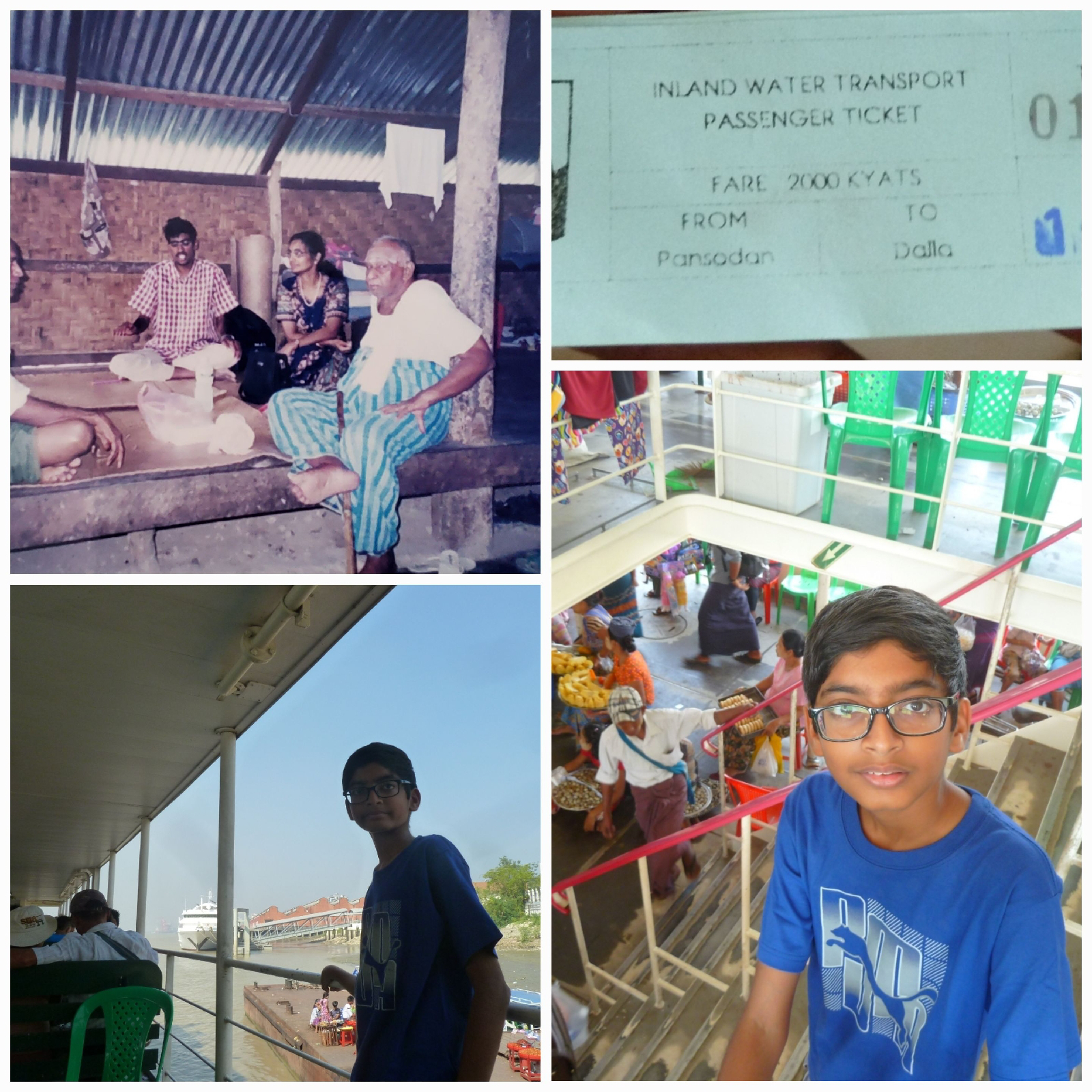
Dressed like locals we walked along the Strand and found the queue to buy ferry tickets to cross the river. The first time we wet the uncle accompanied us, spoke in Myanmese and got us local tickets. We had to play dumb so that we did not give away the fact that we were foreigners and end up paying exorbitant fares. We boarded the ferry and went to the upper deck where we found the typical low plastic stools on which to sit sheltered by our umbrellas. 
On a subsequent trip(2016) we went on our own and got foreign tickets. This time we could go into a covered enclosure on the upper deck and sit on plastic chairs. We were not bothered by vendors. The other side of the river had a vibrant market and hence a colourful village. Walking down one of the back streets we came upon many indians some of whom spoke Tamil. Many of them were retired . One was looking after the temple and was active in a Tamil society. He invited us to his home where we met his wife. They had lots to say about the Hindu temple nearby since they were actively involved in it. We took leave of them and simply walked further to take in the village atmosphere, the houses with their fruit trees, vegetable gardens and poultry. 


Hospitality of a nanogenarian
An auto ride took us to a 90 year old who live on his own in his padi field. He did not keave the country futing the purge and we were familiar with some of his relatives. Anticipating our arrival he had prepared a typical sumptuous 3 course meal for us, on a wood burning stove, served on banana leaves. He had a Burmese family living in the premises to do his bidding and to till the fields. his relatives. He had cooked a three course meal for us on his wood burning stove and served us on banana leaves. We also had a plentiful helping of his daily routine. He had a Myanmese family working for him both in the house and in his fields.
Safety
Talking about safety, as we prepared to board the ferry we noticed a couple of soldiers supervising  three young men, chained to each other, also boarding. We were later told that the chained men could have been drug pushers. The military had its eyes everywhere. 

One of our acquaintances who took us on a walk along Mogul Street (now Shwe Bontha Street) carried diamonds in his shirt pocket. He traded in diamonds. Another friend walked around town with a huge bundle of notes. There was no danger of theft then (about 10 years ago).

In another of our visits we happened to see a borrower returning money to the lender. The bundles of notes came in sacks and the counting took the best part of the afternoon.

Knees-up Transport

We also tried taking the local buses. 10 years ago the seats were very close together, worse than budget seats in Asian flights. And you literally had to brace your legs against the front seat since the leg room was too narrow to plant your feet on the ground. 

Sharing the ride with market produce and fowl and quadrupeds
The Yangon Circle Line, the train, literally crawls 30 miles around the city and its suburbs and taking about 3 hours, passing through what feels like a whole echelon of Yangon society. Again foreigners pay more. Beside us sat people from all kinds of trades carrying their wares in baskets to be balanced on their heads. Some were bringing livestock to the market. We had chicken under our feet and even a goat. The odor of food from the snack vendor mingled with the odor of scented prayer flowers and the smell of animals. We didn't do the whole 30 mile loop. About half an hour was good enough to take us through the various neighbourhoods. Our sophisticated noses could tolerate so much.
Street life
The city is a  heaving jumble of dilapidated colonial buildings, hole in the wall shops, street markets,  noisy and congested alleys and streets, mosques, pagodas and roadside food stalls with their low tables and stools. 

To be continued in 6. Myanmar.


4. Myanmar: underlying compassion

Cont'd from 3. Myanmar

Keeping clear of riots
Then it was simply a long drive back home through teak forests and sugar cane fields. We must have made only one stop. Closer to Yangon we came across a village surrounded by sugar plantations. It was evening and the village folk were sitting on low stools at the palm-leaf roofed wooden tea stalls, enjoying the chai. What was noteworthy was they they were all dressed in Gujerati clothes, and spoke Gujerati. We could have been in India. Our driver did not encourage us to stop because he had heard that trouble was brewing in one of the other villages we would be passing by and he did not want us to be caught in the riots. So we literally sped through.

The final journey of an aunt
After a night's rest it was revealed that the uncle's wife's favourite aunt had passed on in Yangon while we were in Mandalay and that was one of the reasons we hastened back. So we went to the crematorium where the body. Many bodies, each laid out on a trolley and covered by an umbrella like mosquito net to keep flies away, filled up a large part of the covered shed. The aunt payed homage to the old hunched shrunken woman who would be cremated soon. There was a waiting line for the incinerator. We got back home and seven days afterwards a memorial feast was held.  Large amounts in mohinga noodles were cooked, under a makeshift marquee in the tiny backyard, for the continuous stream of relatives.

Yearly Monkhood
A two week monkhood, once a year, is encouraged for adults. The uncle has done it several times and he says the experience is humbling, and very good for anger management. As a monk you go out in the morning after payers, and walk down streets where almost every household reverently ladles food into the alms bowls which the monks carry back to the monastery and tip them all into a common pot. The food that is thus collected is doled out to every monk at 11:00 am, after which there is no other meal. Every household has an elaborate altar where the family's chosen monk arrives once every week to give his blessings and receive alms.
Safe distancing
Two of the uncle's daughters are University graduates. We asked to visit the University. It was now located a hour's drive from the city to prevent student agitation, like those at the time of the military coup. Most of the classrooms had long benches and desks. The teacher heard a blackboard. We met a Professor who spoke a smattering of English, dressed in a longyi, sporting stained teeth from chewing betel leaves. Secondary and tertiary education takes place at government schools. University comes directly after 10th grade. University buses pick up students from various pickup and drop off points in the city.

Vestiges of a glorious past
When Myanmar achieved independence in 1948 its schools were regarded as among the best in Asia, but over the next 50 years, being shut off from the world by the military junta, the quality of education declined. All said and done, the teacher is highly revered.
We also visited the repurposed (still dilapidated) school in Kanpai, once a very special boarding school for highly intelligent Indian students. Kanpai has a large Indian population, as evidenced by two well built and well maintained Hindu Temples. 

To be continued in 5.Myanmar.

Crossing the border at Niagara Falls

We are already in The US having crossed over from Niagara Falls, Canada, via the very short Rainbow Bridge. There are 29 passengers on board and we get off with all our luggage for customs and immigration clearance. The security check takes quite a while. There is only one scanner. But then there is a two hour stop for the train. We then step up to the immigration officers. Raji and the children show their ESTA and 10 year visa and they are almost immediately approved. But when it came to our passports which had the Iran visa on a whole page, they had their doubts. We had ESTA but according the rules if we had entered Iran after getting our ESTA, the visa was considered null and void. We had no idea since we had already been to Alaska after visitng Iran. The officers had to call up various departments in Washington to clarify matters and they were certain we couldn't enter US immediately. 
They asked us if we had an alternative plan. We didn't and simply said we'd return to Canada . But the return train was 8 hours from now. ( It seems Vasanth was at the Canadian end watching the train on American soil for nealy 2 hours. When the train pulled out he started for Cambridge not knowing what had happened to us).We had already seen a lot of the US and there was really no need to visit the country now. The boss was quick to point out that we were assuming we wouldn't be allowed in. Upon more queries we found out that we'd have to have visas no matter what because even if we transit in US we need a visa. Drink wil be flying from Washington and that would mean a visa was necessary. Besides most of the cruises we take either start or end in the US. We had to make a decision. The three were to go ahead. They had the printed Amtrak tickets and the connecting Greyhpound tickets. 10 mins were left before the train was scheduled to leave. The officers were still working on our visas and finally told us they cannot do it in time for the departure. So the three leave without us. 
The office and platform are clear of passengers. We cannot go onto the platform because it is US soil and we are foreigners without a valid visa. We sit in the office nonchalantly. All the years of travelling have prepared us to take everything in our stride and make the best of every moment. We are offered NY's best doughnuts and coffee. We split the humongous doughnut to share and the 'big' officer jokes with us that we had to eat one whole each so that we could be his size, and pulls out his flab jokingly to show us what Americans are all about! We sign a document prepared by the officer on our case stating that we were unaware of the new rules and thus the attempt to enter. After that we are finger printed and within 30 mins we have our single entry visa valid for 6 months. We apologise for the challenges we had posed them, to which they reply that we had made their day fly because they had work to do. It was not a boring day. On our part, we pipe up with, "If not for the hitch we would not be spending a day in US Niagara Falls. Yet another place to add to our travel diary." 
The boss, a young female, now walks us to the ticketing counter at the station and requests that our ticket be dated for the next day. Then she also asks him to call a cab for us. As an officer she was not allowed to call a cab on our behalf or even suggest hotels. But she did say the neigbourhood was unsafe and hence the cab. The cab driven by a Pakistani imigrant arrives in about 10 mins and we ask to be driven to a hotel. He asks if we wanted the Sheraton. We see Comfort Inn and say we'd go there. It is only a 5 mile ride but it costs us $10. We are able to secure a room, same price as yesterday's at Niagra Falls, but only for two queen beds. Breakfast is not included. The moment we enter the room we go on line to book Greyhound seats for our travel to Utica and thence to Springfield. 
All that done, and after some hot coffee, we decide to walk to the falls and we are met with a gorgeous view of both the falls. We are able to get up close to the Bridal Veil falls. It is getting dark and very chilly, and so we just walk the bridge to Goat island, don't have time to enjoy the park, and return. Then we walk to the view points for photos, We explore the town a little and then walke back to the hotel. The tall building opposite the museum houses sovenir shops and has a food court. We walk in to the aroma of all kinds of Asian food. It seems the casino attracts lots of Chinese. It feels and smells like we are back in Singapore. 
The town is planned for massive crowds. It has all the attractions that the Canadian side has , but is well spaced out and therefore the town looked deserted despite it being Halloween. There is no grocery store in this part of town but the reception tells us there is a 7/11 nearby. We try to find our way there, but get a little confused by differing ideas of direction. We were just passing by the Sheraton that looked gloomy on the outside and pathetically deserted in the lobby. The receptionist will surely be able to give us directions. We are going the right way. We manage to find the store  and order a $5 pizza. It is ready within 20 mins, well packed in a cardboard box. It is piping hot and we want to reach our room before it gets cold. It is acceptably warm when we are ready to eat it, and the we find we couldn't eat it all. We would have enough left over for breakfast. That was it for the day. 

Raji and the children had been picked up by Thenu at Springfield. In the morning we finished the pizza , washed it down with coffee and then decide to walk to the station. After all I have only a back pack and Drink, a cabin bag. So we started at 10 am and walked the almost straight route to the station. Every now and then we had to share the carrying of the cabin bag. My Ikea back pack was an excellent buy. It has served me very well. No backaches and strained arms. We are nearly there and we wonder if we have a turn to make. An African American lady showed us when to to take a right. But we were not convinced and a few minutes laters asked a couple of gentlmen. By then we were very close to the station. We had walked five miles in slightly more than an hour (in all that time we only met three people on our route).  The train was to leave at 12:30 and we were ther by 11:30. The seats are comfortable. The overhead shelves have lots of space, even for huge bags. The conductor checks our ticket and puts a marker at our seat with the initial of our destination.

Harbouring hopes at The Harbour Le Havre is the port closest to Paris, sitting on the English Channel – at the estuary of the river Seine –w...

Follow by Email