Showing posts with label murals. Show all posts

Hanoi: exquisite artistic atmosphere

Immersive storytelling

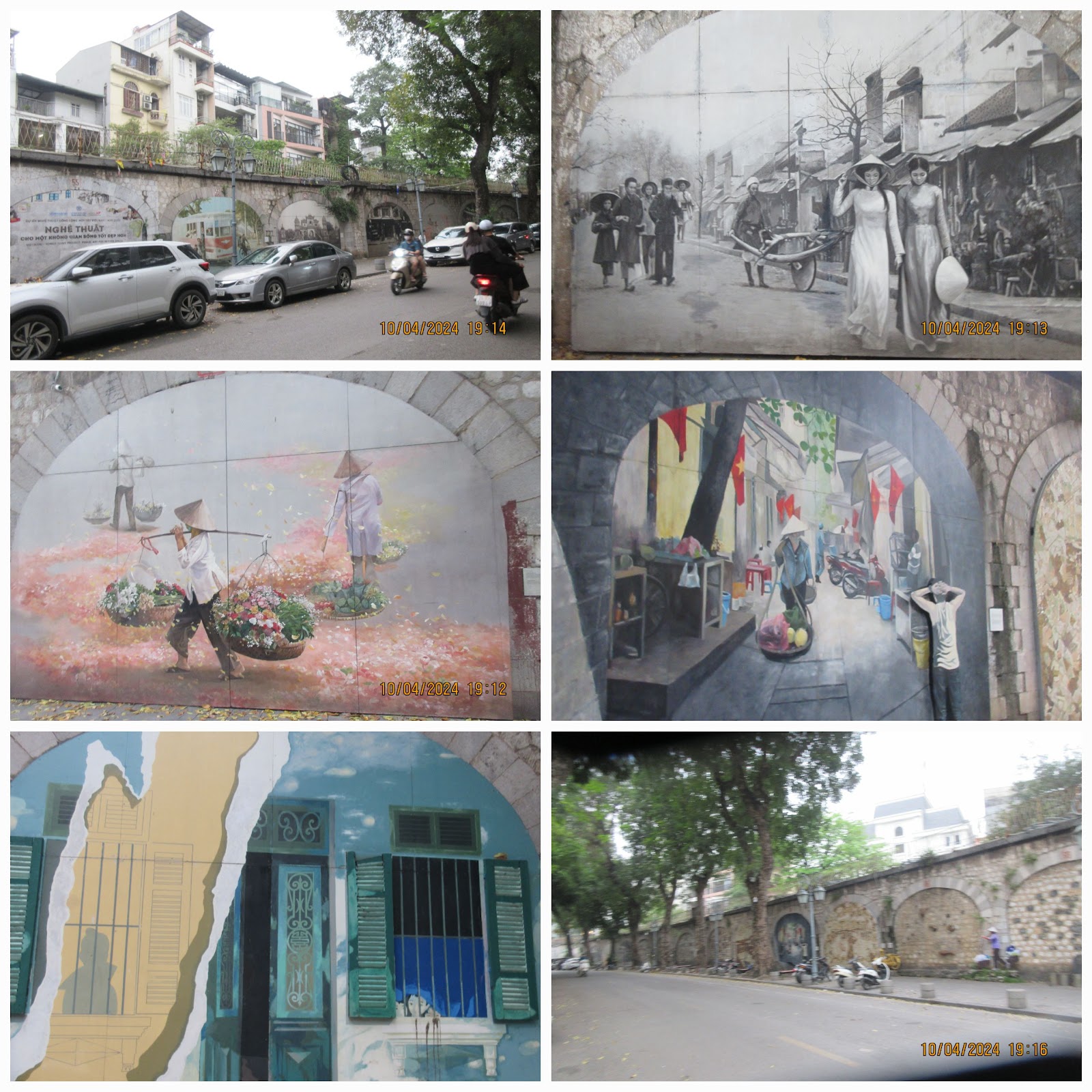
Just a day after our arrival, after having visited the touristy Ngoc Son Temple on  Hoan Kiem lake, I notice that we seemed to be close to Mural Street. A street dedicated to murals definitely needs exploration. Could it be something like in Sao Paulo? Drink isn't interested. Consulting Google maps, while still connected to the local wifi, I work out the route, commiting names and directions to memory. With very slight confusion, only because I wasn't quite familiar with the area, I almost walk past the first few murals simply because I don't know where to look. It takes me a while to realize the paintings are so realistic that they blend seamlessly into the life around them . A closer look reveals the wood canvas on which artists depicted scenes from history, local folklore,and daily life. Everyday aspects stand out in vibrant colours and in three-D for they also include structural elements that pop out. It's as though the artists have woven a tapestry showcasing the cultural heritage of the historic city. 

While strolling back ‘home’ I noticed locals playing traditional board games. The storytelling theme becomes as vivid as it can because anyone can join the locals and learn to play these games immersing themselves into the culture. 
Missing the obvious: a daunting venture

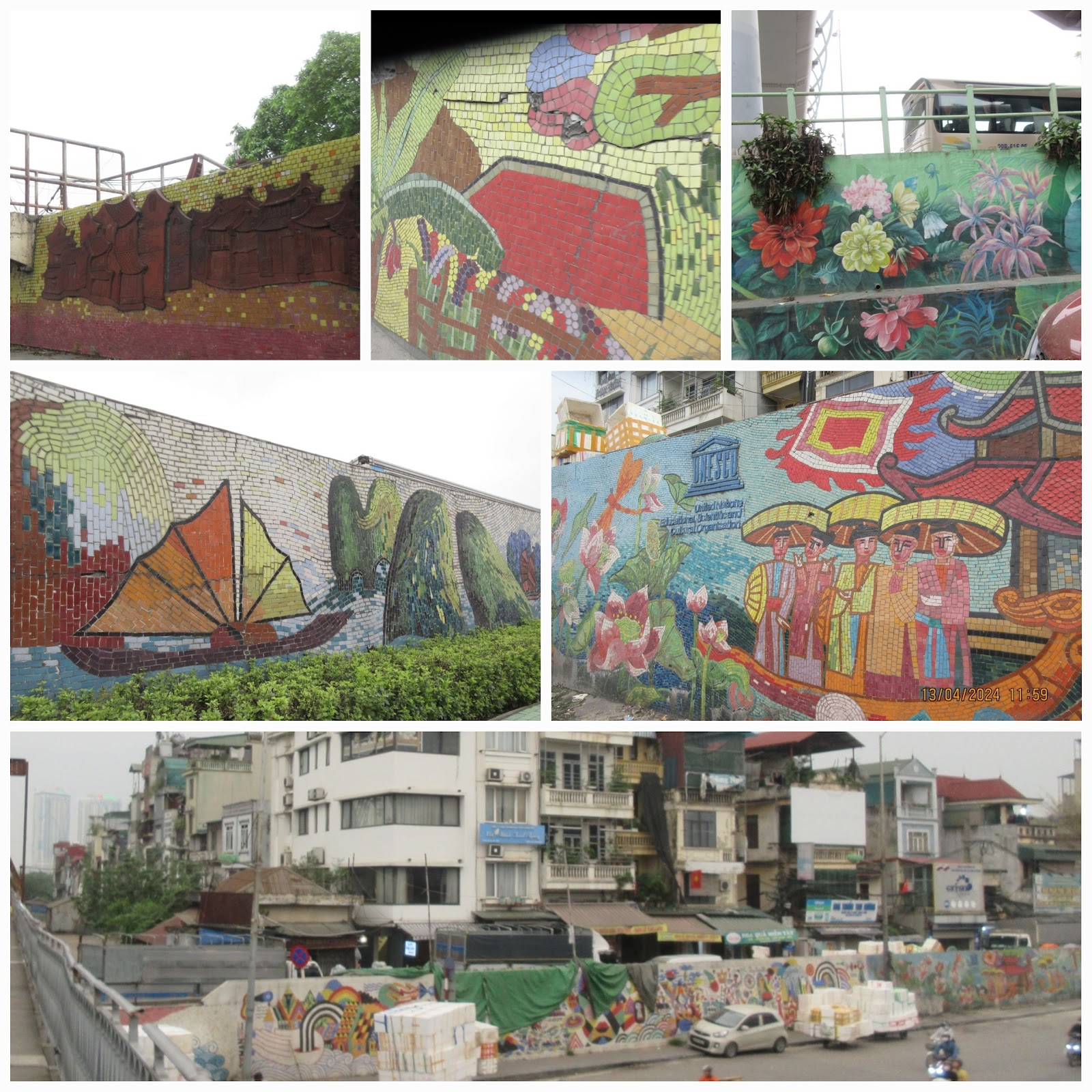
Having heard of the Ceramic Murals we decide it is time to look for them. You can’t miss them on the drive from the airport into Hanoi, but we did. 

We walk into the city centre for the map indicated that it began somewhere there.We have to ask at a boutique whose sales-girls kindly show us the way. It is quite complicated but we do find the murals on the other side of the highway confronting us. At the intersection where a ramp meets the highway  we have a few nerve wracking moments figuring out how to get as close as possible to the said murals without getting into an accident for we are actually on a highway with motorbikes, cars and trucks  bumper to bumper, whizzing by and impatiently honking at each other.

We decide not to cross it and it's a good thing too for these murals are better appreciated from a distance. We walk along the narrow uneven curb performing a dangerous balancing act every now and then. There is no visible end to the Ceramic Murals. 

Is there a way to get off the highway? We find a small break in the curb, with rough stones set down like stairs on the downward slope. Hoping they were steady we manage to wobble down onto the side road. This is probably an improvised shortcut created by impatient locals living across the highway. It serves us well.

Surprise at our doorstep 

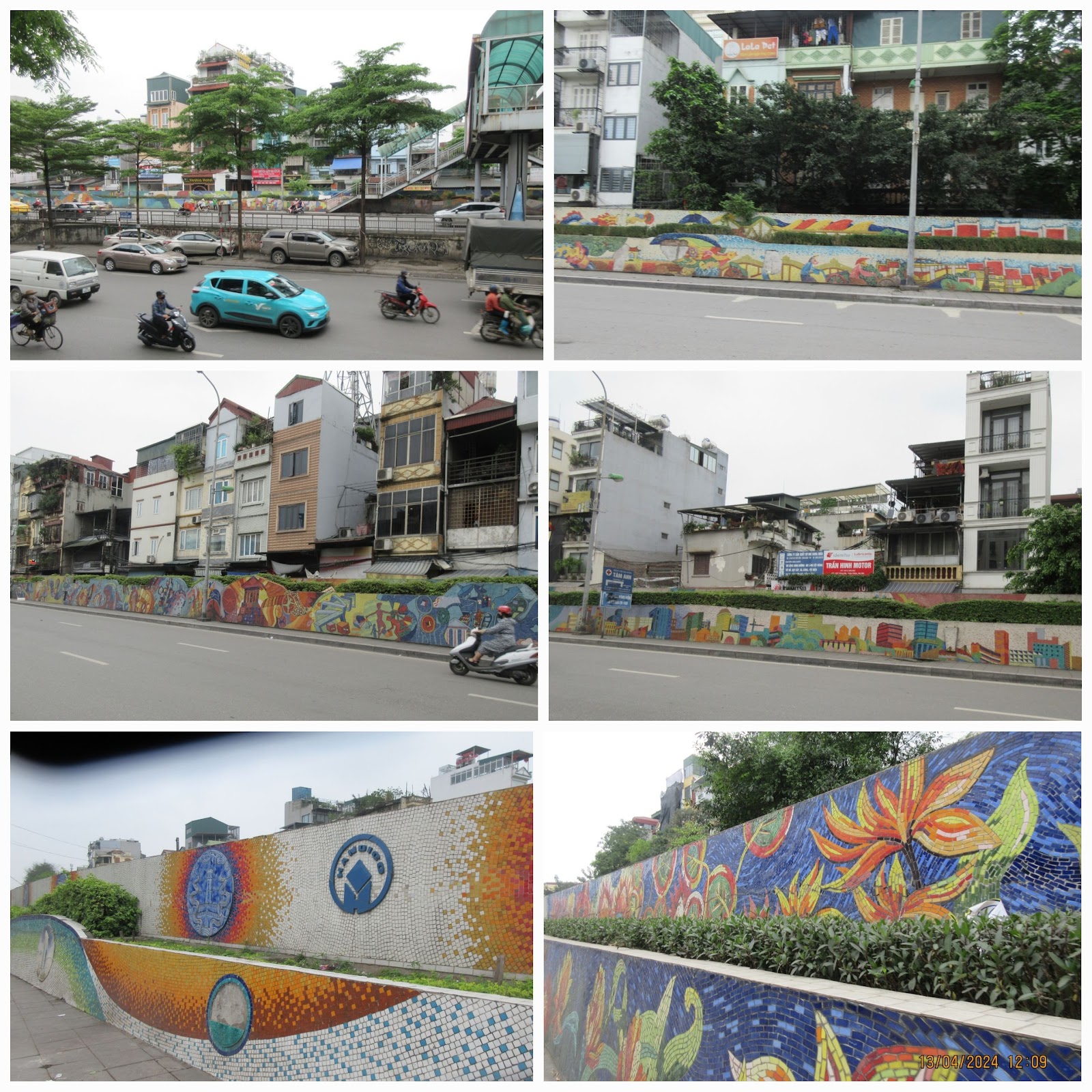
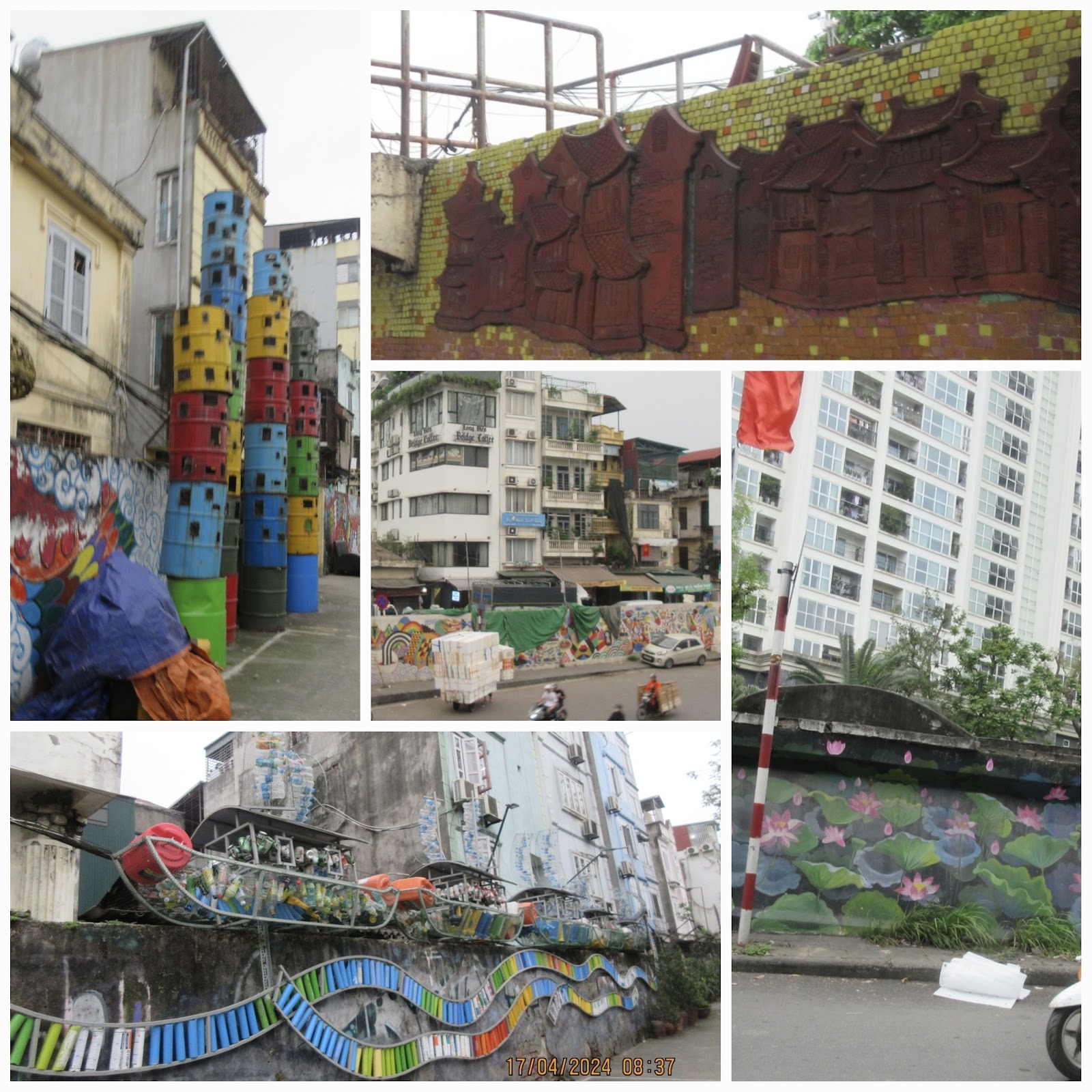
We think  we should call it a day. Since we are now more familiar with the terrain we are able to find our way back home easily. And then we see more of these murals! The wall is actually part of the Red River dike system protecting the historic centre. To our surprise our accommodation is on the other side of the wall. Had we started from here it would have been a little easier and  we would have walked right beside the murals all the way to the city centre. But there would  be no escaping the traffic conundrum.

The next day we take up where we left off and continue to walk along the murals which takes us towards the Long Bien market ( described in a previous blog) and thence under the famous Long Bien bridge. 

A spectrum

The murals  cover nearly a 7 km stretch of which we did nearly 5. When we identify cultural icons from various countries it becomes clear that this long stretch of murals is no ordinary feat. The Hanoi mosaics not only  show different periods of Vietnamese history and  iconic scenes, but also tributes from other countries with their unique designs. 

Is it any wonder then that the mega pictorialisation created to celebrate Hanoi’s millennium anniversary in 2021, has earned it the Guinness World Record for the largest ceramic mosaic?  
 

Inextricably intertwined: art and culture and religion 

The mosaics continue with us as we walk towards West Lake, the biggest freshwater lake in Hanoi. As we approach it we are surrounded by posh restaurants and hotels interspersed with lush gardens and opulent villas. But the Tran Quoc pagoda nestled on an  islet charms us no end.

Founded in the 6th century it was relocated in the 17th century to escape the silt of the Red River. Renamed asTran Quoc (National Defense), it has evolved into a symbol of resilience and spiritual continuity. In its garden stands a Bodhi tree( a gift from India), said to be a descendant of the tree under which Buddha attained enlightenment. The garden also houses several towers and aesthetically designed stupas. The red 11-story stupa and the yellow facade as well as the bonsai dioramas add a quiet beauty to the spiritual serenity. 

Eiffel in Hanoi

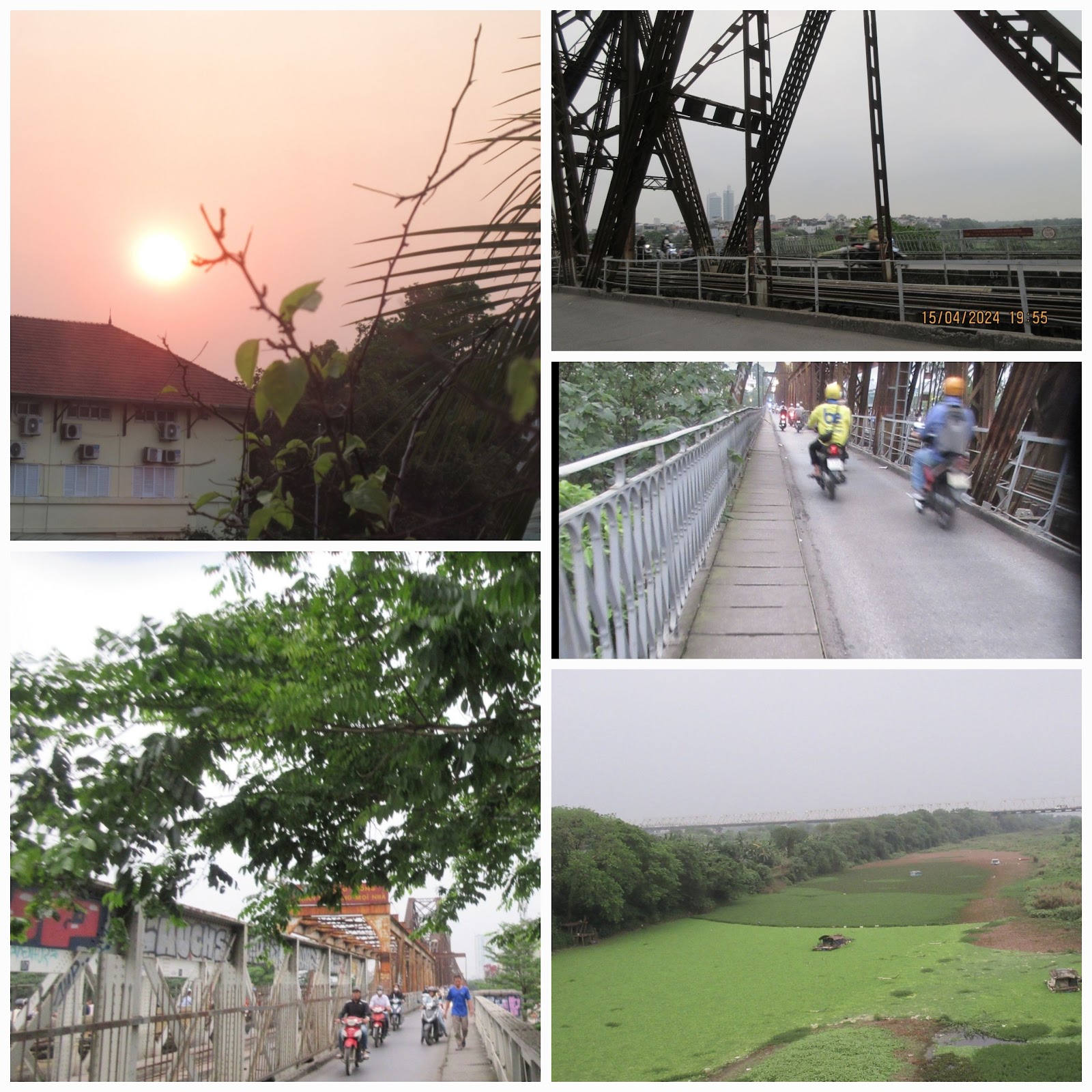
Yes, Long Bien Bridge was  originally built by Gustav Eiffel, the very man  famed for the Eiffel Tower and the Statue of Liberty. The cantilevered bridge was once the longest bridge in Asia. It was bombed during the Vietnam War and then restored. We find a stairway that leads from the ceramic murals to the railway station after the bridge  bridge. Since the sun is about to set and the day has cooled down we decide to walk along the bridge which has lanes only for bikes and pedestrians. 

Though rickety at places we walk the half of the 2km bridge from where we have views of the red river mud flats. It's like another tapestry but of lush vegetation both floating and otherwise, interjected by a boat or two making watery tracks on a green surface. The banks are again a tapestry of vegetable gardens. The lanes on the bank sport artististic sculptures from recycled plastic bottles and incense burning drums. Walls are covered with murals depicting lily or lotus ponds.
As luck would have it

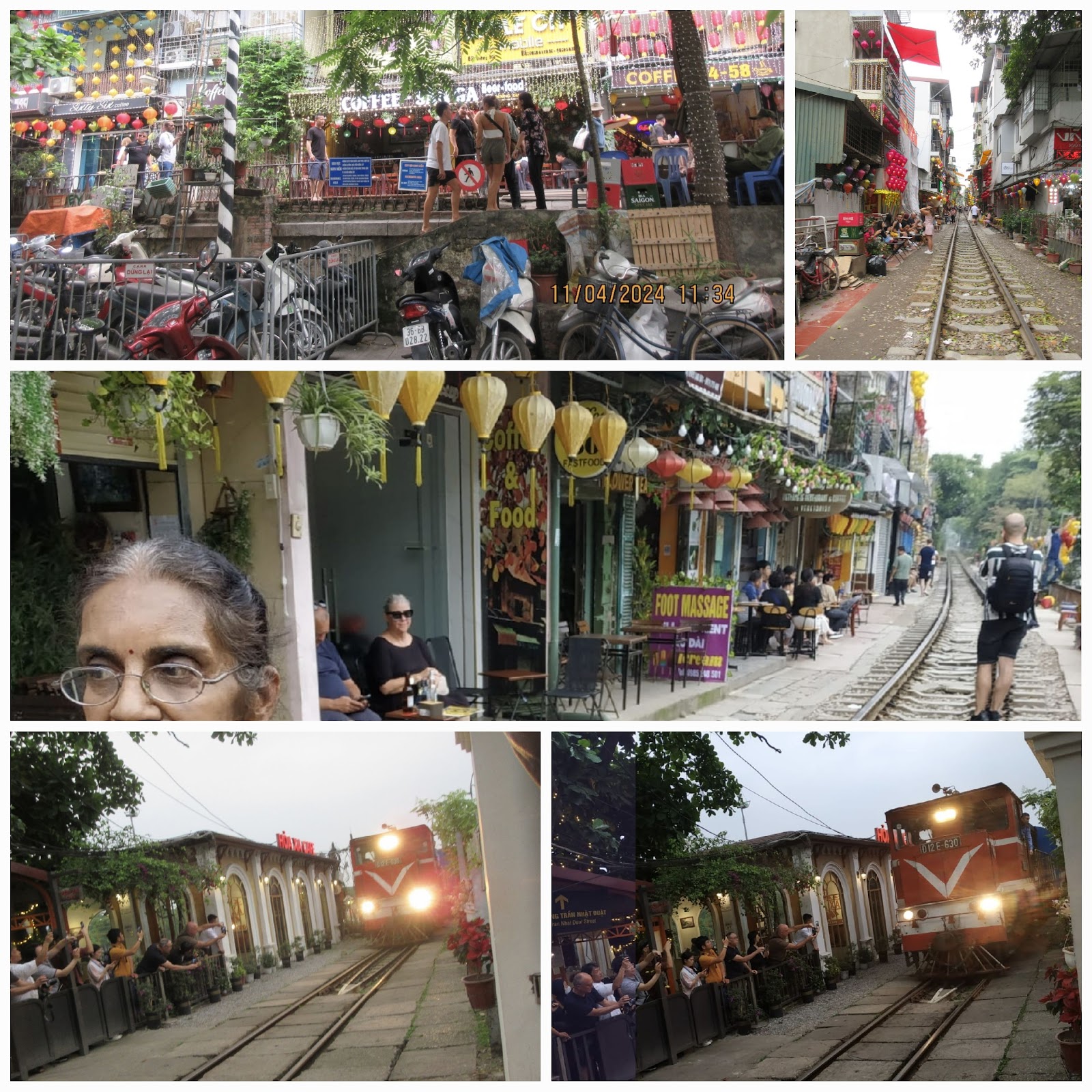
As we return to the railway station we see a crowd. It is getting dark and most are staying put. We hang around for a while and when we decide to move off, the tracks begin to vibrate. There is a gust of wind. The anxious wait of nearly 10 min is worth every minute. We are actually going to see the train that will chug past us into the tracks that lie between restaurants and pubs adorned with attractive graffiti, just two steps away from the tracks. Another surprise: the tracks go along the top of the wall that is famous for its murals and continue on a raised track into the old quarter shopping area.  We've been to the places before but were completely unaware of the proximity of the tracks.

Aesthetics every which way

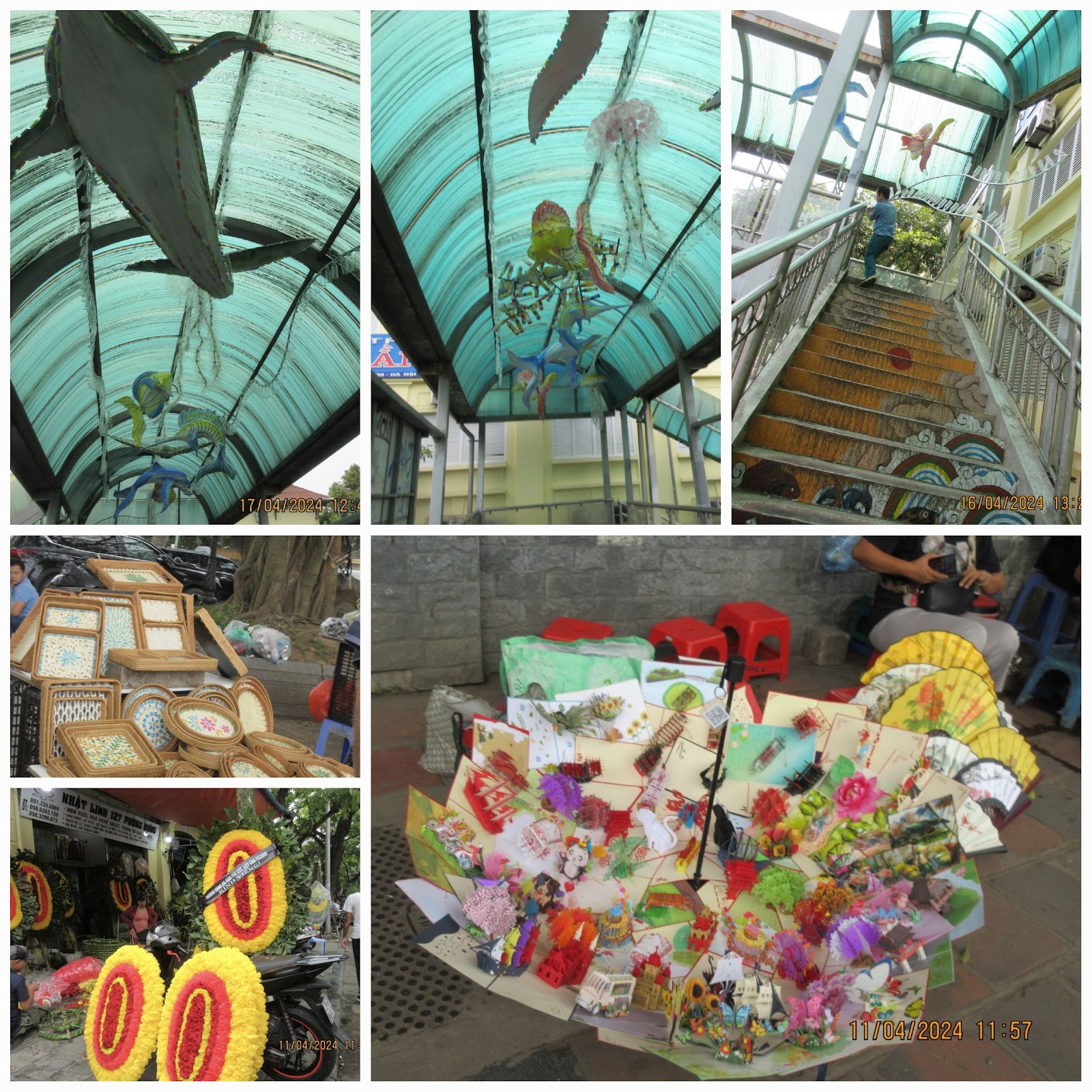
Everyday street art abounds from the way vendors arrange their goods on carts, the intricately embroidered dainty baskets to the flower bouquets and wreaths. Pop up cards  of iconic Vietnamese buildings and mythical creatures are sold as souvenirs.

One day we noticed sea creatures made of recycled plastic bottles sitting on the pedestrian bridge over the 6 lane thoroughfare that we cross everyday to get to the old quarter.  The next day the collection increased with more of these animals and waveforms. By evening they were hung up and being wired. We left the day after but now I know that a group of artists had transformed the bridge into a vibrant,  buoyantly delightful, illuminated work of art in the evening.
We chose well

We hadn't realised we were just across the old quarter when we booked our airbnb.Historic landmarks, cultural delights,  tourist sites quite central, fairly walkable, old quarter, French quarter.


A jewel in the Pacific: Valparaiso lives up to its sobriquet

First impressions 
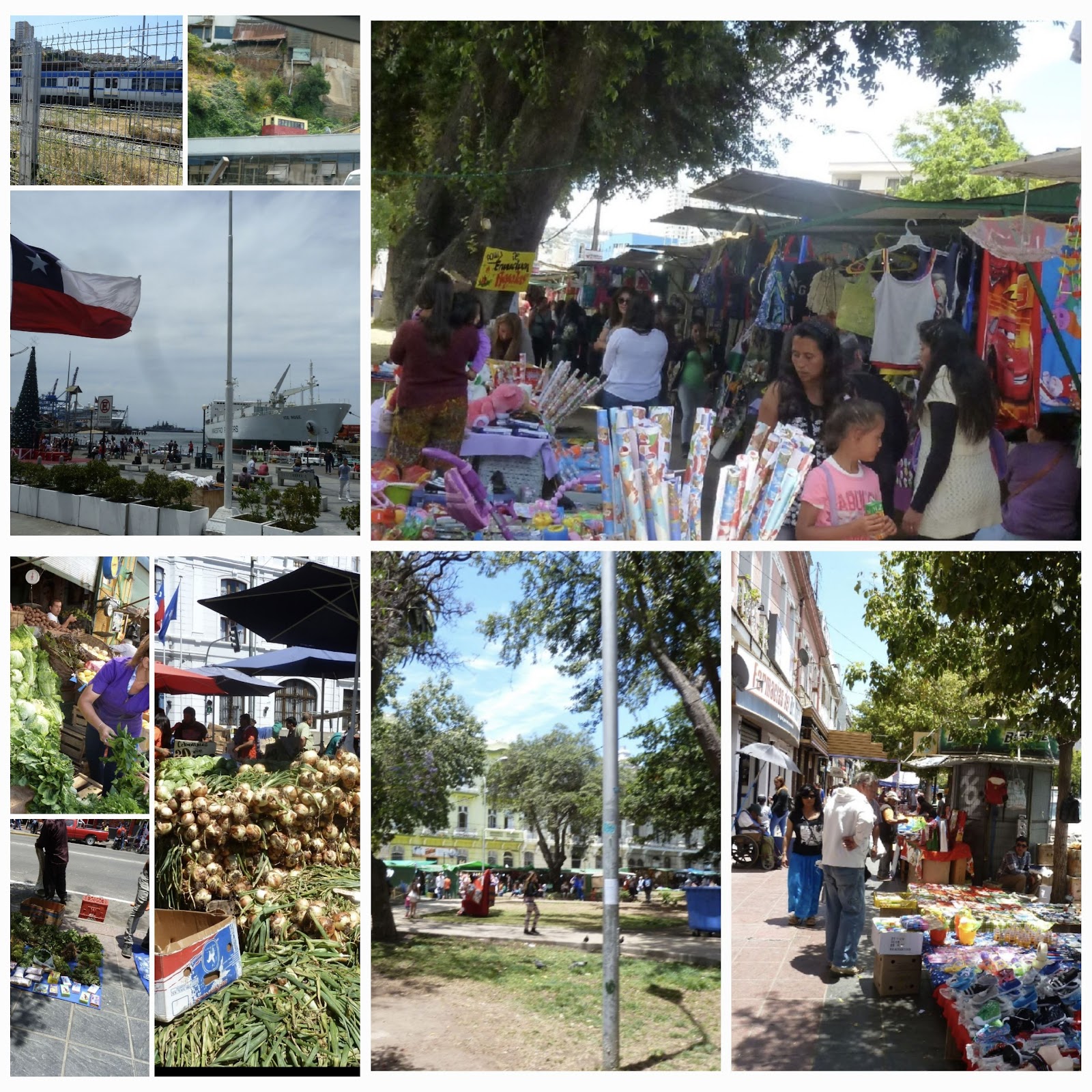
Dilapidated, gritty, littered and unfriendly. A street parallel to the railway track is lined with shop houses filled with vegetables of all sorts that spill out their contents on to the street. Some vegetables lie rotting in corners while others are withering under the hot December sun. But that impression of a rough-and-tumble  town quickly  shifts. As we approach the city centre we see imposing buildings as well as dignified ruins. We are on Plaza Sotomayor proudly dominated by a blue toned majestic Edifico Armada de Chile. To our surprise the plaza lies on reclaimed land! 

Full of exploratory promise
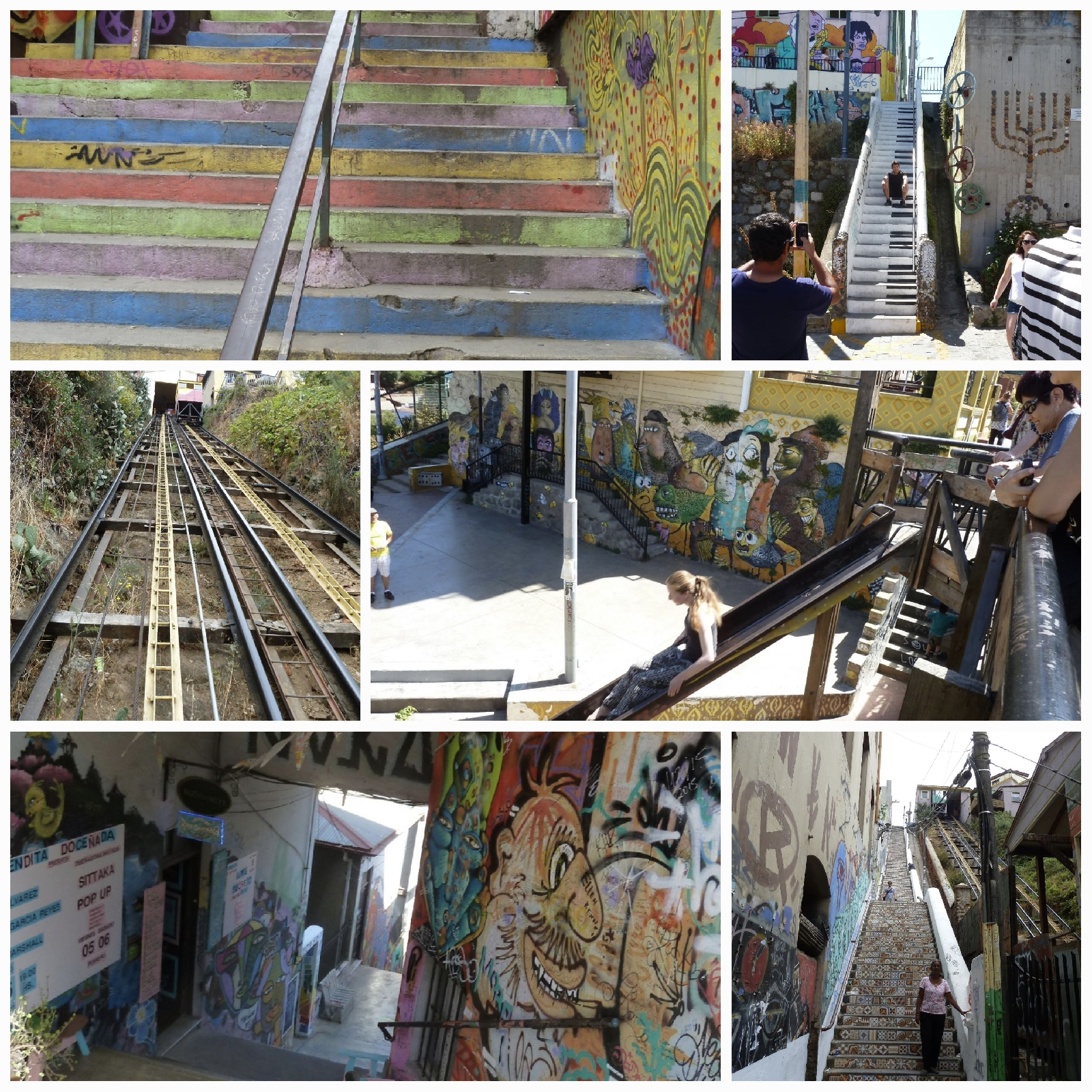
Our first visit is just before Christmas. The streets and the plaza are filled with colourful stalls plying just about everything you can't get in regular stores. The plaza is close to the port which is a hive of activity. A good place for people watching. The rest of the city is on the terraced hill slopes ascended through either stairs or funiculars. There are about 42 hills with 16 ascensors hugging the hillsides. If you look at  map of the city you'll notice that the city area hugging the coast is well laid out in a grid. Extending from the grid towards the interior the roads go higgledy-piggledy following the contours of the hills.
Heeding the warnings
The staircases are so colourful that the temptation is to climb them but the sheer incline on a hot day is enough to squash such a desire. We have been warned of pickpockets and robbery. We carry nothing valuable with us. Yet we decide to play safe, especially in areas that look sketchy. So we attempt the steps up to a alley. The climb reveals  brightly coloured houses on either side. Surely, as we climb higher we would be treated to great views over the port?

Testing the waters of a once great port
The best thing to do would be to get oriented to the city first. What better way than to join the free walking tour of the UNESCO world heritage site.( Almost every city has a set of guides and a couple of itineraries with different timings, starting points, durations and routes. The guide earns only the tip, in USD. ). We take the 10 am tour from Plaza Sotomayor. 8 more tourists have joined us.Our guide enthusiastically tells us briefly about the history of the  monument in the plaza before walking us to the port to learn about the origins of this fascinating Chilean city.  Before the Suez Canal opened, Valparaiso was the largest port along the Chilian coast. The buildings at sea level and the various mansions are testimony to Valparaiso’s  heydays. The palm trees are a gift from Brazil. The arch near the port was built by the British. What was Latin America’s first stock exchange stands near the plaza. 

Rickety but cheap, swift, rewarding
We walk to the El Peral ascensior that dates back to 1901. For 100 pesos each the tatty, time-worn, creaky contraption whisks ( within a minute) us 55m up to the summit of Cerro Alegre aka  “Happy Hill.”  As we saunter through Paseo Yugoslav lined with luxury hotels,  innumerable zig-zagging staircases, churches and houses our senses are overwhelmed. The vibes certainly match the nickname for the hill.  The eccentricity of the architecture, colour and paintings impart an energy that is all embracing. There's even a boardwalk, a look-out point, that grants us a bird's eye view of the city.  

Funky
We are nothing but intrigued when we come to the foot of the truly 'illustrious' rainbow staircase and the piano staircase. Looking for an alternative method to walk downstairs? The city has thought of that too. The boardwalk at Ascensor Reina Victoria includes a slide that can facilitate a descent to the lower level!   

Feed yourself, but that stray dog?
We stop at a dive-in for its famous empanadas, assembled and quickly fried while you wait. There are only a few stools and hence it's more like a take-away. Apparently the pastries were delicious and people went back for more.
One of the tourists was going to feed a stray dog. If you have read my blog on La Serena you'd be familiar about the increasing population of street dogs in Chile and how loyal and gentle they are towards common folk. Hence the interjection from our guide, " If you feed this dog he might follow you all the way to your home wherever in the world it might be"  did not seem far-fetched.

The  tour  walks us through more picturesque streets embellished with street art and bright murals with a generous sprinkling of alcoves and recesses that display the for-sale-works of artsy residents, as well as galleries, hotels and cafes.  We reach the Baburizza Palace resplendant with Alpine balconies and turrets, once a Croatian businessman's mansion, now a museum.  

AirBnB accommodation
To our great delight our rental apartment overlooks an ascensor. We can hear it trundle up and down. From the balcony we see the busy port and the modern part of the city.  We have already bought our groceries and so we enjoy a home cooked meal with a view. 

Vanishing egg  vendor
When we go out in the morning we see a young woman selling eggs. Perhaps she would sell us a few eggs which is all we need. The eggs seem unusually heavy.  She bundles a few for us while we pay her. She is looking around furtively. The moment we finish the transaction she folds up her 'shop' and disappears. She is unlicensed. She had observed a policeman from the corner of her eye
Revelation: burrowing through warrens
With the eggs( they were actually hardboiled) safely back in the apartment we leave to explore the rest of the city. Now we dare the sketchy areas. We climb up broken or unfinished staircases, take the windy roads and are practically lost in a maze of terraces, curved staircases, alleys, slithery sandy slopes and shored up hill sides and precariously propped buildings. As long as we can glimpse the sea we'll find our way back.We understand now that landslides and earthquakes are a reason why everything seems so shabby. However there are colourfully  painted mansions and murals here and there enough to indicate that the area had been vibrant before decaying or that its recovering.

Information and awareness 
As we pant up one of the hills we discover a park, and across it, lo and behold, it's La Sebastiana. That's when I got to know about the Nobelist, Pablo Neruda. My experience there with fake pesos I have recorded in my blog entitled Chile Chicanery. The ship-shaped 5 storeyed home is furnished with eccentricities from foreign adventures. Every window has a view over the city.


Poignant point.
Every city must have a cemetry. Where is Valparaiso's?  Could you have guessed, unless you've been to Recoletta cemetry  in Buenos Aires?

Adventure
The next day we take the bus to Vina Del Mar. The adventurous episode is described in yet another blog.

On our return from Vina del mar we decided to spend the evening at the port. We're in for a treat.  Long lines form for tourist boats. The pier is alive with culinary delights, art and craft booths and performers. Just as people are enjoying the promenade, the gulls and pelicans are looking to enjoy the tidbits tossed at them.

Valparaiso  is breathtaking, in all senses, provocative, mesmerising and amazing.
Grafitti vs murals? Struggle vs celebration? Colour vs drabness? Indomitable spirit?  

Definitely a jewel of the Pacific.


Ljubljana, Slovenia: medieval and modern charm

Jubilantly at Lyoo-blyah-nah ( that is how it is pronounced) On our way from Opatija, Croatia, to Maribor, Slovenia, we stop by Slovenia...

Follow by Email