Showing posts with label history. Show all posts

Acropolis,Athens, Greece: History and Myth

We approach the foot of the rocky hill of pinkish bluish marble veined in red. The gentle slope takes us up towards the 3,300 year old citadel that variously served as a fortress,a shrine and a centre of political power. The place that reflects the ideas, art, and culture of the society that shaped world philosophy is breathtaking in more ways than one.

No match for a tortoise 

Physically the walk is steep and demanding as the morning heat intensifies. To our amusement, we find a tortoise climbing alongside us, retreating into its shell or into the cooler spaces under rocks every now and then. The grandchildren try to ‘keep up with it’ but after a few minutes they lose patience!Apparently the species thrives in the Mediterranean environment and sofrequently spotted living and wandering freely among the ruins of the Acropolis and its slopes, as well as nearby areas like the Acropolis Museum. 

Enthroned for a spectacle 

We emerge from distraction and lift our gaze—only to be met by ruins of staggering magnitude. Before us unfolds the unmistakable form of a theatre: rising tiers carved into the rock. Closest to the stage, throne-like seats stand in solemn dignity, once reserved for figures of great import—the honored, the powerful, perhaps even the Priest of Dionysus himself.

As we climb higher, the view expands into something almost overwhelming. The full sweep of the structure reveals itself, vast and commanding, a testament to a civilization that was built not merely for function, but for awe. From this lofty vantage, we can almost hear the echoes—voices that once carried tragedy, laughter, and biting satire into the open air, filling the immense space with the pulse of human drama.


Marble seating, a façade of looping stone: the world’s first theatre

Before us stands a grand structure on the slopes of the Acropolis, both imposing and ethereal. A vast wall with sweeping arches stretches across multiple tiers, more like portals than windows.

This is the Odeon of Herodes Atticus—an ancient theatre that once held 5,000 people and still hosts performances today. Dedicated to Dionysus, the god of theatre and ecstasy, it has echoed with human emotion for centuries.

Marble seats cascade in worn, graceful rows, tracing the theatre’s early origins. The façade once rose in three levels of arches. Now, only two remain.

It’s easy to imagine its former glory—a cedar roof overhead, statues in the arched niches, and audiences alive with anticipation. Even in ruin, the Odeon feels timeless—an enduring monument to art, gathering, and wonder.

An ascent into the ethereal: Propylaea

Our climb leads to a grand staircase and the monumental gateway beyond—a vast hall framed by elegant porticos and rows of slender columns beneath a lofty ceiling.

These columns, though delicate in appearance, carry the weight of the marble roof while keeping the passage open — an elegant balance of strength and grace.

Above, imagine marble slabs painted deep blue and studded with stars. Sunlight filtering through would cast a radiant glow, blurring the line between earth and sky—as if standing beneath a celestial vault of stone.

More than an entrance 

The awe-inspiring Propylaea has housed various occupants over its 2,000-year history. It served as a Byzantine bishop’s palace, a Frankish noble’s residence, and later an Ottoman governor’s home—testament to its enduring architectural significance. At one point, it was even used as a gunpowder store, leading to a destructive explosion.

The crown jewel: Parthenon

Built as a temple-treasury to celebrate victory in the Greco-Persian War, 200years later became a church, then, after another 900 years,an Ottoman mosque.

From afar, the columns appear perfectly straight and uniform—but up close, subtle variations reveal deliberate refinements to correct optical illusions.

https://www.history.com/articles/parthenon-acropolis-ancient-greece-engineering

Destruction, removal and preservation

All it took was a single blast that changed the fate of one of history’s greatest monuments.

During a fierce battle, the gunpowder store near the entrance gate ignited, unleashing an explosion that tore through the Parthenon.  Large sections of the structure collapsed, along with priceless sculptures that once celebrated the artistic and cultural golden age of ancient Athens.

What survived tells only part of the story. Some of these remaining masterpieces now reside in the British Museum, where they are known as the Elgin Marbles. Others remain closer to home, preserved and displayed in the Acropolis Museum—fragments of a legacy that once stood whole.

And then the Cariyatids beckon

A familiar porch, the Porch of the Caryatids, appears in our periphery. Six towering female figures, graceful and resolute, hold the weight of the structure.  Their elegance  blurs the line between sculpture and architecture.  We are actually admiring the replicas while the originals are at the museum. 

On closer inspection we realise that the temple is made of 3 parts each dedicated to  Athena Polias , Poseidon, and the founder Erechtheus( a legendary king) respectively.

A trace of myth colours the history: a hole in the rock roof is said to have been made by Poseidon's trident and Athena's olive tree  during  their dispute for the patronage of the city.

Nike, here we come

A lone structure distant from all the others in the acropolis stands out.  Four monolithic columns grace both the front and rear facades, while the sides remain open to showcase the inner cella.

A strategic location: The sanctuary served as a protective force, guarding the entrance to the Acropolis thereby defending the city as well as ensuring the favour of the gods. On the parapet, there would have been a marble statue of a wingless Nike (adjusting her sandal, and clothes slipping off her shoulder) which is now in the museum


As we walk down the hill checking out cordoned parts of the ruins we help but be dumbfounded by the sheer scale and history of the monuments. The Hercules pillar stands alone. There must be a story behind it!

Lerwick,Shetland Islands: loch, broch and pony

The anticipation

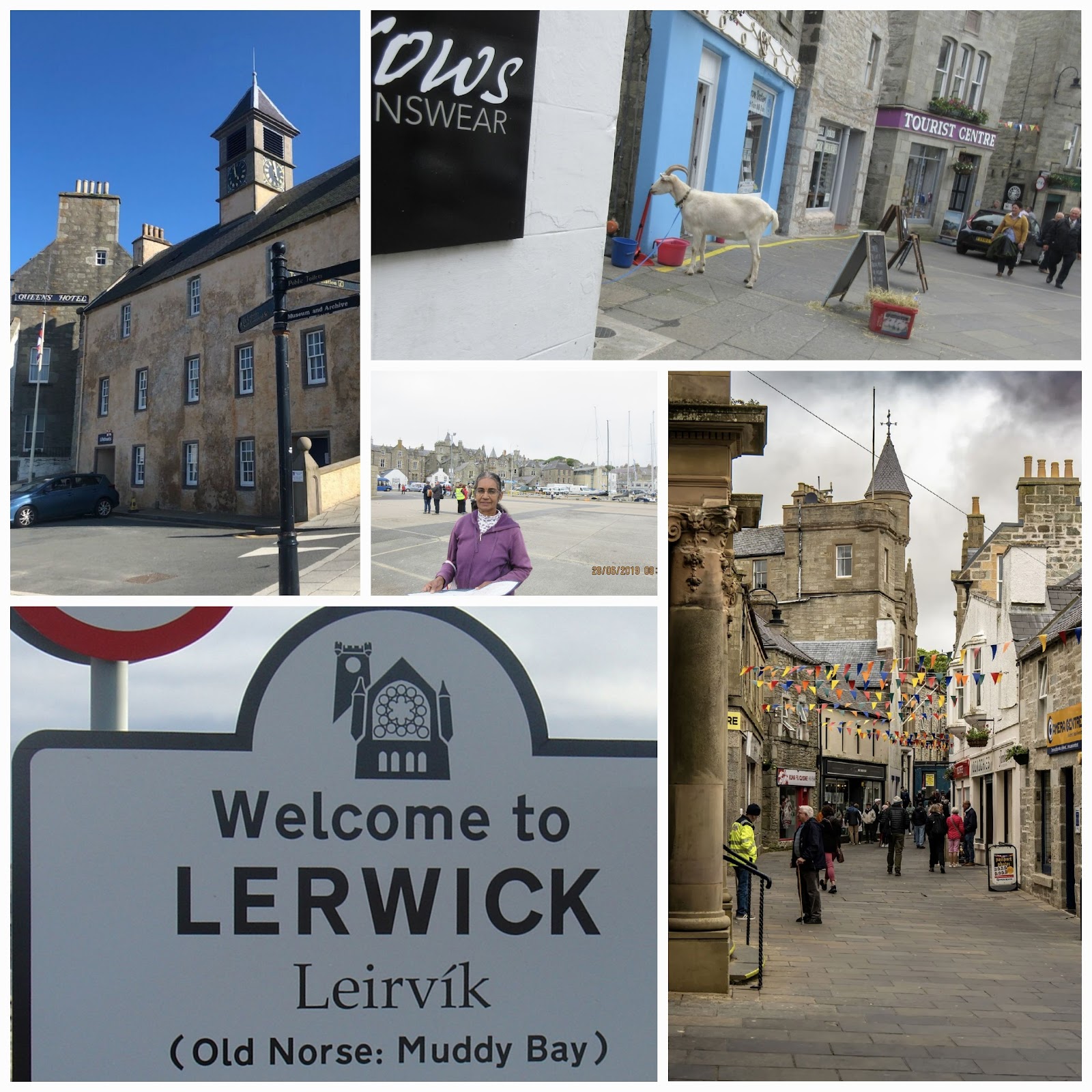
As we approach the harbour it is clear that we are going to experience yet another beautiful undulating island with rolling hills and stone and mortar buildings. What has this island in store for us?  We are at Lerwick, the capital of Shetland Islands, Scotland, about 200 km from the mainland.

Reality

As soon as we disembark it is obvious that we are on Commercial street. The flagstoned street is lined with craft shops and cafés, strung with bunting.  Will the rest of Lerwick be as charming?

Gladdened: poetic justice

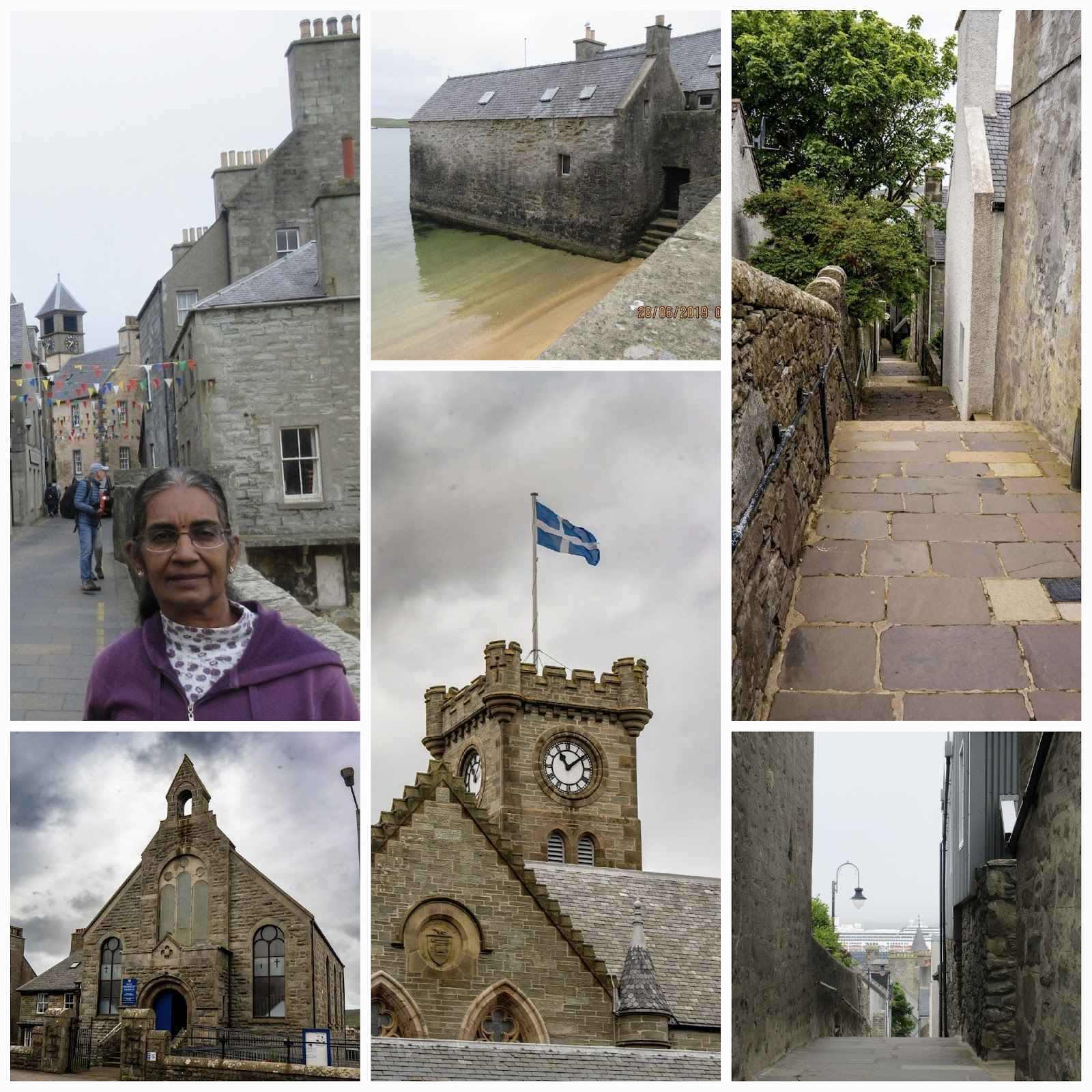
We decide to take the winding, flagstone paved, commercial street lined with enchanting ancient buildings paralleling the sea front for the undulations naturally imitate the gentle waves of the sea. The series of narrow lanes, appropriately called closes, leads us through the old town with 18th and 19th century buildings huddled together tightly. 

Acclimatised accommodation: clustered and cloistered

Adding to the charm is the crookedness of the buildings and their erratic positions. Even the streets have different widths and slopes along the same stretch. Well, Lerwick is known for windiness. I was told by the librarian that the wind takes on various characters and blows unpredictably every which way with varying intensity. Hence the  robust buildings and  doors placed strategically in narrow sheltered lanes to avoid the direct path of the wind and give respite from the sea. Wouldn't living in clusters create a close community with a strong identity? There's  no denying that the character of the wind has bestowed a quaint touch to the old town.

Denotation Enigma

Compounding the enchantment are the alleys ( da lanes) which have baffling names, as well as an alternative name. In actuality, the street signs display both the old and new names for the streets and alleys.

The postmen must be well versed in them. Makes me wonder if there's a system to their sorting, if not technical, or they are as good as the London taxi driver. Perhaps their knowledge of local history is excellent, for the clue to the quirkiness is to be found in the history of the islands.

Amusing Chronicles

In the 17th century Lerwick was initially established as a seaport to trade fish with the Dutch Fishing Fleet. This original  settlement was largely a collection of timber huts. Then it was mortgaged by Denmark to Scotland! In the mid seventeenth century a military outpost was established, Fort Charlotte and around it the first stone buildings constructed. In the 19th century the Police Commissioners voted to modernise the names.

Betty Mann's Closs became Crooked Lane. 

Leather Lane became Union street. 

Sheriff's Closs became Law Lane. 

Steep Closs became Hang Cliff Lane.

Yet another wonder: beach between Lodberries

At the end of Commercial Street (Da Lane) we are met with a small tidy beach flanked by old stone houses standing on the sea. These  lodberries are stone merchant houses built on the seafront by merchants in the 18th century. They reach into the water with their jetties over the shingle beach. This made it easy for their haul to be dropped straight from the boats into dry storage.

Loot to boot

The Lodberries also had another underground function. They were often used to smuggle tea, tobacco, and other goods onto the island. The merchants who lived on Commercial Street even had secret tunnels built from the lodberries into their homes so that they could move their cargo unnoticed.


We walk towards Commercial Road to take in Charlotte's fort. On the way we pass Town Hall, an aristocratic building. The doors are closed. Assuming it is not open to visitors we walk past, just admiring the façade.

Fort Charlotte: fathoming the plumbing

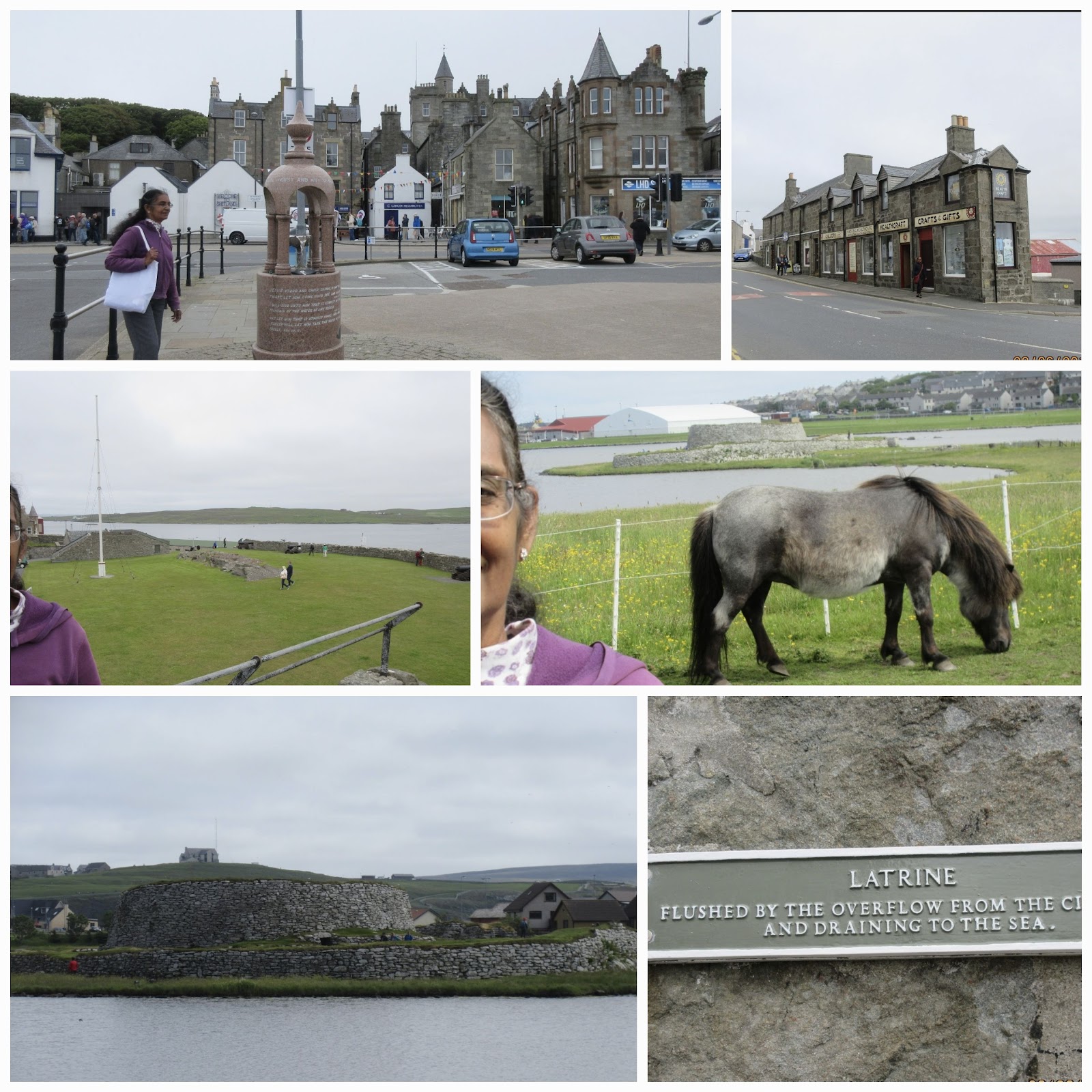
In the mid seventeenth the fort was built as a military outpost was established. It was rebuilt after its first war and the again after a second war when it was named Fort Charlotte. It has not been manned since.What had dominated the shoreline is now in the heart of the town, the town having grown around it. The pentagonal layout is well preserved. There is a panoramic view of Brassey Island.

But what caught my eye most was how nature( ocean waves) took care of flushing out nature's calls

Repurposed

A little later we find ourselves opposite the peer at the Tollbooth. Yes, it was built to collect taxes, but it has served as a jail, museum, post office, etc. Now the navy has taken it over for one of its branches.

Oil industry fuels modern town

We now enter the modern town.traditional occupation did not meet family needs but the discovery of oil immediately opened up avenues. The Co7ncil gained from the oil industry and dutifully invested it in infrastructure, housing and schools. We come across a modern school, a rugby club. Lo and behold! we find ourselves at a lake. We decide to walk around it. We walk quite some time before we realize that  very few people are up and about. As we pass by some of the new houses along the lake we see some life.

The elusive animal:short and sturdy

We spent nearly a whole day in town. Where are the Shetland ponies that have roamed the island for 4000 years?  Just as I was about to give up hope, one stands contentedly grazing right beside me. It's nowhere near the Arabian breeds that are elegant. This workhorse is shaggy, has short legs, and is only slightly more than a metre tall. After all, they were mostly used for carrying heavy items in slung baskets.

There are not many around for they are in the crofts (small farms) farther from town.

Broch in a loch

A few metres more and we face a circular structure. A 2000 year old (iron age)  stone fortification that waS probably built  by some wealthy person to show his wealth and power. It is said to be double walled, the interior l8ned with living quarters around a central court. Being in a loch it was not accessible until a causeway was built. We were at the causeway but decided to Forgo a visit. We are quite counted to be in the vicinity.

A peek turns to disbelief

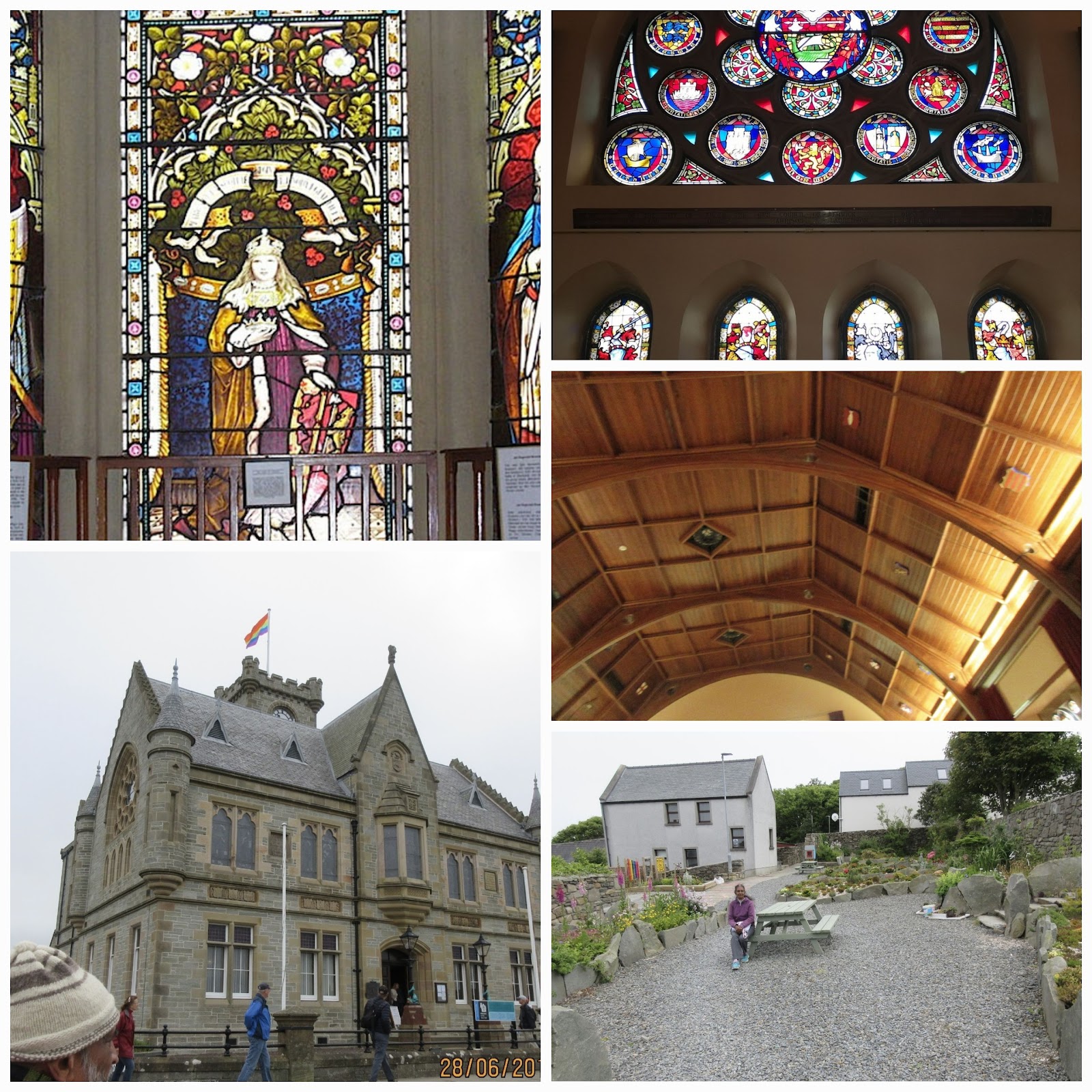
We are back at the town hall.there is some movement at the doors, so we decide to go for it. Surprise. Anyone can go in  through the doors that seemed tightly shut. How mislead we were! We should have come to the doorstep to check. But here we are. The climb up the hilly polished wooden staircase leads to a massive function room. I'm stunned by the stained glass windows that depict the colourful history of Shetland Islands. These impressive works of art are accompanied by relevant information.

The fifteen panels around the main hall occupying the whole of this floor, depict the early history of the islands through the major figures like the Norse kings and earls. There is no way we would have known about the stunning hall for little of the brilliance is visible from the outside.

Lerwick flower par

In our wanderings we come across The Jubilee Flower Park that also has a bowling green and other recreational facilities. The park had started off as a piece of waste ground which was to be used for housing. However the Council bought it for recreational purposes. It is a beautiful setting for walks.

Trivia

1. The lodberries  have been made famous by the BBC TV series called Shetlands. Jimmy perez who stars as the detective inspector lives in one of the Lodberries

2. Lerwick has a population of about 10,000 in total but the town is quiet for about half  the population lives in a radius of 10 miles. It is vibrant in the newer parts of town. Hence there is no crowd anywhere in the old town.


.


..


Back to the Past: History and Literature


When we are almost at the end of our part tour of Great Britain having covered Pembroke, Roslaire, Dublin (distinguished by the likes of Yeats, Synge, Shaw, Joyce), Belfast, Liverpool, Edinburgh( UNESCO World City of Literature) , Lake District ( the haunts of Coleridge and Wordsworth), Yorkshire (Sculpture Park) , Wakefield (setting for Oliver Goldsmith's lampoon), Stonehenge, Stratfort-upon-Avon  (Shakespeare's birthplace), Woodstock, Oxford and Cheltenham we arrive at Bath.
Rub your eyes, pinch yourself
Bath,  as the name suggests, is named after ,what else(?), baths, Roman baths. The World Heritage site is known as one of the great spa towns of Europe. During the Victorian era it was a popular destination for holiday makers. Ambling about we find our selves at the Circus, a crescent shaped building made up of 30 three storey Georgian terraced houses, once populated entirely by the elite. Then we stroll through what seems to be a busy street filled with cafes . And, lo and behold! I'm  rendered speechless when  Mr Darcy stands before me, and incredibly, with him is Elizabeth Bennet (identified by their Victorian era period costume)! Has my imagination gone wild? They are characters from Pride and Prejudice by Jane Austen, my favourite author. Then it strikes me. She lived in Bath for a few years in the nineteenth century. The characters are beckoning us into The Jane Austen Centre, a museum that helps bring alive the Victorian Era in which Austen wrote. I'm so overwhelmed and totally immersed in the past that there's a buoyancy in my step now as I walk towards the historic Roman Baths, temporarily oblivious to the 21st century.
Quirky enthusiasts or heritage celebrants? 
As we drive from Cheltenham to Bath we stop by at Bleinhem Castle, birth place of Sir Winston Churchill. I now realise that it has featured in James Bond movies and period dramas. The extensive landscaped grounds are enchanting. What's  that movement behind the trees? No need to be a sleuth. Can't be harmful since the Unesco World Heritage site is definitely well guarded. But just out of curiosity, since my mind has registered something peculier, I edge closer. A group of men and women dressed in Victorian costume, all hatted and bonnetted and corsetted, sitting at a picnic table, are gingerly sipping tea and enjoying pastries and sandwiches! I didn't venture a conversation for I preferred to register the moment and imbed it into my subconscious literary self, to be "recollected in tranquility" in later years, taking the hint from William Wordsworth. 
Needless to say, it took a while before I could enjoy the landscaped garden, which was being set up to for a musical entertainment. I was somewhat more grounded by the time I entered the Malborough residence and the displays from Churchill's childhood and his artistic talent attested in his watercolours and hallmark cards.

Of, for, by the people
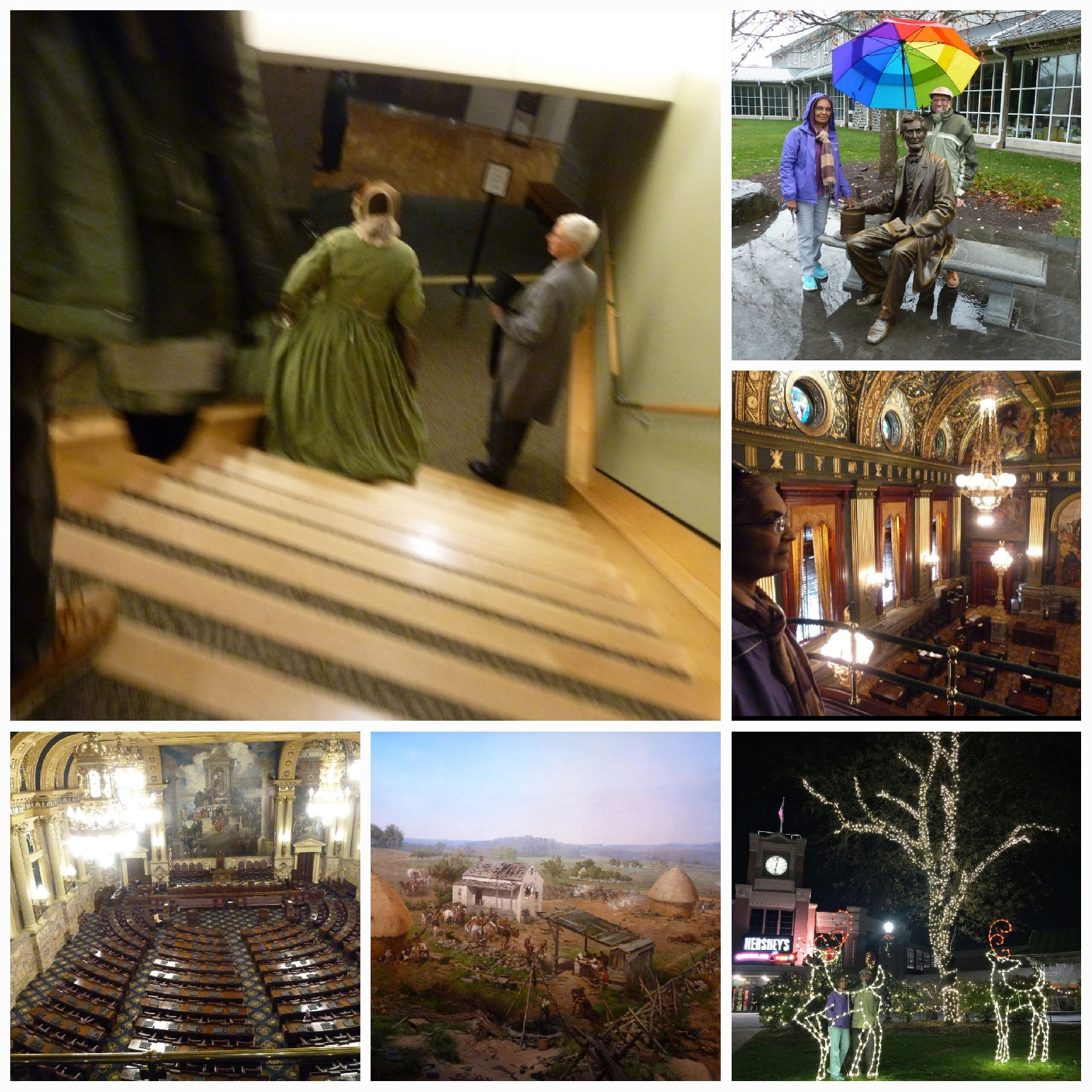
In one of our trips to the US we spend a few days with friends in Harrisburg.  The Pennsylvania Capitol building takes our breath away with its dazzling Parisian staircase,  imposing renaissance themes , murals, stained glass windows, etc. 

We are then encouraged to visit the Hershey Chocolate World nearby.  Taking the complimentary tour, somewhat like a children's fair ride in cars on rails, through the different stages of production, 'coated' by the aroma is an experience we would have enjoyed more had our grandchildren been with us. 

Putting Roal Dhal behind us we pay a vist to Gettysburg ( we hadn't realised it was that close to our host's home). Being a rainy day we only have a glimpse of the area in which the museum stands. This is where Abraham Lincoln made his famous speech on the nature of democracy. But as we are climbing the stairs we spy men and women in period costumes. Were they staff? Actually they happened to be patriots who had participated in the Veterans day celebration. There had been a parade just before we arrived, and of course, just before the rain. What we see upstairs is spell binding. It is a cyclorama made up of  massive panoramic paintings, about 50 feet high and at least 400 feet in circumference, hung in a 360 fashion that allows visitors to seemingly step inside a 'live'battle , replete with gunshots now and then and also wisps of smoke. This was created  before the days of mass communication through radio and TV, but the effect is not compromised ( perhaps only imax can recreate the same effect)!
Representing a cuisine.
When in Tallin we are greeted by waitresses in retro medieval  dresses. But this, of course, is to attract customers to try traditional cuisine.

The Tricity of Poland: Gdansk, Sopot and Gdynia (1)

Respect for order The parking area where our driver (refer to an earlier blog about Conflict and Cohesion) drops us off reflects Gdańsk'...

Follow by Email